
In the battle against coastal erosion in southern Monterey Bay, a powerful player has entered the fray: the Monterey Bay National Marine Sanctuary.
When the Sanctuary Advisory Council met Feb. 19, the day included an hour-long presentation on the Cemex sand mine in Marina, which scientists say is the primary cause of an unsettling reality: In a time when sea level rise is becoming an ever-increasing threat, southern Monterey Bay has the highest coastal erosion rate in the state.
As the presentation unfolded, several council members appeared previously unaware of the mine’s impacts. Among them was Gary Pezzi, the council’s vice chair, who looked shocked as Sanctuary Resource Protection Coordinator Karen Grimmer laid out the facts in her presentation.
“It’s the highest in the whole state?” he asked. When Grimmer confirmed it, Pezzi shook his head in amazement.
Grimmer’s presentation showed erosion impacts at Monterey State Beach, which has grown increasingly narrow this winter, so much so that a recent king tide deposited seaweed on the volleyball courts at Window on the Bay.
At the heart of the issue is whether MBNMS has – or can – establish jurisdiction over the mine, which operates in a lagoon on the beach in northern Marina. Because the mine has historically been located above the mean high tide line – an 18-to-19-year average of high tides – the mine has long been considered outside the agency’s purview.
But council member Brian Nelson questioned whether that was still the case, and suggested that sanctuary officials “drill down into the data” to re-assess where the line falls.
As the presentation wrapped up, council member Richard Hughett shook his head.
“This is scary,” he said.
“This is not over,” added Margaret Webb, the council’s chair. “There are a lot of questions to be answered.”
The council agreed to send a letter to the National Oceanic and Atmospheric Administration indicating that the mine is a high priority issue for the sanctuary, and asking that more resources be dedicated toward finding a solution.
These actions come as MBNMS is reviewing its management plan, which was last updated in 2008. As part of the review, Grimmer says, the agency is taking a hard look at coastal erosion and what can be done about it.
“One of the options we’re looking at is making a regulatory change, or revision, to address the issue specifically,” Grimmer says.
The management plan update will take a few years. Grimmer says the agency is also considering the possibility of allowing the city of Monterey to nourish its beach below the high tide line – for the last few years, the city has dredged the harbor and replenished the beach with sand above that line, which is getting more difficult.
“We have to dispose of the sand above the sanctuary boundary,” says Monterey Harbormaster Steve Scheiblauer, who’s also on the Sanctuary Advisory Council. “But there is not a lot of beach there.”
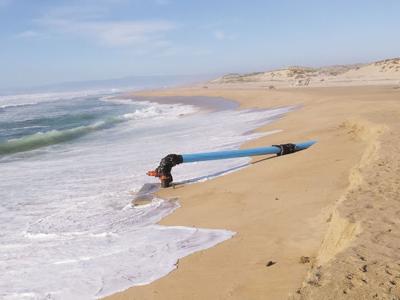
In Marina, recent erosion is so great the plastic discharge pipe for California American Water’s test slant well – which connects to a Monterey Regional Water Pollution Control Agency outfall just south of the Cemex mine – has become exposed on the beach.



(0) comments
Welcome to the discussion.
Log In
Keep it Clean. Please avoid obscene, vulgar, lewd, racist or sexually-oriented language.
PLEASE TURN OFF YOUR CAPS LOCK.
Don't Threaten. Threats of harming another person will not be tolerated.
Be Truthful. Don't knowingly lie about anyone or anything.
Be Nice. No racism, sexism or any sort of -ism that is degrading to another person.
Be Proactive. Use the 'Report' link on each comment to let us know of abusive posts.
Share with Us. We'd love to hear eyewitness accounts, the history behind an article.