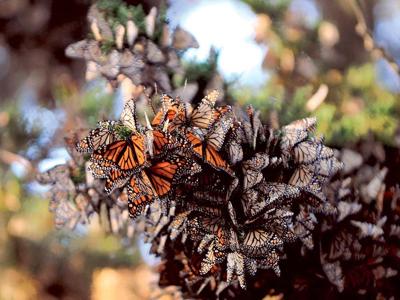

Since the start of the 2017-18 monarch butterfly overwintering season in November, nearly 30,000 people have wandered through the Pacific Grove Monarch Butterfly Sanctuary, including more than 2,000 schoolchildren, says Nick Stong, education programs manager with the Pacific Grove Museum of Natural History. About the same number of people showed up this year as last, but the butterflies are way down. This season the peak was 7,350 – a 57-percent drop from last year.
While Stong says comparing insect numbers from one year to the next does not indicate a problem, he’s alarmed at the trend for all monarchs in the Northern Hemisphere. The nonprofit Xerces Society announced Feb. 2 that monarch populations are at their lowest point in five years. Volunteers during the society’s annual Western Monarch Thanksgiving Count visited more sites than ever since the count began in 1997, and yet the tally was fewer than 200,000, down 100,000 from the previous season.
With scientists sounding the alarm of a possible extinction if no action is taken to protect the monarchs – one estimate gives extinction a 72-percent chance – Assemblymember Mark Stone, D-Scotts Valley, introduced AB 2421 on Feb. 14. If passed, the bill would create the Monarch Butterfly and Pollinator Protection Program, providing funds and technical assistance to restore monarch habitats across the state. Money would be used to restore California inland prairie areas, where butterflies feed on milkweed, as well as protect overwintering sites along the coast.
Editor's note: the print version of this story had Nick Stong's name misspelled as Nick Strong.



(2) comments
"Restore monarch butterfly breeding habitat across the state" sounds appealing, but we already know that planting milkweed plants will NOT boost California’s monarch butterfly population that currently numbers about 300,000 butterflies. Why? Because we already know that when tens of thousands of new milkweed plants are planted on many acres of Central Valley farmland, only mere handfuls of wild monarch butterflies lay eggs on those plants and those eggs do NOT produce thousands of additional monarch butterflies. Video proof: https://youtu.be/ebS7NsceVvg
So what IS the answer then?
Welcome to the discussion.
Log In
Keep it Clean. Please avoid obscene, vulgar, lewd, racist or sexually-oriented language.
PLEASE TURN OFF YOUR CAPS LOCK.
Don't Threaten. Threats of harming another person will not be tolerated.
Be Truthful. Don't knowingly lie about anyone or anything.
Be Nice. No racism, sexism or any sort of -ism that is degrading to another person.
Be Proactive. Use the 'Report' link on each comment to let us know of abusive posts.
Share with Us. We'd love to hear eyewitness accounts, the history behind an article.