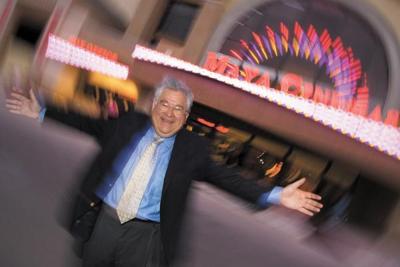
Two Sundays ago, Moctesuma Esparza arrived at LAX at 1am after a whirlwind weekend promoting the new HBO film Walkout, which he produced and Edward James Olmos directed. It may have been coincidental that during the same weekend, thousands of Latino and Latina students all over the country were participating in exactly the kind of walkout depicted in the film—a dramatic story drawn from real events in 1968, in which Esparza himself participated.
On this trip, Esparza had already been to Houston and Washington, DC. He’s been crisscrossing the nation like this for four weeks—talking to this group, delivering speeches to that group.
Esparza had every excuse in the world to skip out on the Chicano Youth Leadership Conference when he desperately needed some rest. But he didn’t.
It’s about 10am and Esparza, with only a few of hours of sleep in the last three days, walks before the crowd of about 40 high school students. He was exactly like them once. They are mostly honor students and high-achievers, and they have spent three days learning about Chicano history, activism and ways to tackle existing social ills.
Esparza takes a deep breath and delivers a speech that is brief but intense. He challenges the students to take responsibility for the future of their country.
“You’ve all heard statistics that we’re 14 percent of the country,” Esparza tells the transfixed young faces. “But Latinos and other people of color are in fact a majority for people under 30. Whether or not this country keeps the promise of the American dream is going to depend largely on whether or not we are prepared to accept the responsibility of being a majority.”
The kids give him a standing ovation and present him with a gift. Then Esparza walks out of the hall for a few minutes and his body shrinks back down. He’s visibly exhausted and in pain.
“I have this eye condition that’s been getting worse,” Esparza says slowly as he looks for a shady spot. “Any bright light makes me feel like a nail is being hammered into my eye.”
Esparza doesn’t go home. He sticks around to listen to the students speak at their final meeting—a process that takes nearly two hours. Their energy is contagious. And Esparza, who as a teenager went through the same three-day conference, begins to revive. For him, this is what his whole life has been about.
“These kids are an inspiration to me because I know they’ve had an experience that’s changed their lives,” Esparza says after the students have funneled elsewhere to eat lunch together. “I know that if there was any doubt about them going to college and graduating, that vanished this weekend.”
By the time he was in high school, Moctesuma Esparza was already a sensation of sorts. “Mocte,” as his friends called him, was serious, acutely self-confident (some say full of himself) and profoundly idealistic. He was a high-achieving honor student, a cadet lieutenant colonel with his school’s ROTC, and valedictorian. He was an active member of the Governor’s Youth Advisory Council and a founder of a slew of other organizations, some of which still exist to this day.
“I was the president of every single club on the campus,” Esparza says of himself as a teenager. “I was as nerdy as you can get.”
Esparza also happened to be a Chicano. He was born in Los Angeles but his ancestry is Mexican. He says he lived in a modest home with plastic windows that stared straight out at a public housing project in East LA, already a heavily Mexican-American enclave by the 1960s.
Esparza discovered early that some people couldn’t see past his background. He realized that these people, no matter how close they got to him, couldn’t see the clean-cut, smart student with a lot of potential.
Esparza’s high school counselor was one of those people.
“I remember my counselor saying that I ought to be grateful because if I had gone to a school in West LA, they would have made me work harder,” recalls Esparza, now 57. “I didn’t think that was something to be grateful for.”
Today, Esparza is the owner of Maya Cinemas in Salinas, an award-winning Hollywood producer, and one of the most influential Latino activist/entrepreneurs to emerge from the Chicano movement of the 1960s. He is on the board of over a dozen public service organizations and is on a first-name basis with the most powerful Latino politicians and power brokers in the country. Yet Esparza remains a activist at heart—his body of work an extension of his militant youth, when he helped spark the first high school walkouts that anyone had ever seen.
~ ~ ~
Esparza’s high school counselor did not help him apply to a university. It was a UCLA student activist who drove out to East LA that ended up recruiting him. And Esparza has not forgotten that counselor’s inability to see him as a young man with potential. It’s an incident he repeats time and again in interviews, as if to affirm that his life-long activism does not stem from some collective angst that he was coerced to buying into.
The angst of Chicano activists in the 1960s and 1970s was not a coerced emotion. It grew naturally in the face of overt and covert attacks on their self-worth that were meted out as a sort of penance for the unpardonable sin of being themselves: American minorities.
“I was like everybody else in my neighborhood and I felt this…pain,” Esparza says. “The pain of being Mexican. There was a deep shame that I had acquired because I was Mexican in heritage. And I wanted so deeply to just be seen as American.”
But what Esparza learned in 1968 was that those who dared to resist, to speak out and be heard as Americans, were often struck down hard.
At Esparza’s high school, as at hundreds of high schools in California during that era, students were regularly paddled, ridiculed, and suspended if they were caught speaking Spanish, which was prohibited in schools. Many high schools with the largest minority populations were also notoriously under-funded and under-staffed. And countless students like Esparza, despite their qualifications for higher education, were dissuaded by teachers from going to a university for no discernable reason other than that they were Chicanos, Blacks or poor.
Esparza saw these things and fought back. But he admits that he wasn’t born a fighter. In elementary school, bullies picked on him constantly, beating him up once a week. That was until an African-American teacher taught him how to fight.
“He told me, ‘Look, until you start fighting back, they’re not going to respect you and they’re not going to leave you alone,’” Esparza remembers.
When he reached high school, Esparza applied that strategy as a means to address the injustices he saw around him.
He became “Mocte” the activist, the rabble-rouser, the radical. He helped found the Brown Berets—modeled partially on the Black Panthers—and later the United Mexican American Students, which evolved into MEChA, an organization that still thrives on high school and college campuses across the US today.
Even after Esparza enrolled at UCLA to study film, he hung around in his old neighborhood. He’d organize high school students, encourage them to apply to the university, and hold strategy sessions with other Chicano activist peers.
It was in this setting—in East LA, March, 1968—during a moment in time when profound social change seemed like a viable possibility to millions of people in this country and around the world, that Esparza was catapulted into the limelight for the first time.
As a freshman at UCLA, Esparza became one of the core organizers for the largest high school student walkouts in California history (until two weeks ago, that is).
In March 1968, students from five Los Angeles high schools populated with mostly Chicano students walked out of classes for two weeks to protest substandard conditions. These walkouts happened a few years after the Watts Riots—at a time when the city was racially charged and the fear of violent police reprisals were acute. Walkout tells the story through the eyes of the students themselves. The movie details the fears they faced in defying their parents, teachers and police. But it also revels in the adrenaline rush of successfully pulling off the walkouts and having the school board begin to address student demands.
Walkout is designed to be historically accurate and emotional. One of the film’s most powerful moments comes from actual footage of the walkouts and of Los Angeles Police Department officers beating students at their schools—footage that never made it to the evening news in 1968 and was only unearthed a few years ago.
The 1968 walkouts proved to be a watershed in Chicano and Latino history. Not only did they inspire other walkouts and increased activism in non-Mexican-American neighborhoods, but they were also the precursors to a more intense level of political activity in urban Latino communities in the Southwest for years to come.
In a real sense, the 1968 walkouts helped set the stage for the forging of a new status and a fresh identity for Chicanos—and later Latinos—in American society.
This struggle was not without its risks. A few weeks after the 1968 walkouts, Esparza was plucked off a picket line protesting police brutality and arrested. He was later indicted by a Grand Jury in Los Angeles, along with 12 others. The young Chicano activists, who became known as the East LA 13, were charged with conspiring to commit a misdemeanor—a felony charge—immediately after the high school student walkouts.
Esparza, the nerdy overachiever, was facing life in prison.
The film Walkout ends with Esparza and the 12 others being arrested. What didn’t make it into the film was his relationship with Oscar Zeta Acosta, gonzo attorney and close friend of author Hunter S. Thompson.
Acosta, along with a string of ACLU lawyers and others, represented the East LA 13 in court and eventually helped get their indictment thrown out.
“He was a character in earlier drafts of the film,” Esparza says. “But he was such a bigger-than-life character that we had to end the story before we get to him.”
Esparza says he had wanted to make a film about the walkouts for decades, but that things started to fall into place only during the last five years. Finally, three weeks ago, his dream came to fruition: HBO premiered Walkout on March 18.
Esparza believes the film has been blessed with uncanny timing; he does not believe that it is responsible for inspiring the recent nationwide Latino high school student walkouts aimed against anti-immigrant legislation now being mulled over by Congress.
“I’d be happy to take the credit,” Esparza says. “But students have been walking out for years on their own.”
Notwithstanding such humble talk, an increasing number of folk, including Walkout director Edward James Olmos, believe that the film is at least partly responsible for the recent walkouts, whose repercussions have been keenly felt in the halls of Congress.
“I see our film as giving students the idea to band together and make a statement,” Olmos told the Orange County Register two weeks ago. “Media is as influential as anything I’ve ever seen.”
That media is influential is something that Esparza believes with his whole heart. It is the belief that underlies his role as an activist filmmaker and as a businessman.
Since graduating from UCLA film school with a masters of arts degree, Esparza has produced more than 30 films, including The Milagro Beanfield War, Selena and Gods and Generals.
Perhaps more than any single man or woman, Esparza has pushed Hollywood studios to begin seeing this nation’s ballooning Latino population as a market that can’t be ignored. As a behind-the-scenes player, he’s helped put brown faces on film and TV, giving dozens of Latino actors and writers their chance to get their foot in the door.
Of all of the films he’s produced, Esparza says that Walkout is the most important project. With his résumé, that’s saying a lot. But it’s also easy to see why he believes it—especially when witnessing scenes on the news that look like scenes from the movie.
~ ~ ~
Except for some gray hair and added weight, friends who knew him as a teen say that Esparza is much the same now as he was in the 1960s—as serious and self-confident as ever, and as passionately idealistic.
Underneath the polished veneer of the Hollywood producer and efficient workaholic who gets 150 calls a day to manage projects he’s spearheading, Esparza remains an activist at heart.
Walkout is just the latest, most sophisticated extension of his activism. Esparza is clear on the matter: “This movie is relevant as a turning point in American history and the empowerment of American Latinos,” he says. “It is after this point in time in which an entire generation is empowered.
While Walkout is still the talk of the town, Esparza is already moving full-speed on other projects, not all of which have to do with making movies.
He’s an active board member for over a dozen organizations, including the New American Alliance Institute, founded by Henry Cisneros, and the Latino Theater Company. As chairman of the latter, he recently helped acquire a 20-year lease to an old Los Angeles theater where he plans to create a new hub of theater arts.
In addition, Esparza founded and helps run a charter school in downtown Los Angeles. And he says he’s just committed to aiding in the creation of a new medical school in California.
Then the activist in him emerges. “We have a situation in heavy Latino communities where there is one doctor for every 20,000 people, while the ratio in places like Beverly Hills is one doctor for every 200 people,” he says. “This is ridiculous. This is a huge disparity. There hasn’t been a new medical school created in 30 years, so something needs to be done.”
~ ~ ~
The Maya Cinemas itself grew out of Esparza’s activism. After the release of Selena in 1997, Esparza says, he orchestrated 20 premieres across the nation in Latino communities.
“It was then that I found out that no modern megaplex, first-rate movie theaters existed in a Latino community anywhere in the nation,” Esparza says. “So in 1998, I decided I was going to pursue this idea, and it took me a while. I had to learn that business, find the right partners and raise the capital.”
The Salinas Maya Cinemas, which opened last summer, was supposed to be the third theater built, but it turned out being the first thanks to community leaders’ “political will” to transform Salinas’ downtown core.
Esparza says that construction crews are about to break ground for the second Maya Cinemas in Bakersfield, and three more theaters are about to be approved in Fresno, Inglewood and Santa Fe, New Mexico.
“I’m looking to build a total of 40 theaters with over 500 screens,” Esparza says.
Esparza says the Maya’s business is increasing every month, while Salinas business leaders say it’s playing a crucial role in the downtown revival there.
“I can’t emphasize enough what its significance is to Oldtown Salinas,” says Catherine Kobrinsky, a board member on the Salinas Oldtown Association. “It’s bringing in a lot of people who normally wouldn’t come.”
Now Esparza is planning to bring a Latino international film festival to Salinas, much like similar festivals in San Francisco and Los Angeles. He says it will happen this year or next.
The Maya Cinemas and its chain are the first piece of a very ambitious plan: a major Latino movie production-distribution enterprise. “This will be part of a vertically integrated entertainment company responsible for distribution, production and exhibition.
“Expanding Maya Cinemas on a national level will allow us to produce our own movies and launch the next generation of Latino filmmakers.”
~ ~ ~
Esparza says that he has achieved all of the goals he set for himself in his youth, and is now establishing new goals. He works 12-hour days and hardly gets a day off (a fact his wife isn’t exactly pleased about).
It is somewhat fitting that Esparza’s last leg on his four-week tour across the nation to promote Walkout ended at a retreat center in Malibu, at the Chicano Youth Leadership Conference.
With the buzz of his cell phone, he breaks off our interview for a moment to answer a call. A media CEO wants to have a meeting with him at 4pm. Esparza, who was driven to Malibu by his son, says yes.
Just like that, the only free afternoon that he might have had—one that he badly needs—vanishes.
“It’s always like this,” he says dryly.
Shifting into activist mode one final time before he must go, Esparza elaborates on the significance of the recent marches for immigrant rights across the US, and how they relate to his experience in the late 1960s.
“We have come full circle as a community,” Esparza says. “Now, as in the 1960s, is a time of personal empowerment. We as a community are being attacked in an ignorant way by those who don’t understand our value to the country, or our history as part of the founders of this country.
“They don’t get that they are attacking all Latinos when they attack undocumented workers,” says Esparza, laying out a verbal roadmap for the next generation of Chicano and Latino activists. “The job we now have, simply, is to educate the rest of the country.”



(0) comments
Welcome to the discussion.
Log In
Keep it Clean. Please avoid obscene, vulgar, lewd, racist or sexually-oriented language.
PLEASE TURN OFF YOUR CAPS LOCK.
Don't Threaten. Threats of harming another person will not be tolerated.
Be Truthful. Don't knowingly lie about anyone or anything.
Be Nice. No racism, sexism or any sort of -ism that is degrading to another person.
Be Proactive. Use the 'Report' link on each comment to let us know of abusive posts.
Share with Us. We'd love to hear eyewitness accounts, the history behind an article.