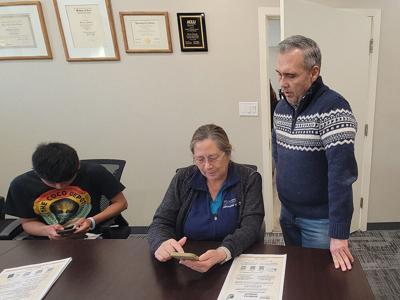

Dozens of people lined up outside the Mexican Honorary Consulate in Salinas on Thursday, Dec. 11 waiting their turn to talk with personnel from the Mexican Consulate and sign up for an appointment to obtain documents like a Mexican ID, passport or dual citizenship.
Making an appointment with the Mexican Consulate in San Jose and its mobile consulate has become a challenge. Slots fill up quickly and sometimes people have to wait for months.
While this may look like a staffing issue, there is a different factor at play: people booking appointments and selling the spots.
“Intermediation prevents us from reaching people,” Consul Neftali Said Pérez González said in Spanish during a meeting with the press.
Intermediaries saturate the consulate’s system and turn it into a business by automatically scheduling all the free appointment slots and selling them.
Guillermina Rivera, executive director of Proyecto Mixteco, an organization that offers interpretation services, says many Indigenous people aren’t fluent in Spanish or don’t know how to download the application to make an appointment so “it’s easier for them to buy an appointment,” she says.
Rivera says she almost paid for one herself after having a hard time scheduling it. “When you go on WhatsApp they send you to San Diego or another place that isn’t San Jose,” she says.
Prices through intermediaries range from $50 to $170 depending on the type of application, with dual citizenship appointments being the most expensive ones.
According to the consulate, dual citizenship applications have skyrocketed since President Donald Trump took office, with family members looking to ease the process in case any of them gets deported or they decide to relocate or self-deport to Mexico.
It is illegal to sell or resell government appointments in the U.S., but the same doesn’t apply for the Mexican Consulate. In the past, the Mexican government has fired staff involved in these practices.
“It isn’t illegal, but it’s immoral,” Pérez González said, adding this practice exploits vulnerable people.
While brokers make a profit off free appointments, the issue has other consequences. On Dec. 6, the Mexican Consulate canceled its mobile consulate in Salinas since most appointments were being sold.
Cristina Arrizon, a Salinas resident, attended the outreach event on Dec. 11 and made a new appointment. She was one of the people impacted by the cancellation. “I felt disappointed,” she says. Her new passport appointment won’t be in Salinas but in San Jose.
A week later, the consulate kicked off an outreach campaign in Salinas titled “Conoce tu consulado,” meaning “know your consulate,” to share information about the services the consulate provides, including repatriation, vital records, legal assistance and more.
Most appointments are made via WhatsApp, a free messaging service application very popular in Mexico and among Latinos.


(1) comment
Scalping of foreign government appointment slots in the U.S.A. should be more than just immoral, but illegal with criminal penalties. Legislative work to do.
Welcome to the discussion.
Log In
Keep it Clean. Please avoid obscene, vulgar, lewd, racist or sexually-oriented language.
PLEASE TURN OFF YOUR CAPS LOCK.
Don't Threaten. Threats of harming another person will not be tolerated.
Be Truthful. Don't knowingly lie about anyone or anything.
Be Nice. No racism, sexism or any sort of -ism that is degrading to another person.
Be Proactive. Use the 'Report' link on each comment to let us know of abusive posts.
Share with Us. We'd love to hear eyewitness accounts, the history behind an article.