
When local historian Burton Anderson wrote about the flower industry on the Central Coast for the spring 1997 issue of the trade magazine Coastal Grower, nurseries were still thriving.
“The list of nurseries and flower growers on the Central Coast is too lengthy to mention in this article,” Anderson wrote, “but there are about 130 Monterey Bay growers engaged in the business.”
In the 20 years since, cut flowers have all but disappeared from Monterey County’s $4.5 billion agricultural industry. And dozens of greenhouses that specialized in carnations and chrysanthemums have long stood empty.
There are a few reasons for the demise of the Salinas Valley flower industry. The 1994 North American Free Trade Agreement (NAFTA) encouraged cheaper imports from Latin America, as did the War on Drugs—the 1991 Andean Trade Preference Act offered incentives to coca growers to transition to other crops, like flowers.
In an ironic twist, it might be a controlled substance that reinvigorates the area’s greenhouses. Cannabis cultivators are eyeing the Salinas Valley as prime territory to grow marijuana.
Anticipating a county ordinance would be adopted by March 1, speculators have jumped on old greenhouses and industrial space. In the last month, the county’s industrial vacancy rate dropped from 7 percent to 2 percent, says Monterey County Economic Development Director Dave Spaur. He attributes that to booming interest in cannabis: “It’s a gold rush,” he says. “I didn’t think it would affect our industrial inventory, which was pretty low.”
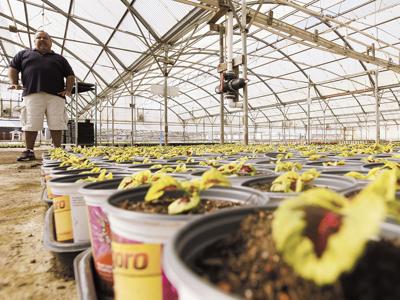
After Salinas restaurateur Mike Hackett sold a successful pallet manufacturing business 16 years ago, he used the cash to buy two greenhouses on 25 acres south of Salinas. He envisioned converting the land into a parking lot; at that time, there was talk of limiting parked cars along roads abutting farm fields, and he wagered that big parking lots would become big business.
That was a miscalculation, but Hackett then leased to a horticulture company that supplies the likes of Home Depot. Now, Hackett plans to get in on bigger business: medical cannabis.
He remembers hobnobbing at an exclusive event at Corral de Tierra Country Club six months ago, where Salinas attorneys, cannabis industry reps and elected officials gathered.
“Right after that, I started getting approached by all these people to lease my greenhouses,” he says. The offers came from Humboldt County, Washington, Oregon and Colorado. The highest bidder offered him $30,000 a month, plus a percentage on the crop.
“I started thinking about it,” Hackett says. “But none of them are from our area, and none of them give a shit about our community. They’re just looking at the money.”
So Hackett’s aiming to get into the business himself, with plans to turn his greenhouses into a grow and hopes to open a dispensary in Salinas. He wants his business, River View Farms, to get in on the action as soon at the Monterey County Board of Supervisors approves an ordinance allowing medical marijuana.
County planners released a draft ordinance Feb. 4, addressing everything from dispensaries to manufacturers that might make tinctures or pot-infused brownies to cultivators – specifying that grows can happen only in greenhouse-type facilities built prior to Jan. 1, 2016.
At a meeting Feb. 26, county supes will discuss whether to extend a moratorium for a year – giving planners a cushion to finalize the draft ordinance, which expires July 5 – and whether to amend the moratorium, giving some growers a loophole to get into the business before a final ordinance is inked.
Even the possibility of legal weed is attracting big players. Harborside Health Center sells medical cannabis to more than 1,000 patients a day at Oakland and San Jose dispensaries. They grow some, but purchase upwards of 90 percent of their supply from vendors.
Harborside Executive Director Steve DeAngelo wants to change that, and anticipates growing weed in the Salinas Valley while also setting up a lab to do research and development, testing and breeding for therapeutic benefits.
Even though no ordinance is in place, DeAngelo is optimistic: “It’s inconceivable the county would choose to pass up a $3 billion economic opportunity and thousands of jobs,” he says. (To hedge his bets, he’s also talking to cities within the county, though he won’t say which: “When Steve DeAngelo starts going into a particular neighborhood, the price of everything starts going up,” he says.)
Harborside’s local partner is Jeff Brothers, who was successful in the flower industry years ago, then chaired 1st Capital Bank before going into the solar energy industry, and now cannabis. They’re repped by Salinas attorney Aaron Johnson, who’s also organized a group of small, local collectives (calling itself the Coastal Growers Association) to influence the county’s ordinance.
Johnson has asked the Board of Supervisors to lighten up its moratorium on cannabis so that Harborside’s Sun Grown Farms can get to planting. “We have prepared the site, we are making payments on the site, we are ready to plant,” Johnson said at a Feb. 9 board meeting. “We spent a significant amount of money getting that property ready.”
The board considers Feb. 26 whether to let Sun Grown start planting.
Not everyone in the ag industry is enthusiastic about the pending green-gold rush. Teresa Matsui is president of Matsui Nursery on Old Stage Road, one of the few remaining flower business. (Her dad, Andy Matsui, survived the ’90s trade policies by switching from cut flowers to potted orchids – and created a monster of an industry.) She’s heard about cannabusiness knocking on the doors of her neighbors, which concerns her – not for moral reasons, she says, but from a security standpoint.
“If they have armed security, I hope they hire very well-trained people,” Matsui says. “I hope they’re not going to hire a $12-an-hour security person and give them a loaded firearm. I am concerned about the operation of a business that potentially can be a crime magnet operating so close to our facility.”
Gavin Kogan, an attorney who specializes in cannabis business and co-founded Altai Brands, a cannabis edibles manufacturer in Salinas, understands the security and regulatory concerns. But just as the feds helped destroy the local flower industry, the county now has a chance to reimagine it.
“It’s an incredible thing,” Kogan says. “It satisfies the county’s goal to resuscitate the flower industry. We’re just using a different flower.”





(1) comment
Harborside plays dirty with their competition by trying to report smaller commercial growers with the intent of pushing them out of business. We had a little run in with them recently, they weren't successful.
Welcome to the discussion.
Log In
Keep it Clean. Please avoid obscene, vulgar, lewd, racist or sexually-oriented language.
PLEASE TURN OFF YOUR CAPS LOCK.
Don't Threaten. Threats of harming another person will not be tolerated.
Be Truthful. Don't knowingly lie about anyone or anything.
Be Nice. No racism, sexism or any sort of -ism that is degrading to another person.
Be Proactive. Use the 'Report' link on each comment to let us know of abusive posts.
Share with Us. We'd love to hear eyewitness accounts, the history behind an article.