Thomas Gray plunged into blue waters off the coast of Isla Mujeres, Mexico, beside marine biologist Rafael de la Parra – and a whale shark.
As the 30-foot fish cruised by, Gray swam hard to keep up. He wanted to see exactly how a scientist tags a marine giant.
“It all goes by in the blink of an eye,” Gray recalls, describing how de la Parra used a harpoon-like instrument to plunge the tag into the whale shark’s fin.
Hundreds of whale sharks gather near Isla Mujeres every fall, but no one knows where they go afterward. Gray’s the chief financial officer of a local company that builds satellite tags to track the migration.
He moved to California in 2006 at the age of 21, looking for adventure. “My thoughts were that I would be heading back home in just a few months,” he says. “I never expected to become owner in a company, let alone find myself swimming alongside whale sharks.”
Gray soon met Marco Flagg, founder and CEO of Desert Star Systems. Flagg’s Marina-based company works with universities, government agencies and scientists to develop and build underwater tracking devices. Unconcerned by Gray’s lack of relevant work experience (he’d been bartending) and high-school education, Flagg hired him.
Over seven years, Gray earned partial ownership in the company. He helped in the production of dive-buddy trackers for scuba divers, waterproof cameras for military divers and the satellite tags that can track marine animals like whale sharks.
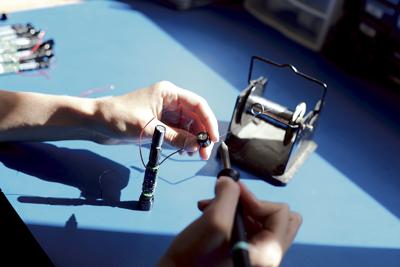
The tags resemble 8-inch rockets. Each is equipped with sensors that detect the location of the sun, the magnetic field of the earth and the speed the tag travels. When the animal surfaces to breathe or look for food, the tag broadcasts the data via satellite.
Desert Star Systems sells these tags for about half their competitors’ price. “Science is a numbers game,” Gray says. “You have to tag a substantial number [of animals] to get a statistical representation of the migration. And you can’t do that at $4,000 a tag.”
Desert Star’s tags also use stored solar power instead of batteries, so tracking data can be collected for longer periods of time. “Our tags will transmit literally until the sun goes away,” Gray says.
According to Taylor Chapple, a post-doctoral researcher at Hopkins Marine Station, tracking tags are opening new windows for scientific exploration.
“In order to study an animal’s life-cycle we have to be able to ‘follow’ the animal,” Chapple says. “We can’t be with them all the time, so [tags] give us insights into the secret lives of sharks and other fish.”
Desert Star staffers are currently working on a smaller version of the pop-up tag that will be easier to use on small fish. They’re also building an acoustic recording device, dubbed “micro-mars,” to monitor whale calls and help determine whether man-made underwater noise interferes with whale communication.
“To learn about what we still don’t know, that’s one of the craziest things,” Gray says. “We still have no idea what goes on under the ocean.”



(0) comments
Welcome to the discussion.
Log In
Keep it Clean. Please avoid obscene, vulgar, lewd, racist or sexually-oriented language.
PLEASE TURN OFF YOUR CAPS LOCK.
Don't Threaten. Threats of harming another person will not be tolerated.
Be Truthful. Don't knowingly lie about anyone or anything.
Be Nice. No racism, sexism or any sort of -ism that is degrading to another person.
Be Proactive. Use the 'Report' link on each comment to let us know of abusive posts.
Share with Us. We'd love to hear eyewitness accounts, the history behind an article.