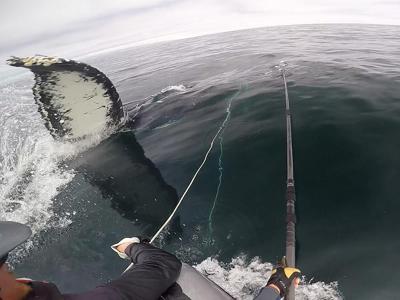

The idea was born in 2006, at a garage sale. Peggy Stap and Mary Whitney – who both studied whales in Hawaii and who later became friends after meeting in Monterey – were holding a fundraiser for their respective marine nonprofits when Stap got a call about an entangled whale.
That moment brought a surprising realization: Despite Monterey Bay being among the most protected marine environments on the planet, there was no system in place to free whales entangled in fishing gear.
Stap and Whitney set out to change that. Under the umbrella of Stap’s nonprofit Marine Life Studies, the two founded the Whale Entanglement Team, and in the nearly 10 years since, they have built a team of volunteers equipped to free entangled whales around the clock whenever necessary.
Working on a shoestring budget and with an all-volunteer staff, their mission has been beset with challenges. When Stap gets a call about an entangled whale, she needs the boat that spots the whale to remain onsite. If it doesn’t, finding the whale is near impossible.
“It’s like a moving needle in a moving haystack,” Stap says.
But because the boats that usually spot the whales are going about their business – be it whale watching or fishing – Stap and Whitney realized it was paramount to expedite WET’s response time. To achieve this, Marine Life Studies acquired a 40-foot boat in June that’s big enough to store all their disentanglement equipment on deck.
That quickened response time is a game changer, and Stap estimates WET could have freed at least six whales this year if it had its new boat earlier.
Just how many whales get entangled is a tough number to pin down. Stap says that 25 entangled whales have been reported in California this year, and that 21 of them have been around Monterey Bay. But the actual number of entanglements could be far higher. Up to 62 percent of the 22,000 humpbacks in the North Pacific bear entanglement scars, Stap says.
“It just makes you wonder: How many don’t make it?” she says.
For Stap, who’s the executive director of MLS, raising the funds to keep WET going is a nonstop gig. For her and Whitney, it’s also a labor of love, and one that pays off every time they save a whale.
“It’s just elation, it’s impossible to describe,” Whitney says. “It’s saving a life.”

(0) comments
Welcome to the discussion.
Log In
Keep it Clean. Please avoid obscene, vulgar, lewd, racist or sexually-oriented language.
PLEASE TURN OFF YOUR CAPS LOCK.
Don't Threaten. Threats of harming another person will not be tolerated.
Be Truthful. Don't knowingly lie about anyone or anything.
Be Nice. No racism, sexism or any sort of -ism that is degrading to another person.
Be Proactive. Use the 'Report' link on each comment to let us know of abusive posts.
Share with Us. We'd love to hear eyewitness accounts, the history behind an article.