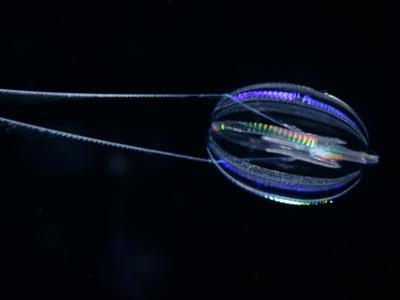

From what did human life evolve from some 700 million years ago? Sponges, or comb jellies?
This has long been a vexing question for scientists, but perhaps no longer: In a paper published May 17 in the scientific journal Nature, evidence uncovered by a team of researchers at UC Berkeley, UC Santa Cruz, the Monterey Bay Aquarium Research Institute (MBARI) and the University of Vienna shows a definitive answer – comb jellies, aka ctenophores (the c is silent).
This discovery was achieved by mapping genomes going back 1 billion years to get a clear picture of what genes existed in that time, so as to understand the divergence in the tree of life, and fundamental questions about evolution.
So what does this mean? Darrin Schultz, who was previously a graduate student researcher at MBARI and UC Santa Cruz and is now a postdoctoral researcher at the University of Vienna, says that is where the human branch in that tree developed neurons and muscles. Previously, it was assumed that sponges, which lack both of those things, were the earliest known ancestors to human life.
A statement MBARI put out about the groundbreaking study reads: “The team compares this event to a genetic fork in the road of evolution that happened hundreds of millions of years ago. One lone single-celled organism, the ancestor of all animals, was traveling along that road with its two offspring. One child, which would evolve into comb jellies as we know them today, took one path. As it evolved, the genes on its chromosomes stayed in a specific order and did not change much.”
Schultz, who is currently living in Vienna, puts it into perspective for those who live alongside Monterey Bay.
“All the animals we used were collected in Monterey Bay,” he says. “You can go anywhere out on the beach, and all of these things are in [your] backyard. All of the unanswered secrets to life are all out there in Monterey Bay.”



(1) comment
The study of phylogeny is fascinating, and the advances in chromosome mapping allows for such discoveries/confirmations when previouysly he only had suspicions based on morphology.
Personally, I'm far more fascinated with elucidating the phylogenies of the plant kingdom, which is a huge ongoing process as well.
Welcome to the discussion.
Log In
Keep it Clean. Please avoid obscene, vulgar, lewd, racist or sexually-oriented language.
PLEASE TURN OFF YOUR CAPS LOCK.
Don't Threaten. Threats of harming another person will not be tolerated.
Be Truthful. Don't knowingly lie about anyone or anything.
Be Nice. No racism, sexism or any sort of -ism that is degrading to another person.
Be Proactive. Use the 'Report' link on each comment to let us know of abusive posts.
Share with Us. We'd love to hear eyewitness accounts, the history behind an article.