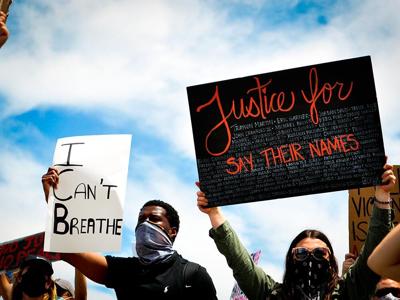

On May 25, 2020, then-Minneapolis police officer Derek Chauvin knelt on George Floyd’s neck. “I can’t breathe. My neck hurts,” were Floyd’s last words after seven-and-a-half minutes. Chauvin kept kneeling for two more minutes. Nine minutes and 29 seconds later, Floyd was dead. The incident went viral, prompting a movement against police brutality.
Unlike countless similar instances before, a jury found Chauvin guilty of murder. On April 20, many people who took to the streets last summer huddled around televisions or gathered in the streets watching the news on their phone when the verdict was announced. There was a moment of celebratory relief – but Floyd is still dead.
“It’s more of an anomaly, a result of public pressure,” says Shanelle Adeyemi, who explains without protests, Chauvin would likely be free. Adeyemi considers themselves an abolitionist (someone who works to dismantle policing and the prison system) and is part of Community Before Cops, a local group that advocates for defunding the police.
Community Before Cops members Adeyemi and Jeff Noven note that historically, cases of police violence often don’t go to trial at all, let alone result in a guilty verdict. Noven recalls local examples in which prosecutors investigated and exonerated police, including Brenda Mendoza who was shot and killed in Salinas in 2019 and Donald Miller who was shot and killed in Monterey in 2015.
“We understand in Monterey County that [Chauvin’s trial] is an anomaly too. This happens here,” Noven says. A guilty verdict for Chauvin is the exception and not the rule when it comes to police-involved deaths. In a way, the verdict was a call for activists to keep the pressure on.
“We don’t want to be reactive to the situation, we want to be proactive,” says Rosalyn Green, a board member of Monterey Peninsula College and an organizer for Building Healthy Communities’ Building Black Connection, an initiative developing Black leadership. “Work still has to be done.” That means attending public meetings on things like budgets, policy and police accountability.
“It’s been made clear there is no police training that truly prevents or holds to account the horrendous murderous violence, whether that’s in Monterey County or Minneapolis,” Noven says. He will keep calling for social and health services to replace policing. Green says her work continues by electing leaders rooted in activism.
Both groups will continue participating in demonstrations in the streets, a tool they believe is necessary when policy is too slow, or not enough. “When we take it to the streets, we’ll do it collectively to press our leaders to look at what’s wrong with our system internally,” Green says.


(0) comments
Welcome to the discussion.
Log In
Keep it Clean. Please avoid obscene, vulgar, lewd, racist or sexually-oriented language.
PLEASE TURN OFF YOUR CAPS LOCK.
Don't Threaten. Threats of harming another person will not be tolerated.
Be Truthful. Don't knowingly lie about anyone or anything.
Be Nice. No racism, sexism or any sort of -ism that is degrading to another person.
Be Proactive. Use the 'Report' link on each comment to let us know of abusive posts.
Share with Us. We'd love to hear eyewitness accounts, the history behind an article.