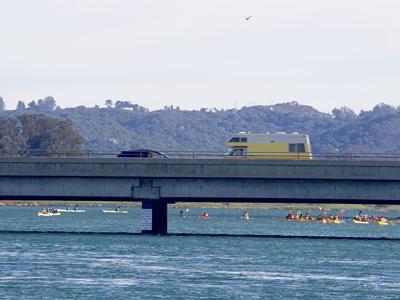

When the sea rises due to climate change, what does that look like on the ground? At Moss Landing and Elkhorn Slough, we can now look into the future – or rather, different choices for the future.
In 2021, Caltrans, in partnership with the Association of Monterey Bay Area Governments and The Nature Conservancy, issued a press release announcing its first-ever use of a virtual reality app, Sea Level Rise Explorer, in order to better understand how sea level rise will impact eight miles of Highway 1 west of Elkhorn Slough and five miles of railroad track that cuts across it.
The simulation, which is viewable online, shows seawater lapping on the shoulder of the highway and the rail line inundated. That is with two feet of sea level rise, a projection expected to be reached around 2050. With five feet of sea level rise – projected to happen around 2100 – the entire stretch is underwater, as is the Moss Landing State Wildlife Area, a vital salt marsh wildlife habitat.
“Not taking action is not an option,” then-Caltrans Director Toks Omishakin said in the statement.
But what action to take? The simulation also runs through a few different options for potential mitigation. One is to add fill to elevate that stretch of highway, while also creating more salt marsh habitat that will act as a buffer for the road, what is called an “ecotone levee.”
Another is to use piles to elevate sections of the highway, but because it would allow for the free flow of water, it wouldn’t stave off degradation of the slough salt marsh habitat.
These are among a suite of options discussed in AMBAG’s 2020 Central Coast Highway 1 Climate Resiliency Study. That comprehensive report estimates the costs of various options – which also include rerouting Highway 1 to the east of Elkhorn Slough – and they range anywhere from $300 million to $1.14 billion.
Regardless of which option is ultimately chosen, it will take years to plan, get permitted and, perhaps most challenging, secure the necessary funding. In other words, there is no time to waste.
To that end, Assemblymember Dawn Addis, D-Morro Bay, submitted a request on behalf of the Transportation Agency for Monterey County to fund some initial planning for the project. (Addis represents District 30, which includes Moss Landing and Elkhorn Slough.) The request was granted: On July 10, the state’s 2023-24 budget was signed into law, and included $1 million for TAMC to begin that planning process.
TAMC is also seeking federal grant funding through the 2021 Infrastructure Investment and Jobs Act to help move it along further.
“We want to get this whole process started, and it does take a long time and we all know it’s going to be a very expensive series of projects,” TAMC Executive Director Todd Muck says. The most important part of that, he adds, is working with various parties on how to move forward.
But aside from building consensus about what the best option is, the immediate goal, Muck says, is to create with Caltrans what’s called a “project initiation document” that lays out initial design concepts and a “roadmap” for the project’s phases.


(0) comments
Welcome to the discussion.
Log In
Keep it Clean. Please avoid obscene, vulgar, lewd, racist or sexually-oriented language.
PLEASE TURN OFF YOUR CAPS LOCK.
Don't Threaten. Threats of harming another person will not be tolerated.
Be Truthful. Don't knowingly lie about anyone or anything.
Be Nice. No racism, sexism or any sort of -ism that is degrading to another person.
Be Proactive. Use the 'Report' link on each comment to let us know of abusive posts.
Share with Us. We'd love to hear eyewitness accounts, the history behind an article.