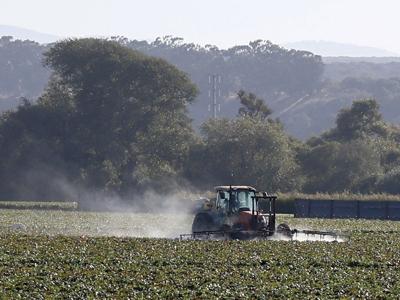

Local pesticide reform advocates are ramping up pressure on regulators over what they deem “environmentally racist” policies that leave Monterey County’s agricultural communities at risk of health hazards.
Safe Ag Safe Schools, a local group that’s part of the statewide coalition Californians for Pesticide Reform, has criticized the California Department of Pesticide Regulation’s draft strategic plan for 2024-2028 – a set of regulations guiding the agency’s oversight of pesticide use over the five-year period.
At a public hearing in Watsonville on Oct. 30 and in a subsequent letter to DPR Director Julie Henderson, Safe Ag Safe Schools attacked the agency’s stated targets of formally mitigating as few as two “priority pesticides” per year in the form of 5-percent annual reductions in their use. The group criticized those goals as inadequate.
“It’s a plan to make sure our communities continue to get poisoned and permanently damaged not just for the next five years, but far into the future,” Safe Ag Safe Schools’ Future Leaders of Change group – composed of local, predominantly Latino high school students – wrote in its letter.
The advocacy group has also escalated a letter-writing campaign to Monterey County Agricultural Commissioner Juan Hidalgo expressing concerns over the local use of chemicals like Dacthal, Telone and organophosphates, which they cite as particularly harmful to children.
In an Oct. 24 letter to Hidalgo, Safe Ag Safe Schools pointed to data indicating that in 2021, one-fourth of all organophosphate pesticides in California, by weight, were applied in Monterey County. The group wants him to impose measures like requiring public notices of intent for the use of all organophosphates, as well as buffers around all residences, schools and hospitals.
Safe Ag Safe Schools organizer (and Greenfield City Councilmember) Yanely Martinez says they have met with the recently appointed commissioner and he has thus far proven more open and receptive to their input than his predecessor, Henry Gonzales.
Hidalgo says while he understands activists’ concerns, the state’s guidelines are a science-based process that must also consider impact on California growers. He also cited progress in restrictions around the use of chemicals like Telone, or 1,3-D – noting stricter rules requiring deeper soil injections and impermeable plastic film covers over fields where the pesticide has been applied.
In a statement, a DPR spokesperson says the agency “regularly engages with advocacy, environmental justice and community groups. We appreciate the feedback we received; it will inform our five-year strategic plan and immediate priorities.”
Still, Safe Ag Safe Schools believes DPR’s rules around the use of pesticides like Telone remain too lenient.
“This is an environmentally racist policy,” Martinez says of allowed levels of pesticide use around schools serving mostly Latino students. “That’s something they don’t want to hear, but they have to hear it.”



(3) comments
Bob, SASS has called for the State to follow the science-based process by making a regulation of cancer-causing 1,3-D that is grounded in the lifetime cancer risk level set by the California Office of Environmental Health Hazard Assessment (OEHHA) last year of 3.7 micrograms per day, the equivalent of breathing air concentrated with 0.04 parts per billion (ppb) of 1,3-D. The Department of Pesticide Regulation has ignored that scientific finding and has put forward a regulation that allows for 0.56 ppb of 1,3-D -- 14 times more than the official Prop 65 cancer warning set by OEHHA. SASS has asked the State to follow its own science. How is that radical? SASS has never called for the elimination of all pesticides. But as the former Deputy Ag Commissioner (unless you are a different Robert Roach), you know that, so stop lying.
Bob, please note that SASS' whole point is that the State is ignoring its own science-based process. The California Office of Environmental Health Hazard Assessment set it's science-based lifetime cancer risk warning level for 1,3-D last year at 3.7 micrograms per day, the equivalent of breathing air concentrated with 0.04 parts per billion (ppb) of 1,3-D. DPR's regulation is based on air concentration of 0.56 ppb -- 14 times higher (and exactly what the manufacturer Dow Chemical called for last year). How is it "radical" to demand that the state follow its own science? How is it not racist to allow for 14 times more cancer-causing chemicals in the air of communities that are disproportionately Latino and Indigenous?
SASS is a radical organization whose goal is the complete elimination of pesticides. The DPR is totally in the thrall of the CA Dept of Environmental Protection political agenda and has become antagonistic to agriculture. We have a science-based pesticide registration process at both federal and state levels but SASS does not believe in it. Cal-EPA has actually been funding these anti-pesticide activists!
Welcome to the discussion.
Log In
Keep it Clean. Please avoid obscene, vulgar, lewd, racist or sexually-oriented language.
PLEASE TURN OFF YOUR CAPS LOCK.
Don't Threaten. Threats of harming another person will not be tolerated.
Be Truthful. Don't knowingly lie about anyone or anything.
Be Nice. No racism, sexism or any sort of -ism that is degrading to another person.
Be Proactive. Use the 'Report' link on each comment to let us know of abusive posts.
Share with Us. We'd love to hear eyewitness accounts, the history behind an article.