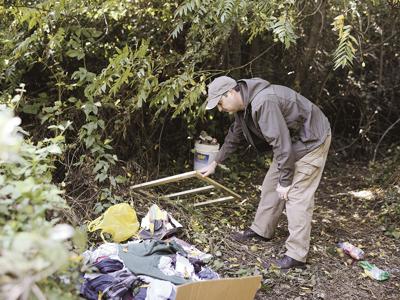

The agencies that manage Laguna Grande Park, long a hub for homeless camps and illegal activity, are finally starting to change their strategy: Instead of reacting to crime after it occurs, they are hoping to create conditions that will prevent it from happening. For Chris Hartzell, vice president of the Monterey Audubon Society and a longtime champion of the park, it’s taken three years to get to this place.
“We finally got the team together, we got them on the field together, now we have to continue playing the game together,” Hartzell says. “That’s what the entire three years took.”
The “team” Hartzell is referring to is a joint powers authority comprised of the Monterey Peninsula Regional Park District and the cities of Seaside and Monterey, all of which own land in the park, and the Monterey Audubon Society, which is concerned with maintaining habitat at one of the prime birding locations on the Central Coast.
Over the last year and a half, three dead bodies have been found in the park, and a transient was charged with attempted murder after setting two other homeless people on fire.
Frustrated by the lack of change in the park over the past years, and the ongoing cutting of trees by the homeless, Hartzell gave a two-hour presentation in Pacific Grove in September on the park’s problems and potential solutions. Seaside City Manager John Dunn was in attendance, as were Monterey Assistant City Manager Hans Uslar and several Monterey residents.
Things have moved quickly since: Dunn met with Hartzell early this month then with Uslar a week later, and there are finally steps being taken to bring about both short – and long-term change.
“One thing we absolutely agree on,” Dunn says, “is we have to do our best to keep homeless encampments out of the park.
“They destroy vegetation and they’re harmful to the environment.”
To that end, Dunn has a city parks employee making sweeps through the park three times a week to ensure there are no permanent encampments, and to suggest available social services to the homeless who are there.
As far as a long-term solution, the city of Monterey has agreed to create a request for proposals for a consultant to do a comprehensive analysis of past plans and studies in the park, and to make recommendations going forward. For budgetary reasons, that study likely won’t begin until next spring or summer, and Dunn can’t give an estimate for how much it will cost until some bids come in.
Dunn also says the park’s joint powers authority will meet more frequently to talk about the issues of the park and what needs to be done, and how to go about doing it.
The parties are also invested in bringing the public into the discussion. Uslar says public workshops will be held as early as the first quarter of next year.
“We are looking at a holistic approach,” Uslar says. “We will be looking at the whole Laguna Grande area, and looking at the public to ask, ‘What do you want to do with this area? How would you envision it for the future?’”
Hartzell has long advocated for a trails system in park, but he’s happy for any kind of positive change.
“There’s no way to keep that park 100-percent free of illegal activity,” he says. “What we’re looking at is mitigation of the most dangerous activities, to people and the environment.”



(0) comments
Welcome to the discussion.
Log In
Keep it Clean. Please avoid obscene, vulgar, lewd, racist or sexually-oriented language.
PLEASE TURN OFF YOUR CAPS LOCK.
Don't Threaten. Threats of harming another person will not be tolerated.
Be Truthful. Don't knowingly lie about anyone or anything.
Be Nice. No racism, sexism or any sort of -ism that is degrading to another person.
Be Proactive. Use the 'Report' link on each comment to let us know of abusive posts.
Share with Us. We'd love to hear eyewitness accounts, the history behind an article.