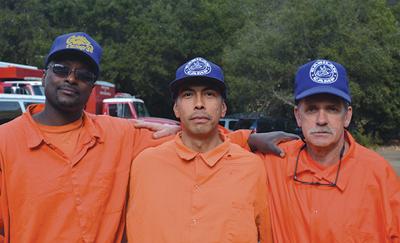

As I approach a crew of firefighters on the edge of smoldering redwoods, just west of the Big Sur River, it struck me that their uniforms were orange, not the yellow you usually see on firefighters.
It was Monday afternoon, just 12 hours after the Pfeiffer Fire broke out. I had arrived in the valley a few hours earlier, and was still getting a lay of the land.
I greet the first crew member I encounter, and ask if he would answer some questions; he just shakes his head with a grin and doesn’t say anything. Then a whole bunch of other heads turn my way.
“I’ll answer some questions!”
Four of them came to my side and tell me of a redwood tree falling in the night and almost hitting a member of their crew. That they’ve been out since 2am, and a tree seems to fall every five minutes. They are effusive, excitable. I ask where they are from.
“We’re from Gabilan Camp, in Soledad,” one says, pointing to the decal on his helmet. “You heard of Gabilan Camp?”
Gabilan Conservation Camp, located in Soledad, was formed in 1986 as part of the California Conservation Camp program administered by the California Department of Corrections and Rehabilitation. The program’s aim is to allow able-bodied (and willing) inmates to perform meaningful work for the public. And since 1947, after teaming up with Cal Fire, much of that work is firefighting.
“For the Department of Corrections, it’s the one ray of sunshine,” Gabilan Conservation Camp Commander Steve Pate says. “It’s a great program.”
Pate speaks to me on Dec. 18 from Big Sur, as he oversees 374 inmate firefighters from throughout the state’s conservation camps, including those from Gabilan, where 134 inmate-firefighters have been assigned.
At the time we spoke, inmates comprised over 42 percent of the fire suppression personnel. “We’re the largest force out here,” Pate says.
Each of their 11 strike teams on site in Big Sur consist of 34 inmate firefighters and two each of correctional officers, corrections supervisors, Cal Fire captains and Cal Fire strike team leaders.
Gabilan’s inmate firefighters are convicts who have met a list of qualifications including good behavior, being medically fit, and having no convictions for sex offenses or arson. Their training begins at a prison, the Sierra Conservation Center in Jamestown, Calif. After passing tests for fitness and skills, they are assigned to a camp, where their lives change markedly.
“There’s a lot of freedom in the camp,” Pate says. “They’re not in cells, they have an open dorm, the doors are not locked, and they can go to the yard anytime.” He also adds the food is much better than regular prison food. “Probably better than I eat every day,” he says.
When Gabilan’s inmate firefighters are not fighting fires around the state (Pate says they also played a role in suppressing the Basin Complex Fire), they’re out in Monterey County, performing public works duties.
They sandbag in Carmel when a flood hits, or clear brush in the forests of Pebble Beach.
“Our crews account for $280,000 a month in labor saved by community,” Pate says. That number is conservative, he adds, since it assumes minimum wage; inmate firefighters are paid $1 per hour.
Marina Public Works Crew Chief Ed Meachem has nothing but praise for the Gabilan crews. “They just spent a month at Locke-Paddon Park, clearing out brush,” he says. “They are definitely a helping hand.”
I meet three of them at the Pfeiffer Fire incident base on Dec. 19, after they come off a 24-hour shift. Pate indicates that the three prisons each of them came from – New Folsom, Santa Nella and Corcoran – are a far cry from Gabilan Camp.
“They’re the three hardest prisons in the state,” he says.
Melvin Gray, 47, was in prison for 11 years before coming to Gabilan, where he’s spent the last two. “It changed my whole life,” he says, adding he plans to apply for a job with Cal Fire when his sentence is up, just four months from now. “I have something to go home to.”
Patrick Meyer, 59, voices a sentiment they all share: It’s great to be part of a team, to work together and help the community. “We’re more than a crew,” Meyer says. “We’re a family.”
And 40-year-old Mark Nunez (not the same Mark Nunez who is the U.S. Forest Service’s incident commander of this fire) relays tales of locals cheering them on, driving by them on Highway 1 and saying, “We love you!”
“They don’t treat you like an inmate,” Nunez says. “It makes you feel good.”


(3) comments
Good story. Are there any state or county barriers that prevent these men from doing similar work once they leave prison?
Thanks Bob; all inmate firefighters can apply for a job with Cal Fire or elsewhere after time served, and I've been told it's not uncommon for them to land a job as such, though I can't confirm any number, or their acceptance rate.
This topic might make a good follow up story. Report on how state and or county facilitates or places barriers to employment of these firefighters once the return to life outside prison.
Welcome to the discussion.
Log In
Keep it Clean. Please avoid obscene, vulgar, lewd, racist or sexually-oriented language.
PLEASE TURN OFF YOUR CAPS LOCK.
Don't Threaten. Threats of harming another person will not be tolerated.
Be Truthful. Don't knowingly lie about anyone or anything.
Be Nice. No racism, sexism or any sort of -ism that is degrading to another person.
Be Proactive. Use the 'Report' link on each comment to let us know of abusive posts.
Share with Us. We'd love to hear eyewitness accounts, the history behind an article.