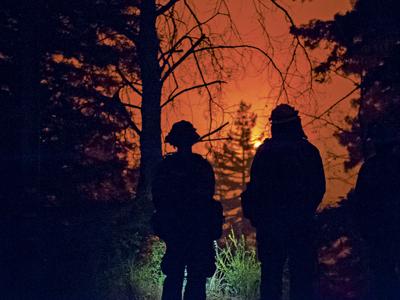

In the days after the Soberanes Fire broke out on July 22, it burned south into the Ventana Wilderness, in the northern portion of the Los Padres National Forest.
On July 30, at a community meeting at Carmel High School, officials announced the fire could ultimately burn 170,000 acres, more than quadruple its size at the time.
The possibility that the fire might spread into the wilderness was a concern among firefighters from the beginning, and for good reason: In the wilderness, the nature of the firefight changes dramatically.
Federally recognized wilderness areas are a product of the Wilderness Act of 1964, which was created in response to the ever-encroaching nature of human development. The idea was to establish large tracts of land that are, by definition, “an area where the earth and its community of life are untrammeled by man, where man himself is a visitor who does not remain.”
Even when the fire reaches the burn scar of the Basin Complex fire, there will be little reprieve.
Wilderness areas are intended to preserve the “primeval character” of the land so as to offer “outstanding opportunities for solitude” and “primitive” recreation.
They are also to be free of permanent improvements, which means no roads and no fire hydrants.
The use of mechanized equipment like dozers and chainsaws is also prohibited in wilderness areas, except in cases of emergency. Even then, the use of such equipment requires federal approval.
In the case of the Soberanes Fire, local U.S. Forest Service officials have already obtained that permission, gaining approvals to use chainsaws and dozers to reopen historic fire breaks last used in the Basin Complex Fire of 2008.
But the fire jumped some of those breaks July 28, burning into a vast, parched forest where the nearest fire breaks to the south are several miles away.
USFS Fire Chief Jay Kurth, who is in unified command of the Soberanes Fire, puts the potential acreage burned into the context of those fire breaks.
“We start with as a big a box as we think we’ll be successful at,” he says.
Kurth adds that the top priority in any firefight is protecting human life, which means firefighters have to be strategic in where they attack the fire in the wilderness, so as to allow themselves a safe place to retreat and get some sleep.
And while there are no fire hydrants in the wilderness for firefighters to tap into, he says they may fly in portable pumps to draw from rivers and streams. There are also more historic firebreaks in the wilderness, he says, which might get reopened depending on the weather.
USFS spokesman Andrew Marsden says the top priority in the Ventana Wilderness area is preventing the fire from reaching homes in Big Sur, and adds that even when the fire reaches the burn scar of the Basin Complex fire, there will be little reprieve for firefighters.
“There was real good vegetation recovery after that fire,” he says, meaning there is plenty of fuel to burn.
Furthermore, due to prolonged drought, sections of the chapparal have died off, making them increasingly flammable.

(0) comments
Welcome to the discussion.
Log In
Keep it Clean. Please avoid obscene, vulgar, lewd, racist or sexually-oriented language.
PLEASE TURN OFF YOUR CAPS LOCK.
Don't Threaten. Threats of harming another person will not be tolerated.
Be Truthful. Don't knowingly lie about anyone or anything.
Be Nice. No racism, sexism or any sort of -ism that is degrading to another person.
Be Proactive. Use the 'Report' link on each comment to let us know of abusive posts.
Share with Us. We'd love to hear eyewitness accounts, the history behind an article.