
On March 2, President Donald Trump, defending tariffs he had recently imposed on steel and aluminum, made a claim on Twitter that few, if any, economists would agree with: “Trade wars are good, and easy to win.”
(Of 104 economists Reuters polled from March 5-13, 80 percent said they believed the tariffs would hurt the U.S. economy; none said they would help it.)
The tariffs have since multiplied, and locally they are starting to negatively impact one of the pillars of Trump’s platform: American manufacturing jobs.
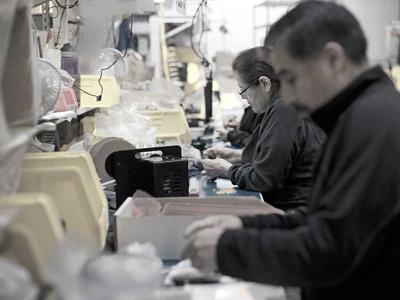
At Light & Motion, a Marina-based company that manufactures lights for activities like biking, diving and underwater photography, jobs are on the line.
What’s not in question, Light & Motion President Daniel Emerson says, is that the company is moving its manufacturing to the Philippines “as soon as physically possible. We need to be up and running in six months.”
Light & Motion’s conundrum is this: The company, whose competitors largely manufacture their products in China, has to pay a 10-percent tariffs for many components of their lights – which are assembled in Marina – like circuit boards, which the company partially sources from China. By Jan. 1, that tariff, according to Trump, will be 25 percent.
Emerson says his company, which does about $10 million in annual sales, imports about $2 million worth of product from China each year and that the company can’t weather an annual $200,000 hit (10 percent) in the long term, much less $500,000.
“We are basically being taxed out of existence by our own government,” Emerson says. “[Tariffs are] a wall you build around your country, if you’re manufacturing inside that wall, it’s difficult to get parts in, and it’s difficult to ship products out. The best strategy for any company is to move your manufacturing outside that wall.”
Which is why he’s moving manufacturing to the Philippines, which has “most favored nation” status with the U.S. – no tariffs. Light & Motion plans to import its parts – some from the U.S. – to that country, where it will pay no tariffs, and them import the finished product back to the U.S, also free of tariffs.
It’s what Emerson calls a “tunnel” under current trade policy. The primary impact, in this case, will be a loss of about a dozen American manufacturing jobs.
Other local businesses are being impacted by the ongoing trade war, but in large part, that cost is being passed on to consumers.
Greg Molinari says his restaurant and cleaning supply distributor, Salinas-based American Supply Company, has seen prices increase on its inventory imported from China – mainly low-grade paper products – and that he has spent hundreds of hours repricing orders from his clients, as well as looking for potentially cheaper suppliers from other sources.
“The customer realizes what’s happening,” Molinari says, “and quite frankly, none of us like it.”
Pete Scudder, who owns a roofing and solar company based in Marina, says his suppliers increased prices on things like metals even before the tariffs took effect. He says he’s trying to find efficiencies where he can to cut costs, but there’s only so much he can do.
“Ultimately, it goes back to the consumer,” Scudder says. “There’s not a lot of margin in any of these businesses.”


(0) comments
Welcome to the discussion.
Log In
Keep it Clean. Please avoid obscene, vulgar, lewd, racist or sexually-oriented language.
PLEASE TURN OFF YOUR CAPS LOCK.
Don't Threaten. Threats of harming another person will not be tolerated.
Be Truthful. Don't knowingly lie about anyone or anything.
Be Nice. No racism, sexism or any sort of -ism that is degrading to another person.
Be Proactive. Use the 'Report' link on each comment to let us know of abusive posts.
Share with Us. We'd love to hear eyewitness accounts, the history behind an article.