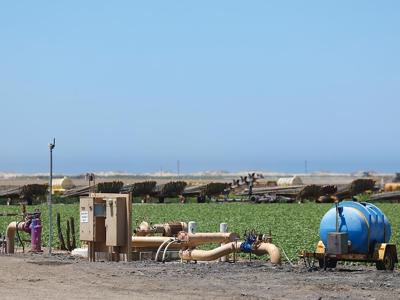

For decades, drilling a well in the Salinas Valley and its outlying rural communities has required only one bureaucratic step – applying to the county’s Environmental Health Bureau for a ministerial permit and paying a one-time fee.
But with the advent of the Salinas Valley Basin Groundwater Sustainability Agency (SVBGSA) in 2017, that paradigm was no longer sustainable.
In the years since forming following California’s 2014 Sustainable Groundwater Management Act, SVBGSA has been collecting data and creating reports to send to the state Department of Water Resources to show proof the region is on track to meet SGMA’s requirements to achieve groundwater sustainability by 2040. If the Department of Water Resources doesn’t think a GSA is effectively doing that, it is empowered to step in and take over the process, which is the worst-case scenario for stakeholders who want to retain local control over managing their groundwater.
From the outset, SVBGSA teamed up with the Monterey County Water Resources Agency (MCWRA), which has been tracking groundwater levels in most of the Salinas Valley since 1995. But one problem that’s since arisen is gaps in the data, areas where there’s been no historic monitoring of groundwater. To help solve that, the Board of Supervisors last October approved MCWRA’s proposal to establish an annual well fee to pay for groundwater monitoring across the basin.
Rather than have two different agencies sending bills, MCWRA will send out a single bill to cover the costs of the program for both agencies. How much the proposed annual fee comes out to depends on the subbasin, ranging from $140 to $280.
On June 3, MCWRA will come back to the Board of Supervisors to seek approval of the new fee schedule.
MCWRA General Manager Ara Azhderian says his agency estimates there are 3,500 wells in the county that would be subject to the fee, but says there could be more – County Health’s records only go back a few decades.
“No one wants a new fee, [but] if we don’t do it, the state will,” Azhderian says. “Retaining that local control is a vital part of what we’re trying to accomplish here.”
Azhderian says the biggest challenge in instituting the program will likely come from owners of smaller domestic systems; while agricultural growers have been working with MCWRA on groundwater monitoring for years, owners of smaller production wells have not.
Registering a well with MCWRA will be required in the new program – a one-time fee of $160 for well owners not already registered – and it will also give key data points to provide the state with what it needs, like where the well is on the property, at what depth and whether it’s still in use.
“We’re trying to make the burden on the well owner as light as we can,” Azhderian says, who concedes that it will likely take some time for some well owners to get used to.
Piret Harmon, SVBGSA’s general manager, emphasizes the bigger picture: The groundwater basin is overdrafted and seawater intrusion continues, and the data will be critical in evaluating future groundwater sustainability projects.



(1) comment
There’s something rare and hopeful in this moment: cooperation. Across the Salinas Valley and Peninsula, agencies long operating in silos are moving together, not apart. That’s what progress looks like—optimization not just of well fees, but of purpose.
The monitoring gaps remain real, especially in the southern reaches where the MCWRA’s reach historically ended. Extending the Upper Valley to the County line surfaced new voids. Mismatched maps between Bulletin 118 and Zone 2C only deepened them. But closing these isn’t just technical work—it’s moral work. It fulfills the SVBGSA’s charge to account for all six subbasins. All means all.
No one wants state control—not even the state. But the path to retaining local stewardship runs through discipline. This article focuses on a fee. Necessary, yes. But the deeper matter is seawater intrusion, pushing into the 180 and 400-foot aquifers, inching toward Salinas. The Deep Aquifers are still a mystery. Stopping the intrusion is non-negotiable. Reversing it, healing it—that’s written in the plan, even if it takes beyond 2040.
That healing will be hard. It may cost more than some can carry alone. And so we must speak plainly: those outside the problem area cannot be asked to pay for a benefit they don’t receive. That would cut against justice, against law, against conscience.
We are stewards, not owners. We inherit the ground we stand on, and we are charged to leave it better than we found it. The aquifers don’t care about our deadlines. But the people who depend on them do.
Time is short. Tempers may rise. But grace will carry the day, if we let it. Keep eyes on the prize. Do the work. Hold each other to account. And don’t look away.
Welcome to the discussion.
Log In
Keep it Clean. Please avoid obscene, vulgar, lewd, racist or sexually-oriented language.
PLEASE TURN OFF YOUR CAPS LOCK.
Don't Threaten. Threats of harming another person will not be tolerated.
Be Truthful. Don't knowingly lie about anyone or anything.
Be Nice. No racism, sexism or any sort of -ism that is degrading to another person.
Be Proactive. Use the 'Report' link on each comment to let us know of abusive posts.
Share with Us. We'd love to hear eyewitness accounts, the history behind an article.