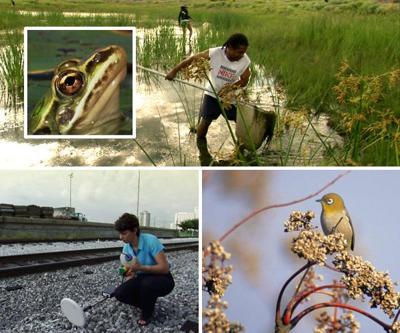
A mystery: Lake Chad, in Central Africa, is drying up. Dust clouds rise from the center of the continent and are blown across the Atlantic. In Trinidad, 5,100 miles away, asthma rates among children skyrocket, and in the coastal waters surrounding the Caribbean island nation, brilliant coral sea fans are becoming ratty and faded. How are these disturbing incidents connected?
Another mystery: The Lamar River, in Yellowstone National Park, silts up, changes its course; it becomes a “river in chaos.” Its banks, once covered with stabilizing trees, are now barren. Core samples taken elsewhere in the Park reveal that nowhere are there aspen trees less than 80 years old. It’s as if the aspens stopped sprouting in 1930—almost exactly when the last native wolf was killed. Could it be that the elimination of wolves from an area could destroy a river?
And how could it be that the biggest herd of caribou in Alaska is dying off even as food seems to become more plentiful in their warming arctic valley? And what does it mean that Formosan termites are causing houses in New Orleans to crumble?
These are just a handful of the mysteries—there are dozens—explored in National Geographic’s Strange Days on Planet Earth, a four-part series produced by the Cannery Row-based Sea Studios Foundation, which premieres nationwide on PBS-TV next Wednesday, April 20.
Strange Days is a nature film, a science film, a film about environmental issues. But it feels, at times, more like a mystery movie, at times like a science fiction whodunit. The mystery it probes is huge: How does the earth work, and what is causing all of these inexplicable crises? There are suspected culprits—did global warming do it? There are brilliant sleuths—a small army of determined scientists. And like many a good mystery movie, there is a threat at its core—in this case, the threat of ecological catastrophe.
No matter how familiar a viewer is with the scary environmental news of our day, Strange Days will likely provoke a hair-raising response. Fact is, the earth scientists who study this stuff have been working hard over the past few years, and they have made some frightening discoveries. They all agree—and there is a scientific consensus here—that we are living in a period of rapid planetary change unlike anything humans have seen before.
Global trade, global travel and massive international technological expansion have dramatically accelerated the changes being wrought upon the world. And that is not entirely a good thing.
Strange Days reports the recent findings of a far-flung band of researchers working in a variety of disciplines all over the planet. These are geologists and biologists of various stripes, as well as sociologists and economists, and they are looking at global-scale phenomena as well as small-scale, one-time events. The one thing they all are finding is that whatever is happening is happening alarmingly fast.
Clearly, all of this could have made for some painfully depressing television. Instead, the makers of this show have turned it into an edge-of-your-seat life-or-death adventure.
While Strange Days seeks to explore the forces that change the climate of continents, destroy forests in a protected wilderness, make children sick and drive species to extinction—subjects that have been explored in many a finger-wagging enviro-documentarty—this feels and looks more like a prime-time mini-series.
Mark Shelley, president of Sea Studios and one of the series’ four executive producers, says the members of his team set out to overcome what he calls “eco-fatigue.” They wanted to avoid the preaching and the talking heads, as well as the after-school special look. It was their hope, he says, that when people tuned in, they wouldn’t know how to pigeonhole what they were watching.
“The fact is, the public is a little turned off by the environment,” Shelley says. “We decided to be very direct about avoiding the pitfalls of the genre. The science itself, we all thought, was really, really interesting. The challenge was to look at the subject matter in a new way. We knew we wanted to make a difference. So the large battle was attracting an audience.”
Shelley’s team came up with a motto, which they circulated to everyone involved in the enterprise: “Think David Lynch, not David Attenborough.” The decision to look for inspiration from the disturbing and visually stunning Twin Peaks instead of BBC’s lofty and grave Life on Earth affected not only the way Strange Days tells its story, but also the way the show looks.
The edgy aesthetic makes itself felt immediately in episode one, “The Invaders.” A car winds its way along a suburban road and pulls into a cul-de-sac. As it parks, there is no welcoming narrator. Instead, disembodied voices lifted from the film tease the drama to come. The program’s host, Edward Norton—star of Primal Fear, Fight Club and other hip Hollywood fare—steps out of the door and into the street with a lawn chair, sets it up and sits down to face the camera.
“Alien species are invading every continent,” he says. “They have enormous power. They are spreading diseases…leveling buildings.” The camera jumps from shot to shot as he speaks. This is not unpleasant or unfamiliar to anyone who has seen a film by, say, Wim Wenders or Baz Luhrmann, or watched MTV, for that matter. But it doesn’t look much like a documentary.
Throughout, the filmmakers pull out the stops. Slow-mo and fast-mo scenes rub up against one another. Start-and-stop sequences build tension. Split screens (borrowed from the Kiefer Sutherland TV series 24) present poetic juxtapositions—a leaping monkey above a leaping frog, a meandering band of elk and a meandering stream. The gorgeous animated footage, a staple of the nature doc, is elevated here to a glossier, more effective device.
“A lot of feature films borrow from the documentary genre,” Shelley says. “We figured, let’s start borrowing production values, tools and techniques from feature films.”
Listening to Shelley, it’s clear that this was not all simply a matter of pandering to jaded contemporary audiences. He clearly believes the subject matter itself demanded a kind of re-invention of the nature documentary.
Thirty years ago, he says, Americans responded strongly to the message that they heard on the first Earth Day (the show’s broadcast is timed to coincide with this year’s annual event). Back then, environmental problems were a lot simpler.
“When a river catches fire, that’s pretty easy to comprehend as a problem,” Shelley says, recalling Ohio’s infamous burning Cuyahoga River. “Black smoke billowing out of buses, acid rain destroying forests, upstream pollution killing downstream fish—those big problems for the most part have been addressed.
“Now the problems are more insidious. Climate change, invasive species, vanishing predators, low-level toxins in the water—these are more complex ideas. And the storytelling we brought in is our response to that. These are much harder problems to get across as urgent issues that demand our attention and our response.”
That, ultimately, is the goal that motivates Shelley and his Sea Studios team—not just to make a great show, and not even just to raise awareness about the complex threats to the environment, but “to deliver you to opportunities to get involved.”
To accomplish this end, Sea Studios created a partnership with National Geographic, the National Science Foundation, and Vulcan Productions, the Seattle outfit run by the Microsoft billionaire Paul Allen. Together, they have fashioned a vastly ambitious multimedia juggernaut that is much more than just a TV show. (Full disclosure: Bradley Zeve, founder and CEO of the Weekly, is chair of the board of the nonprofit Sea Studios Foundation.)
David Elisco, the lead writer and series producer of Strange Days on Planet Earth, says an academic tract brought the main idea of the program into focus for him.
The Globalization of Ecological Thought, by Harold O’Malley, describes the emergence of a new way to look at the environment. It depicts an interdisciplinary approach, one in which, for the first time, researchers from all over the world and from various fields within the natural sciences share information.
“It was shocking to me that scientists don’t talk to each other,” says Elisco, who has a BA in film from Penn State. “This book chronicles what happened when they did, and began to see connections in things they hadn’t seen before. And I realized: This is a great story. What were they seeing?”
Elisco says the first story line began to appear during a conversation with a retired earth sciences professor. He says Richard Butler of Duke University inspired him to see the narrative that would become “The One Degree Factor,” a powerful episode on global climate change.
“He just started to spin a story,” Elisco recalls. It was a tale of forests creeping northward, of Pacific zooplankton populations plummeting, of dust storms in Chad and asthma in the Caribbean. These stories were all the result of scientists worldwide talking and discovering that “their work was interconnected,” Elisco says.
“I realized, these people are on the front lines of a new discipline. They are some of the greatest science minds and talents studying the natural world, and they were confronting a big, mysterious question.”
Having decided to tell this story born of scientific collaboration, the Sea Studios team set to work in their own highly collaborative manner. Most filmmaking is a team sport. At Sea Studios, it involves a very big team and an unusual degree of cooperation.
In 2002, the same team had worked with National Geographic to produce The Shape of Life, an award-winning series about breakthroughs in the study of evolutionary biology. Strange Days, which was initially called The Living Machine, picked up where that series had left off.
The Sea Studios team includes a “science unit” headed by Nancy Burnett, one of the founders of the Monterey Bay Aquarium; Chuck Baxter, a retired Stanford marine biologist who was both Burnett’s and Shelley’s teacher in the 1970s; and Tierney Thys, a scientist who specializes in biometrics.
The scientists and the filmmakers met for months and brainstormed, ultimately compiling a remarkably detailed framework for the video shooting, which was still a ways off.
In Elisco’s office at Sea Studios, perched just above the breakers on Cannery Row, bookshelves are filled with white binders that he calls “roadmaps.” Each of these binders contains the raw materials for a one-hour show: scientific themes, the names of scientists who would be able to address these issues, narrative techniques and specific ideas for the show’s sequences. The Sea Sudios team even “storyboarded,” a scripting device that directors of feature films use, where scenes are drawn out, comic-book style.
“This is not the way documentaries are usually made,” Elisco concedes. In fact, it is typical in documentaries for the filmmaker to begin the process by gathering footage. Sea Studios had four shows sketched out from beginning to end before they even hired the producers who would go out in the field and shoot.
Sea Studios then entered into a unique process of collaboration with each of the separate shows’ producers. (As is typical in television, each program is shot, directed and edited by a different producer.) Each was given the “roadmap” as well as a “style guide,” which described in detail the distinct look and feel of the series. Each packet included a clip reel of scenes from the feature films that the Sea Studios team intended to borrow techniques from.
“This takes nothing away from the contribution of the producers themselves,” Elisco says. “We expected the producers to bring a lot of value to the enterprise. These guys have to get it off the page and onto film. They have to figure out how to get into Chad, for instance, where’s there’s a civil war going on. And they have their own ideas, which we were eager to hear. And we knew that as soon as they went into the field, we were going to get a lot of surprises.”
Before they even began talking to the producers, Elisco and Shelley brought in their partners at National Geographic and Vulcan Productions. In addition to providing enough money for the project to allow Sea Studios to “swing for the fences,” Elisco says, each brought a considerable amount of creative capital to the table.
From their work together on The Shape of Life, they already had a relationship with National Geographic, the world’s premier outlet for science and nature programming. For Strange Days, they once again worked with Keenan Smart, head of National Geographic’s natural history unit.
Smart immediately signed off on the decision to take the series in a direction not seen in nature documentaries.
“Historically, it’s been very, very difficult to create a program on the environment,” he says. “In the business, it’s seen as an area of programming that can stifle viewers’ interest.”
The collaboration involved a significant amount of “to-and-fro” between Monterey and National Geographic’s headquarters, Smart says, beginning with a review of the roadmaps and ending with a rigorous peer review in which every scientific claim in the series was vetted by three independent scientists.
“This show has brought the traditional standards of National Geographic’s television programming—including quality scientific content and great photography—to issues that were regarded as too difficult to crack in a way that would grab people’s attention,” Smart says.
“There’s no doubt in my mind that in the evolution of film about the environment, on subjects like climate change, this is the benchmark. I don’t think any production company or broadcaster anywhere has produced anything like this.”
Smart’s high praise for the project is shared by others in the world of nature documentaries. Strange Days on Planet Earth won Best Series awards at the International Wildlife Film Festival, in Missoula, Montana, and at Wildscreen, in Bristol, England, where it was the first American film to receive that honor.
For Smart, the success of the project will not be measured solely in awards or viewership. Like his partners at Sea Studios, Smart hopes that the series will have an effect—not only on the way people see the world, but on what they do after the show is over.
“This is a story about the plight of the living system that we all need to survive,” he says. “We are looking here at evidence that is incontrovertible. This program tells stories of people whose very lives, the foundation of their existence, is threatened, in a way that it could be for all of us. It’s a timely and essential contribution to a debate that has the potential to affect all of us on the planet.”
There is an arresting moment in the Strange Days episode called “The One Degree Factor” which illustrates some startling problems created by global climate change. It’s the kind of thing that makes you say “Huh?” and then “Wow!” It occurs when an atmospheric scientist named Jim Hurrell is puzzling over the strange case of the African dust caused asthma outbreak among the children of Trinidad.
Hurrell, studying computerized global weather models, demonstrates how temperature changes in the Indian Ocean have caused prevailing westward winds thousands of miles away, in the Atlantic Ocean, to accelerate.
It’s complicated, for sure, but Hurrell uses animated maps (so cool they make the fanciest evening-news weather map look almost clunky) to show how increased storms in South Asia—an effect of global climate change—have created wind currents that are affecting something called the “Atlantic oscillation,” a competing pair of high and low pressure systems. These “new” prevailing winds appear to be responsible for carrying dust all the way across the Atlantic. In five minutes, he seems to prove this bizarre occurrence beyond a doubt.
“The One Degree Factor” makes no claims about whether the drought that has dried up the once-enormous Lake Chad in less than 20 years is a symptom of global warming—the jury is still out on that one. And the political debate about whether global warming is real, or whether it is caused by human technology, is ignored. That debate is not about science, it’s about politics, and, thankfully, outside the frame of the series.
More broadly, the fact that human activies are wreaking havoc on the earth’s ecosystems, about which there is no question among a vast majority of scientists, is taken as a given.
The real questions considered in Strange Days are these: what is going to happen as a result of global warming, pollution, species depletion, etc? And more importantly, how can this scourge on the planet be stopped?
Ultimately, this television series is intended as a tool to encourage and enable its viewers to become part of the solution to this huge predicament.
Paul Allen, the co-founder of Microsoft, the fourth-richest man in the world, and head of Vulcan Inc., calls it “moving the needle.” Early in their collaboration with Sea Studios, Vulcan made it clear that that would have to be the goal of the effort.
Mark Shelley says he was a bit flummoxed when he first heard the notion.
“Paul Allen’s charge to us was: ‘We have to move the needle.’ Just that one sentence, but it was powerful. He wanted to see measurable results.
“At first we thought, ‘What needle? Move it how far? Whose needle?’ but we embraced it, and it became like a mantra for us.”
The idea, as explained by Richard Hutton, vice president of media development at Vulcan and an executive producer of Strange Days, is simple and profound: “We want something to happen as a result of the project that can change people’s lives.”
Hutton, a veteran television producer who counts among his credits the remarkable 2000 PBS series Evolution, knows from experience that a television program can extend its influence way beyond the few weeks that it is on the air. The Evolution series was part of a package that included, among other things, teaching tools for middle school science teachers. He points out that it is in such wide circulation, five years after the series aired, that the Evolution Web site is flooded by kids every March and April, when the subject is generally taught. (In fact, if you “Google” the word “evolution” right now, the series’ Web site is the first thing that comes up.)
“To me,” Hutton says, “it’s not really all that satisfying to make a TV show, get it on the air, and have people say, ‘that’s nice.’ That doesn’t really do it for me.”
Vulcan’s initial contribution to the creative effort drove the filmmakers to use rigorous science to help determine the show’s impact. They conducted brainstorming sessions on Cannery Row in which they used sociological data to discuss things like the ways audiences create meaning from images and narratives—butcher-paper charts from these sessions still hang on the walls in Sea Studios’ conference room.
And they insisted that the program should not turn into a downer, as the subject matter might have allowed it to become.
Alisco says he welcomed the advice.
“Our mission at the [Sea Studios] Foundation has actually expanded,” he says, “from simply building awareness and understanding, to inspiring action. And to inspire people to take action, you have to leave them with some hope that they can make a change.”
Vulcan also encouraged the Sea Studios/National Geographic team to produce an “impact campaign” in conjunction with the series, to ensure that viewers can learn more, and take action, after watching the program.
To that end, they have created a snazzy Web site (www.pbs.org/strangedays), and enlisted a consortium of zoos, aquariums, parks and museums to participate. They have armed schoolteachers with materials to join in what they hope will be an ongoing nationwide educational effort. And with the United States Geological Survey, they hope to create an army of “citizen scientists” to track invasive species the way birdwatchers track their life-lists of sightings.
It’s a different way of thinking about the production of a TV documentary, born from what the program’s producers all believe is new era of scientific breakthrough.
Tierney Thys of the Sea Studios’ science unit feels that the timing couldn’t be better.
“I think we are truly in the golden age of discovery in earth system science,” Thys says, “particularly because of the tremendous global synergy we see in the scientific community. There is no way we could grasp the complexity of our earth systems without having global cooperation.”
And Thys, like all of her colleagues, hopes to see an even broader sort of cooperation coming.
Strange Days on Planet Earth airs on PBS Wednesday, April 20.


(0) comments
Welcome to the discussion.
Log In
Keep it Clean. Please avoid obscene, vulgar, lewd, racist or sexually-oriented language.
PLEASE TURN OFF YOUR CAPS LOCK.
Don't Threaten. Threats of harming another person will not be tolerated.
Be Truthful. Don't knowingly lie about anyone or anything.
Be Nice. No racism, sexism or any sort of -ism that is degrading to another person.
Be Proactive. Use the 'Report' link on each comment to let us know of abusive posts.
Share with Us. We'd love to hear eyewitness accounts, the history behind an article.