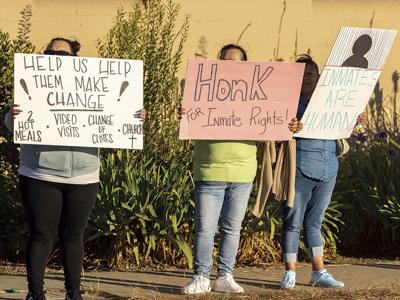

On Sunday afternoon, Aug. 14, 150 inmates who had been refusing to eat at the Monterey County jail ended their two-week hunger strike.
Loved ones and inmates were protesting, asking for better conditions and services. They were seeking better medical care and food prices, longer socializing times, reinstatement of Covid-19 protocols and two rounds of clean clothes (socks, shirt and underwear) per week instead of one.
Family members say inmates ended the strike because the lack of food was affecting their health. Derrel Simpson, the spokesperson at the Monterey County Sheriff’s Office, says inmates were in good health and notes no one was taken to the hospital. “They were all doing fine, and several of them actually gained weight,” he says. He adds that commissary sales prior to the Aug. 1 hunger strike were higher than usual: “Most of them are not actually refusing to eat. They’re just refusing to eat the meals we prepare.”
Joe Moses, who manages the county jail and is running for sheriff, claims conditions at the jail have gotten better over time and says the allegations are false. “We are doing a good job of trying to meet the mandates of the Hernandez lawsuit,” he says, referring to a 2015 settlement agreement in a class-action lawsuit that requires county officials to provide adequate medical care, among other things.
Moses also recognizes that more needs to be done to help inmates with mental illnesses: “Jail is really not the place that we should have our people that are suffering from mental health issues,” he says.
The suit, filed in 2013, argued the jail was unsafe, poorly designed, overcrowded, and inadequate to provide dental, medical, and mental health care. The jail is monitored to make sure they are complying with the settlement terms. Since then, the jail also moved to a new location.
Relatives and inmates who spoke with the Weekly say the jail is still unsafe and they don’t receive proper care. Alphonso Vanderslice, a veteran with PTSD who was released last December, says there was mold in his cell and he felt unsafe. He claims he was jumped while in custody.
The hunger strike didn’t surprise him: “I totally understand that because the only way to get people’s attention is to do something drastic.” He says the only way he received help was by telling guards he was suicidal.
(Simpson says Vanderslice received needed attention while in custody, including placement in a mental health unit.)
Tina Nieto, the Marina police chief who is also running for sheriff, says more transparency is needed to avert actions like a hunger strike: “It just tells me that the communication isn’t there between the two groups, and that we can do better with communicating with each other.”
One complaint from protesters and strikers was the end of video calls, which jail officials say has been resolved and was an equipment issue.
Moses says the decision to reduce the weekly commissary limit from $900 to $150 per inmate was because officials saw an uptick in incidents of extortion. “I made the decision that that was not conducive to the environment we need to have in our jail,” Moses says.
Several complaints were raised over current commissary prices; Simpson says jail officials are working with vendors to reduce prices.


(0) comments
Welcome to the discussion.
Log In
Keep it Clean. Please avoid obscene, vulgar, lewd, racist or sexually-oriented language.
PLEASE TURN OFF YOUR CAPS LOCK.
Don't Threaten. Threats of harming another person will not be tolerated.
Be Truthful. Don't knowingly lie about anyone or anything.
Be Nice. No racism, sexism or any sort of -ism that is degrading to another person.
Be Proactive. Use the 'Report' link on each comment to let us know of abusive posts.
Share with Us. We'd love to hear eyewitness accounts, the history behind an article.