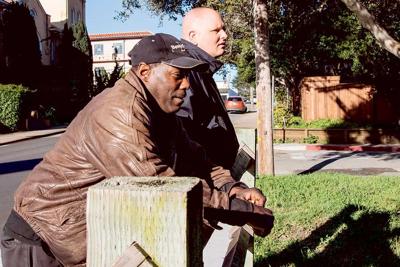

Driving down Del Monte Boulevard from the Salvation Army Community Center in Seaside, Andrew Millington and Harvey Smith are bundled up for a frosty morning after one of the coldest nights of the winter. They are among the hundreds of people who gathered at 5:45am on Jan. 25 for the 2017 point-in-time regional homeless census launching from Seaside, Salinas and Hollister.
“I know all the spots. Up right here there’s at least four people in encampments,” Smith says, pointing to the trees and bushes around the Highway 1 overpass at the Seaside-Monterey border.
The two men drive along the Monterey Bay toward Pacific Grove. Volunteers for the census receive maps of areas they are asked to canvass, then get a head count of homeless people there. The maps also have a few dots to mark locations where a high concentration of people living in the rough were found in prior censuses.
They stop the car on Ocean View Boulevard at Andy Jacobsen Park and look for signs of people who spent the night sleeping in tents, cars and sleeping bags. But there’s no one to be seen.
Smith, a “guide” who is paid for his participation, has been homeless for the better part of two decades after growing up in Marina. Millington works at the Salvation Army’s Good Samaritan Center in Sand City. The two aren’t the average census-takers. Most are volunteers with no professional experience with homeless people, but still wake up early to help.
Millington says the point-in-time survey has proven to be the best method of getting a rough estimate of people living outside and in their cars. The survey doesn’t account for those couch surfing and living in garages.
Every county looking for federal Housing and Urban Development funding is required to conduct a point-in-time survey during the last 10 days of January, every two years. Monterey County homeless service providers received $1.7 million in funds from HUD in 2016.
The results of the survey won’t be compiled and released until May or June, but the 2015 count found 2,308 homeless people in Monterey and San Benito counties. The point-in-time count is only one part of the survey; there is also a count of those living in homeless shelters, says Katherine Thoeni, executive officer of the Coalition of Homeless Service Providers, which conducts the census.
While the cold weather might affect the count if people made arrangements to stay inside, there are always variables to consider when trying to get an accurate count of homeless people, Thoeni says, adding she’s happy it didn’t rain.





(0) comments
Welcome to the discussion.
Log In
Keep it Clean. Please avoid obscene, vulgar, lewd, racist or sexually-oriented language.
PLEASE TURN OFF YOUR CAPS LOCK.
Don't Threaten. Threats of harming another person will not be tolerated.
Be Truthful. Don't knowingly lie about anyone or anything.
Be Nice. No racism, sexism or any sort of -ism that is degrading to another person.
Be Proactive. Use the 'Report' link on each comment to let us know of abusive posts.
Share with Us. We'd love to hear eyewitness accounts, the history behind an article.