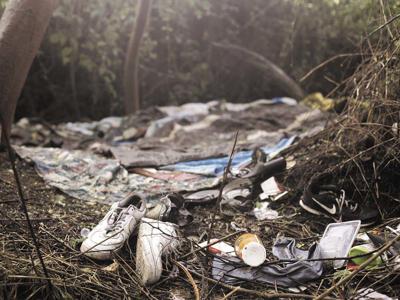

An orange sunrise broke through dense grey clouds on a dreary January morning. It rained the night before and the forest floor, on the east side of Fort Ord behind Assured Aggregates Recycling off Imjin Road, was soaked. “I got a good lead,” says a volunteer. “[An employee] says he hears people behind here.”
And so a three-hour trek in the oak trees to find encampments and count the homeless as part of the 2019 Homeless Census began. It wasn’t just the east side of Fort Ord getting a good comb through – from around 5am-noon, searches were simultaneously happening throughout the county, from South County cities to Prunedale, to residential areas and even remote locations in Big Sur.
“We’ve got to look everywhere,” says Katherine Thoeni, executive officer of the Coalition of Homeless Service Providers. This process, Thoeni explains – mobilizing hundreds of volunteers and law enforcement to search the county high and low – is called enumeration. It’s a simple headcount, but it’s only one of the many moving parts of the Homeless Census.
That’s because the census isn’t just about the number of people who are homeless. It’s also about knowing who they are, where they’re staying and why they are homeless. According to Thoeni, this is done in a separate process; people trained to give surveys do so with several hundred homeless people and apply those statistics proportionally to the population.
In 2017, 654 valid surveys illustrated the demographics and other relevant information of 2,837 homeless people in Monterey County.
The formula is simple on paper, but the fieldwork yields more complications. “There should be more people here,” says the volunteer, who has asked to remain anonymous, pushing their way through the shrubs. “The rain has probably forced more people inside.” Thoeni says that just means the shelter count – the headcount that happens the night before in all local shelters – will be higher. “We collect those numbers from everybody,” she emphasizes. “The numbers re-balance themselves.”
However, the volunteer points out while there was an unprecedented number – 50-plus – of volunteers on the Peninsula, there were only seven guides, or homeless people paid to help search teams navigate to encampments. The volunteer and Thoeni both mention that the lack of shelters on the Peninsula and the concentration of services in Salinas are likely why there are so few this year. “There’s always going to be fewer guides on the Peninsula,” says Thoeni.
But an approximation is as good as any survey on homelessness is going to get, she adds.
The only issue she sees is that enumeration only happens once every other year as a “point-in-time” survey. “The biggest thing is that this is just a snapshot.” Because of the timing, Thoeni says it’s impossible to track migration in-and-out of the county.
Though local shelters collect their own data, she says often their data doesn’t go as in-depth as this countywide survey. “These are the numbers we send to Congress for funding, the numbers that cities use to shape policies,” she says.


(0) comments
Welcome to the discussion.
Log In
Keep it Clean. Please avoid obscene, vulgar, lewd, racist or sexually-oriented language.
PLEASE TURN OFF YOUR CAPS LOCK.
Don't Threaten. Threats of harming another person will not be tolerated.
Be Truthful. Don't knowingly lie about anyone or anything.
Be Nice. No racism, sexism or any sort of -ism that is degrading to another person.
Be Proactive. Use the 'Report' link on each comment to let us know of abusive posts.
Share with Us. We'd love to hear eyewitness accounts, the history behind an article.