
Despite the constant drumbeat of public messaging about not gathering for Thanksgiving – the city of Monterey joined in with a #GiveThanksNotCovid social media campaign – there is an unspoken understanding that not everyone is going to heed the warnings to stay home. By the time the last of the leftovers are gone, Monterey County could see a big spike in cases.
The county is already seeing a rise in cases, up 17 percent from Nov. 1-24, to more than 14,200 cases, according to the Monterey County Health Department. On Nov. 19, the county saw its largest single-day jump yet, 368 confirmed cases, topping the record of 351 cases on Aug. 15.
More troubling is the 64-percent rise in hospitalizations between Nov. 1-23, based on state reporting. The county saw it’s largest number of cases so far, 64, on Nov. 23, 13 of those were in ICUs. (The highest number of ICU patients was 21 on Aug. 8.)
Hospitals have kept up with the pace but after nine months of strain and a possible new surge, administrators are bolstering their planning – representatives of all four Monterey County hospitals say they are ready for whatever happens. At the three largest hospitals – Salinas Valley Memorial, Natividad and Community Hospital of the Monterey Peninsula – teams meet daily to discuss county data, the number of infected patients, medicine supplies, personal protective equipment on hand and other gear. Staff levels are a main focus.
“With what’s happening now with the spike in cases and surge in admissions, staffing is always a concern,” says Carla Spencer, RN, director of the SVMH Emergency Department and the hospital’s Covid-19 operations chief. She says they’ve been proactive by asking part-time staff to work more hours and booking traveling nurses to fill in the gaps. They arranged for more traveling nurses to arrive in mid-December. Natividad Hospital has employed a similar strategy, a spokesperson confirms.
Like all the hospitals, CHOMP has had a surge plan in place since before the pandemic struck and is ready for more patients, says Tim Nylen, vice president and chief compliance officer of Montage Health, which operates the hospital. The plan includes staff members cross trained in different areas in case they are needed to fill in during a crisis.
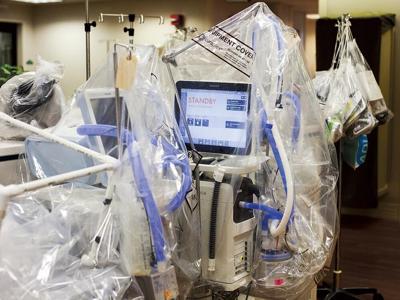
Operating ventilators are included in the surge plan. They require respiratory therapists to operate but the hospital has on staff trained nurses and physicians who could step in. CHOMP has 42 ventilators, although the majority of Covid patients have not needed them, says Montage spokesperson Brenda Moore. (A California Department of Public Health spokesperson says there are just over 130 ventilators among all four hospitals.)
Beyond any possible surges, hospitals are preparing for the coming Covid-19 vaccines. Nylen says as soon as the two vaccines earlier this month were announced – one by Pfizer/BioNTech and another by Moderna – CHOMP formed a team to lay plans to secure government approval for administering them. Montage purchased two ultra-low-temperature freezers for storing the Pfizer vaccine, which needs to be kept at minus 70 degrees for shipping and storage of up to six months. It can be stored in refrigeration units at temperatures of 2-8 degrees for a maximum of five days.


(0) comments
Welcome to the discussion.
Log In
Keep it Clean. Please avoid obscene, vulgar, lewd, racist or sexually-oriented language.
PLEASE TURN OFF YOUR CAPS LOCK.
Don't Threaten. Threats of harming another person will not be tolerated.
Be Truthful. Don't knowingly lie about anyone or anything.
Be Nice. No racism, sexism or any sort of -ism that is degrading to another person.
Be Proactive. Use the 'Report' link on each comment to let us know of abusive posts.
Share with Us. We'd love to hear eyewitness accounts, the history behind an article.