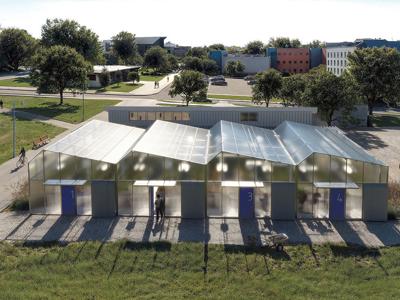

It’s one thing to study agriculture in the classroom, but to really get an idea of how growing and harvesting work, students need to get their hands dirty. CSU Monterey Bay students in the burgeoning agricultural sciences major face logistical challenges getting out into the fields, but in the near future they won’t have to travel far. CSUMB officials are actively planning to add a small farm and greenhouses for hands-on experience and research to not only better train students, but also provide a much-needed research hub for the local ag industry.
“We have the human talent but we don’t have the facilities to train them to the level that they deserve,” says JP Dundore-Arias, assistant professor of plant pathology.
The agricultural plant and soil sciences major program was launched in the fall of 2020 with just seven students. It’s grown to over 130 – many first generation college students – and graduated approximately 70, Dundore-Arias says. It’s one of the fastest-growing majors at CSUMB, according to Thomas Horvath, interim dean of the College of Science.
Many of the students enter the program with a goal of becoming pest control advisors, Dundore-Arias says, but some go on to local positions that range from breeding technicians to greenhouse managers or supervisors. Adding a greenhouse on campus became a major need.
Besides greenhouses, they also knew they needed a modest amount of farmland, starting at around seven acres, to give students a chance to experiment growing and managing crops. They’ve been able to take field trips to farms around Monterey County, but due to time and distance, it’s been a challenge.
“Having the facilities allows [students] to gain the experience and use their education to do whatever they want,” Dundore-Arias says. “They won’t be limited to jobs their family used to have… they’ll be able to create their own pathway to pursue the careers they want.”
A feasibility study to determine a precise location on campus and other details is about 80 percent complete, Horvath says. The current cost estimate is $10 million. They expect it will be financed through donations from local ag companies and grants.
The small farm will also give students and faculty a chance to do research that will benefit the local ag industry, Horvath says. “We need some research spaces, such as greenhouses, for controlled experiments and plots to do experiments and trials to get them to think about systems identical to those in the Salinas Valley.”
Dundore-Arias, himself a plant pathologist, says a farm facility will help him further his own research into pathogens, both harmful and helpful, and find ways to reduce the reliance on pesticides.
The campus farm will also bolster the university’s new mechatronics engineering major launching this fall. Students will learn how to build and use robots in agricultural settings. Once the farm is complete, “we expect they will be able to test robots in real field conditions,” Horvath says.


(0) comments
Welcome to the discussion.
Log In
Keep it Clean. Please avoid obscene, vulgar, lewd, racist or sexually-oriented language.
PLEASE TURN OFF YOUR CAPS LOCK.
Don't Threaten. Threats of harming another person will not be tolerated.
Be Truthful. Don't knowingly lie about anyone or anything.
Be Nice. No racism, sexism or any sort of -ism that is degrading to another person.
Be Proactive. Use the 'Report' link on each comment to let us know of abusive posts.
Share with Us. We'd love to hear eyewitness accounts, the history behind an article.