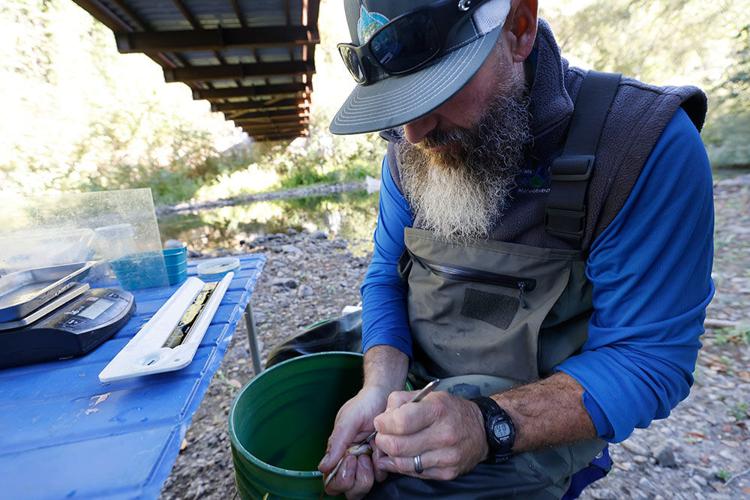


Right: Fisheries biologist Cory Hamilton makes an incision on a juvenile fish to insert a tagging chip.
Just past 9am on a mid-October weekday, a small team of employees from the Monterey Peninsula Water Management District begin staging equipment along a stretch of the Carmel River, just upstream of the district’s Sleepy Hollow Steelhead Rearing Facility.
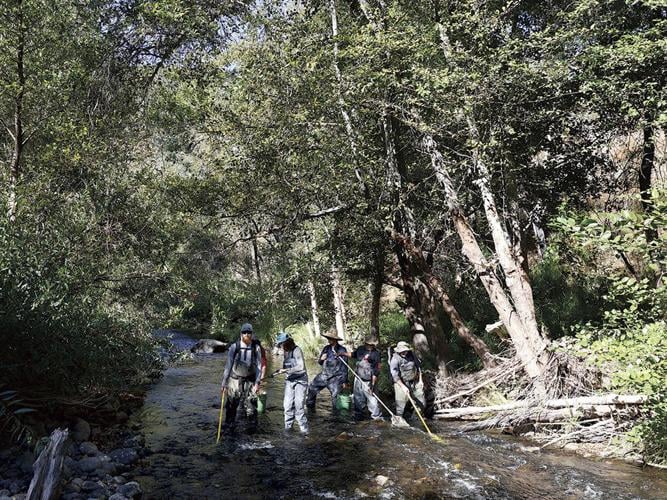
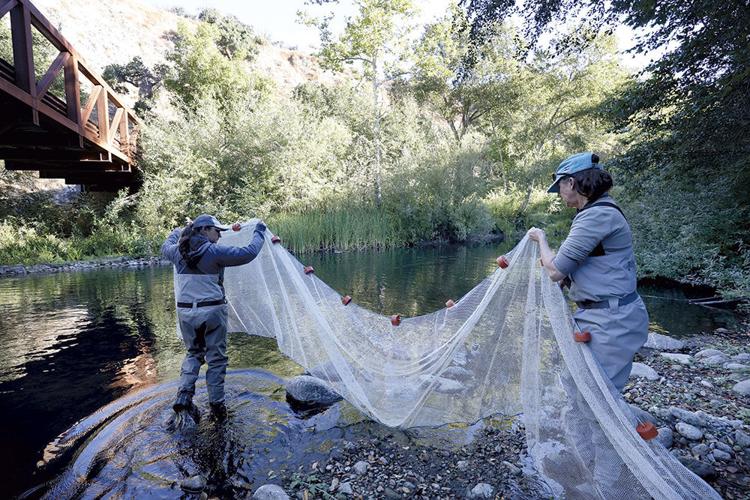
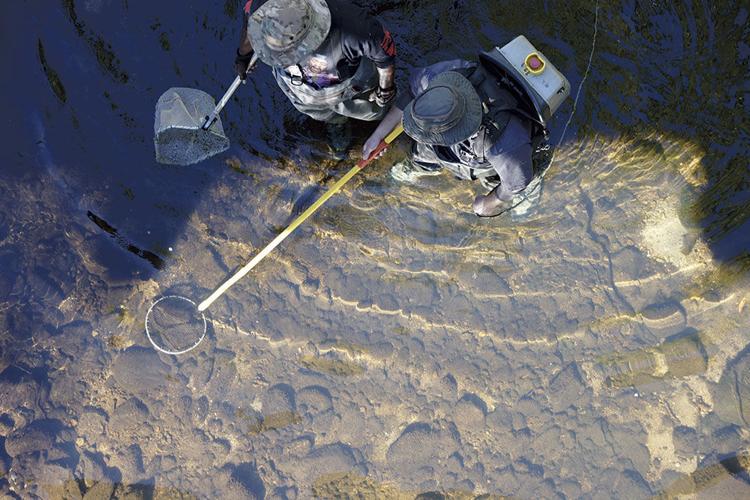
The team strings two nets across the river about 300 feet apart, and then two groups of three wade into the river and begin working their way upstream. One member of each group holds an electrofisher, which stuns the steelhead out of the nooks and crannies they like to hang out in. They are trailed by another member carrying a net to scoop up the stunned fish, who in turn is being trailed by someone carrying a bucket to hold the captured fish.

In two teams of three, Monterey Peninsula Water Management District employees walk up the Carmel River on Tuesday, Oct. 17 to capture juvenile steelhead to be weighed, measured and tagged.
Once a bucket starts to fill up, it’s traded out and brought to a small folding table set on the bank near the upstream net. Seated at the table is Cory Hamilton, one of the district’s three fisheries biologists, who – one by one – starts pulling the fish out of the bucket.
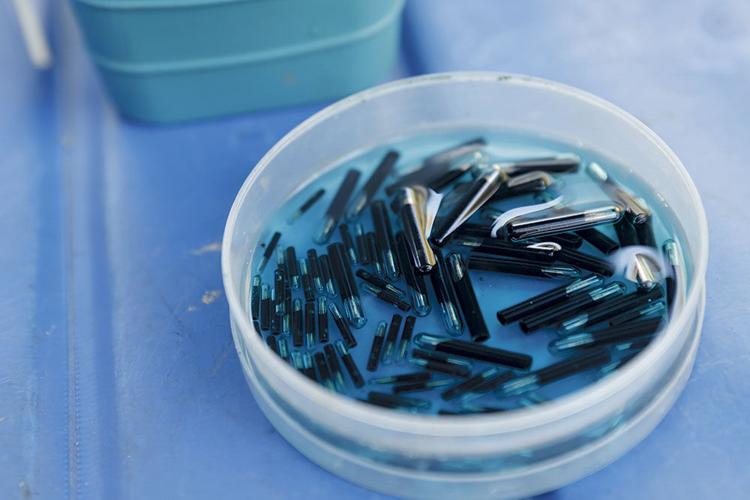
The fish are recently spawned juveniles, and the morning’s count is one of about 10 the district carries out in October at various sites along the river. On the table next to Hamilton is a tray that holds small tagging chips, which look like gel-cap pills, of two different sizes. Hamilton weighs and measures each fish – a technician sitting across from him enters the data – and he holds them over a sensor to see if they’ve already been tagged. If not, he takes a chip from the tray and holds it over the sensor so it’s logged into the system, then he effortlessly uses a scalpel to cut a small slit on the fish’s belly and inserts the chip. The fish then goes into another bucket to be released when the counting is over.
Counting juvenile steelhead every fall is one of the primary ways MPWMD biologists gather data about the steelhead, a threatened species whose decline in the Carmel River became a driving catalyst behind the state’s cease-and-desist order against Cal Am for the utility’s decades-long overpumping.

The tags that are inserted, through a slight incision, into the captured juveniles’ bellies. The bigger tags are for fish that measure above 100 millimeters.
The district assesses the river’s steelhead population other ways too, but this year they were a wash, literally. Hamilton and others set up weirs – traps – in the lower river to capture adults and tag them, and arrays of wire set up under the water in places that capture the signal of tagged fish as they swim by, but all the equipment got blown out by last winter’s atmospheric rivers. (They have since been replaced.)
Biologists also walk in the river and count steelhead nests, called redds, but were unable to do so for much of this year because the flow was too high to wade into during the months that count. So for 2023, the most useful data set will be the count of juveniles, and Hamilton says a good number riverwide is about one juvenile steelhead per foot. This year at Sleepy Hollow the fish numbered about 1.18 per foot, but riverwide the count was about 0.8 juveniles per foot (anything above 0.75, Hamilton says, is solid).

MPWMD staff preparing one of two nets along a 300-foot-long stretch of the Carmel River to box in juvenile steelhead for capture and tagging.
That number – 0.8 steelhead per linear foot of the river – will be presented to the MPWMD board at a Nov. 20 meeting, and be rolled into an annual report the district publishes in April.
Over the long term, steelhead numbers in the Carmel are on a downward trend. That is expected to continue, Hamilton says, as climate change continues warming the ocean and, locally, leading to more extreme droughts – just around 1 to 2 percent of steelhead that make the trip out to sea successfully return to spawn, and the number of steelhead in the system ebbs and flows based on how much water is in the river. In times of drought, there are fewer places for spawning and for juveniles to mature, which has an effect in later years – even wet ones – in how many adults return to spawn.
“Droughts put a big hiccup in a steelhead’s life cycle,” Hamilton says. To that end, though, last winter was a good one: Hamilton says it saw the seventh-highest rainfall total on the river since 1902, and fourth-highest in terms of runoff. “In big years, when the river is completely functioning and nothing is drying up, all the conditions are right for fish to be prosperous,” he says. “Fish need water.”
Even with the Carmel River being pumped at the lowest levels in decades, the long-term outlook for the fish is precarious due to climate change. “It’s very dynamic,” Hamilton says of the variables impacting steelhead. “A lot of things have to play in their favor.”

Left: MPWMD staff use an electrofisher, which briefly stuns fish, to bring them from their hiding places to be scooped up in a net.
Until the next drought, though, the steelhead numbers are expected to continue ticking up. But long term, as we continue carbon-loading the atmosphere, the species will remain on life support.



(1) comment
In the summer months, our Carmel River Steelhead Association (https://www.carmelsteelhead.org/) rescues steelhead fry in the Carmel River as it dries up due to overpumping for habitation and golf-course usage. Using electroshock, we stun the fry, scoop them up, and relocate them to the lagoon where they can thrive. We also hand-carry older steelhead over the sandbar and release them in the sea. Without those efforts, it's likely the steelhead would have already been done in. It's a great thrill to carry a large steelhead from the lagoon and release it to the sea. We should implement more water conservation using dryscape for large sections of golfcourses and housing landscape, to assist in this effort.
Welcome to the discussion.
Log In
Keep it Clean. Please avoid obscene, vulgar, lewd, racist or sexually-oriented language.
PLEASE TURN OFF YOUR CAPS LOCK.
Don't Threaten. Threats of harming another person will not be tolerated.
Be Truthful. Don't knowingly lie about anyone or anything.
Be Nice. No racism, sexism or any sort of -ism that is degrading to another person.
Be Proactive. Use the 'Report' link on each comment to let us know of abusive posts.
Share with Us. We'd love to hear eyewitness accounts, the history behind an article.