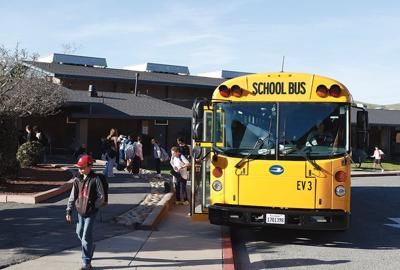

While the state’s proposed funding for K-12 education has reached record levels for the upcoming school year, $125.5 billion for schools and community colleges, many school districts are projecting red balances in the near future.
One-time funding, declining enrollment and increased costs are putting a strain on their budgets.
“We’re losing revenue year after year,” says Monterey Peninsula Unified School District Superintendent PK Diffenbaugh, noting the district loses 50-70 students every year, and the district is funded by the state based on attendance.
Keeping the same level of services and personnel would put MPUSD below the requirement of having 3 percent of its expenditures in reserves, as required by the state, within the next three or four years.
To prevent this, Diffenbaugh proposed a first draft of a plan for $4 million cuts on Tuesday, Jan. 27 to the MPUSD board. It calls for the elimination or reduction of 42 full-time positions, including cutting 4.6 school psychologists and nine mental health professionals. The board is scheduled to vote on the proposed staffing reductions on Feb. 24.
According to the Monterey County Office of Education, out of the 24 school districts in Monterey County, only four – Carmel Unified, Salinas City Elementary, South Monterey County Joint Union High and Washington Union School District – are not facing a deficit in the 2025-2026 school year. (WUSD’s net positive is just $12,333.)
The three districts with the highest projected deficits are Alisal Union ($40.5 million), Salinas Union High ($29.8 million) and MPUSD ($13.7 million).
To address the shortfalls, leaders are making tough decisions. Salinas City Elementary School District decided to pause inter-district transfers, meaning they no longer release students in their jurisdiction to attend school in other districts, unless it is required by education code (for reasons such as victims of bullying or maximum capacity).
Last year, Pajaro Valley Unified School District’s board approved cutting 160 positions, including teachers, counselors and special education assistants.
Washington Union’s board decided to shrink the number of students, meaning its funding model shifts from state reimbursement to property taxes (joining the only two local districts, Carmel and Pacific Grove Unified, that are funded by property taxes). To get there, the district is phasing out its interdistrict transfer program, which accounts for 44 percent of its enrollment, or 327 students.
The end result will mean more money per child at WUSD. During the 2023-24 school year the district spent $11,300 per pupil, the lowest in the county; with the new funding method its spending would be similar to districts in South County, about $15,600.
“It’s a very difficult decision. Obviously it has huge impacts to our school community, but if we’re going to be able to sustain this district financially over the long term it was a necessary step,” WUSD Superintendent Gina Uccelli says.
Interdistrict transfer students who are currently enrolled will be able to remain at Washington Union through the highest grade available at their current school, meaning third, fifth or eighth grade.


(0) comments
Welcome to the discussion.
Log In
Keep it Clean. Please avoid obscene, vulgar, lewd, racist or sexually-oriented language.
PLEASE TURN OFF YOUR CAPS LOCK.
Don't Threaten. Threats of harming another person will not be tolerated.
Be Truthful. Don't knowingly lie about anyone or anything.
Be Nice. No racism, sexism or any sort of -ism that is degrading to another person.
Be Proactive. Use the 'Report' link on each comment to let us know of abusive posts.
Share with Us. We'd love to hear eyewitness accounts, the history behind an article.