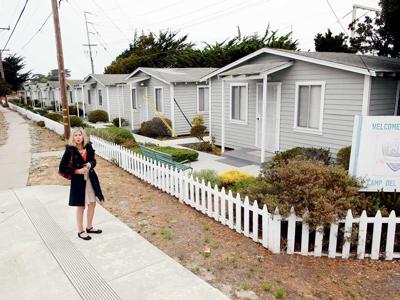

To help alleviate the region’s worsening housing crisis, Seaside City Manager Craig Malin is not just thinking big, he’s thinking small. Tiny, in fact.
On Aug. 10, the city will host a daylong charette at the city’s economic development office to explore the possibility of one or more tiny home developments in Seaside, which would aim to both make home ownership more affordable, and to help the homeless.
Malin is modeling his idea after the “one for one” business concept employed by Toms, a Los Angeles-based shoe company that, for every pair of shoes sold, gives a pair of shoes away to a child in need. The vision in Seaside is that when someone purchases a tiny home for themselves, they also purchase a tiny home for a homeless person.
“The diversity of the Seaside community demands creativity in housing,” Malin says, “so let’s give it a shot.”
Roughly, the idea is this: identify a location in one or more places – either urban infill, non-forested or semi-forested – and build a small community. The key, Malin says, is affordability, and to that end, he thinks shipping containers are the ideal building block.
“You could put two or three or four together for a larger house, and stack them in architecturally interesting ways,” Malin says, adding that he thinks the additional cost of buying a single container home for a homeless person could be as low as $50,000. “I don’t see why that’s not workable.”
The idea is purely conceptual at this point, as no locations, or water supply, have yet been figured out. But the city does have a leg up on one aspect: money.
Seaside has about $5 million set aside in an affordable housing fund, and Deputy City Manager Daphne Hodgson says it will grow by an additional $1.5 million in the next two years when some loan repayments come due.
Additionally, the city’s short-term rental ordinance went into effect Aug. 1, and thanks to a push by Councilmember Kayla Jones – who raised concerns about the negative impact short-term rentals have on housing availability – 50 percent of the transient-occupancy tax generated by short-term rentals will also go into the fund.
Malin’s enthusiasm for the idea is rooted, in part, in his own experience. He says the first home he bought in Illinois was about 1,300 square feet, and his current abode in Carmel Valley (which he refers to as a “shack”) is about 12-by-14 feet.
Whether or not the “live one, give one” idea pans out, Malin at least wants to start the conversation. “You’ve got to let the idea breathe,” he says.



(2) comments
Seaside City and its residents have tried so hard over the years to improve the desirability of the city. How does giving free tiny homes to homeless people help improve the city? How about giving some free stuff to our schools? How about using the funds to whack the weeds that are infesting Seaside's streets?
My home is on Hamilton Avenue in Seaside. We have a homeless problem in our alley. We find syringes. Homeless people toss bags of excrement over the fence into our backyards.
I met one of these homeless people, because we found this random guy sleeping in our guest house one day - my mistake for leaving the window unlatched. When the cops arrived, I asked the police officers to "take it easy" on this guy. I even had a conversation with the homeless guy and took his number so that I could check on him later. Alas, after he left, I found a syringe in my guest house's bathroom. He acted like the whole ordeal was no big deal. The cops knew him from prior infractions.
In my conversation with this guy, I found that his family lived nearby. Obviously, they couldn't stand his drug use and lifestyle, so they let him live on the street.
I also see other homeless people panhandling for money near Home Depot. Incidentally, they ask drivers for money only 50 feet away from highly motivated day laborers who are eagerly waiting for homeowners to offer payment for hard, labor-intensive work.
I find it jarring to see the panhandlers literally just steps away from the day laborers who work all day in the sun to make $20 per hour.
My point is that hard-working people often assume that homeless people fell haplessly through the cracks. From what I have seen, it is usually not true. I have seen the crack addicts. I have seen the people who panhandle for money only steps away from motivated people at Home Depot who are eagerly looking for hard work that pays decently well.
The proportion of addicts, drug abusers and complacent personalities is very high in the homeless population. Let's try not to fool ourselves into thinking that giving someone free stuff will motivate them into doing the life planning and work that leads to earning that stuff.
This social engineering experiment will bring more crime and drugs into our community.
It's great to see our economic development team move Seaside forward with such energy, expertise and vision. Can you tell us the starting and ending times for the Aug. 10th charette in Seaside?
Welcome to the discussion.
Log In
Keep it Clean. Please avoid obscene, vulgar, lewd, racist or sexually-oriented language.
PLEASE TURN OFF YOUR CAPS LOCK.
Don't Threaten. Threats of harming another person will not be tolerated.
Be Truthful. Don't knowingly lie about anyone or anything.
Be Nice. No racism, sexism or any sort of -ism that is degrading to another person.
Be Proactive. Use the 'Report' link on each comment to let us know of abusive posts.
Share with Us. We'd love to hear eyewitness accounts, the history behind an article.