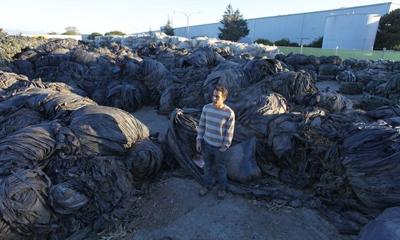
On the surface, it sounds like a green dream: take all of California’s ag plastic – the sheeting that covers the ground or drapes over plants on farms – and divert it from the landfill, recycle it, create local manufacturing jobs and save businesses money.
Encore Recycling, which kicked off operations in Salinas this last November, is doing all of those things. But local greens are crying foul, and see an underlying agenda to skirt bag bans and keep disposable plastic shopping bags king.
If Encore was taking all that ag plastic and recycling it back into ag plastic, local greens would be cheering, says Matthew Speigl of Sustainable Salinas, who runs that group’s “Bring your own bag” campaign. But Encore plans to turn them into a trademarked product called smarterbags, which are thicker than regular plastic bags and can be reused dozens of times.
“We don’t need them taking that plastic and making bags,” Spiegl says. “It’s an unnecessary product.”
Encore’s parent company, Vernon-based Command Packaging, is a plastic bag manufacturer, and Peter Grande, who is CEO of both, sees things differently.
Grande says nearly all reusable plastic bags are currently imported from China, which he sees as a missed opportunity.
“We’re the first in North America, as far as we know, to recycle ag plastic,” Grande says. “Our goal is to take 150 million tons of ag plastic annually and turn it into reusable bags, diverting it from the landfill.” 150 million tons is how much ag plastic is laid over California’s fields every year.
“It’s recycling with a purpose,” he says.
Spiegl thinks that purpose is to maintain the status quo of grocery stores handing out plastic bags, as smarterbags are “bag-ban compliant,” meaning that they’re at least 2.25 mm thick, and able to carry 20 pounds at least 100 times – the minimum requirements of most bag bans across California.
“Grande acknowledges they should be available at the same fee as a paper bag,” Spiegl says. “Their business model won’t work if people actually reuse these bags.”
Grande says that smarterbags aren’t available locally just yet, but he is in negotiations with grocers. He also has plans for Encore to ramp up: They’ve already hired 20 local employees, and hope to reach 40 soon.
And while currently Encore’s facility only creates plastic pellets that are then shipped to Vernon, he hopes to set up a manufacturing facility in Salinas.
“So far the employees we’ve hired are terrific,” Grande says. “They’re focused on making a difference. They see how this all fits together.”


(2) comments
This firm hires temp workers thru a local employment agency and promises full time work after 3 months probation. They just recently "laid off" a bunch of workers, some just shy of 3 months---with the reason being they are closing to add new equipment. The temp agency let the workers know they day before they were due to come in and of course those workers have no benefits, are now jobless and will have to reapply should this company re-open. Beware of Encore employment practices.
The reason Monterey County is working so hard to pass bans on plastic bags is because they are harmful to the environment, injure wildlife, are a litter problem and are unnecessary and easily replaced by reusable bags. True reusable bags are bags that shoppers bring from their home, put in their trunk, and bring into the store with them. These bags do not tend to end up as litter. The so-called reusable bags that Encore is planning to make are just 2.25 mm thick. These will be distributed at check out and do you know how many shoppers are bringing these bags back to the store to use again? Practically none. We know because we have counted shoppers and we can count on one hand how many times these 2.25 mm bags are reused. We don't need more plastic bags in the county that borders the Monterey Bay National Marine Sanctuary. This is the sanctuary that houses the largest population of Southern Sea Otters. This brings a huge tourist economy to our area every year. We are jeopardizing this economic advantage if we now have to worry that baby otters will get trapped in slightly thicker plastic bags.
Welcome to the discussion.
Log In
Keep it Clean. Please avoid obscene, vulgar, lewd, racist or sexually-oriented language.
PLEASE TURN OFF YOUR CAPS LOCK.
Don't Threaten. Threats of harming another person will not be tolerated.
Be Truthful. Don't knowingly lie about anyone or anything.
Be Nice. No racism, sexism or any sort of -ism that is degrading to another person.
Be Proactive. Use the 'Report' link on each comment to let us know of abusive posts.
Share with Us. We'd love to hear eyewitness accounts, the history behind an article.