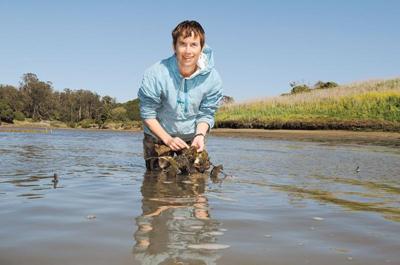
The gaper and butter clam shells discarded by feasting sea otters could be considered raw material for boho jewelry. But the clam-shell necklaces strung up around the Elkhorn Slough National Estuarine Research Reserve aren’t for people; they’re for oysters.
Kerstin Wasson, research coordinator for the reserve, says Elkhorn’s native Olympia oyster population has been decimated by poor water quality, burial by sediment and competition from invaders such as sponges and tubeworms.
In 2007, she estimated the slough’s oyster population at about 5,000, low enough to place it at risk of local extinction. She set a goal to double it.
Improving the estuary’s water quality and removing invasives could take decades. But in the short term, Wasson figured she could help keep the oysters from getting buried in the mud.
Oyster larvae float around for a while, then cement themselves to hard surfaces. If they were offered broad substrates off the estuary floor, she reasoned, they might fare better.
Last summer, Wasson and her team strung 60 shell necklaces between rebar, creating modular oyster reefs. In December, they counted an average of 54 oysters per clam-shell necklace. This summer, the team plans to deploy another 60 necklaces, with help from volunteers and a $95,000 grant from the California Department of Fish and Wildlife.
They’ll also experiment with “reef balls,” which Wasson describes as “little apartment buildings for oysters.”
Olympias, the only true oysters native to the North American Pacific coast, are tiny and reportedly tasty; experts believe they were part of the local Native American diet. But most Elkhorn oysters are protected, Wasson says, and the poor water quality probably makes them unsafe to eat. “They’re rare enough you’d spend a long time getting a dinner plate’s worth,” she adds.
Wasson’s collaborator, Smithsonian Environmental Research Center ecologist Chela Zabin, sees another potential benefit to restoring Elkhorn’s Olympias. The question of whether oyster larvae travel between estuaries is still unanswered, she says – but if they do, Elkhorn may be a critical stepping stone for genetic exchange between populations in San Francisco Bay to the north and Mugu Lagoon, near Oxnard, to the south.
Michael Beck, lead marine scientist for The Nature Conservancy, says 99 percent of oyster reefs on the North American West Coast have been lost since the 1880s. The good news: “We actually know a great deal about how to restore them,” he says.
Beck says the filter-feeders improve water quality, provide habitat and, in some cases, reduce shoreline erosion.“If we want clean oysters,” he says, “we have to actually clean up the bay.”




(0) comments
Welcome to the discussion.
Log In
Keep it Clean. Please avoid obscene, vulgar, lewd, racist or sexually-oriented language.
PLEASE TURN OFF YOUR CAPS LOCK.
Don't Threaten. Threats of harming another person will not be tolerated.
Be Truthful. Don't knowingly lie about anyone or anything.
Be Nice. No racism, sexism or any sort of -ism that is degrading to another person.
Be Proactive. Use the 'Report' link on each comment to let us know of abusive posts.
Share with Us. We'd love to hear eyewitness accounts, the history behind an article.