
At noon on Saturday, Sept. 7, Gordon Smith did recon on Mary Ann Leffel’s house in the Monterey hills. The Vietnam veteran’s mission: to serve her with a notice to appear in court the following Monday.
They have different versions of what happened next.
As Leffel tells it: Smith spotted Mary Ann’s husband, Hal, chatting with a neighbor in the driveway. Smith slapped the papers down and told the woman she’d been served, to which Hal responded, “That’s not my wife.”
As Smith tells it: He marched up to the door and saw Hal working on his truck. Smith bellowed “Hello” a few times before dropping the papers in Leffel’s entryway. To prove it, he produces photos of a manila envelope lying on a Persian runner rug and an email from Leffel to the lawyer suing her, acknowledging receipt of the notice.
But Leffel didn’t show up for the hearing in Monterey County Superior Court. Only her lawyer did.
The lawsuit had been filed by Smith’s comrades at the Fort Ord Access Alliance, backers of Measure M, the Fort Ord open-space initiative on the November countywide ballot. The Access Alliance alleged the voter-pamphlet arguments Leffel, president of the Monterey County Business Council, had authored against M and for Measure K – the opposing pro-business initiative submitted by Secure the Promise – were bogus.
But Judge Thomas Wills tossed the case because Leffel had never been served the lawsuit itself. Since the hearing butted right up against the County Elections Department’s deadline to send voter materials to the printer, Leffel’s arguments were left unrevised. Many Access supporters, including Smith, were convinced she’d ducked service of the legal papers on purpose.
They circulated a Facebook post from a supporter claiming to have overheard Measure K cronies on a flight to San Diego the week before, calling Measure M organizers mean names and talking about their trip to see the horse races at Santa Anita.
One Measure M backer speculated Leffel was hiding in the San Diego beach house of Monterey Downs developer Brian Boudreau, who’s proposing a mammoth Fort Ord equestrian-themed project that Measure M would block and Measure K would encourage.
Despite the fact Monterey Downs has almost entirely funded the Measure K campaign so far, it’s a theory without evidence. Leffel laughingly denies she was at Boudreau’s pad.
Smith says he returned to Leffel’s house a half-dozen times over the following week to try to serve her the lawsuit, but the blinds were always drawn tight. (He has photos of that.) He waited for her at Sept. 11 and 12 meetings of two boards she sits on, but she was MIA. (He has photos of that, too.)
She didn’t start showing her face in public, Smith says, until Access attorney Mark Wolfe, whose firm also represents pro-Measure M group LandWatch, called off the other process server who’d visited Leffel’s home eight times. “I do believe she was deliberately evading service,” Wolfe writes by email, “but obviously can’t prove her intent.”
Leffel laughs at that too. She was here in Monterey County the whole time, she says, going about her high-profile business as usual and returning at night to her home. The process servers might have had trouble finding her, she adds with a shrug, because a recent DUI has her catching rides instead of driving.
And that, in one nutty nutshell, is how ridiculous the fight over land use on 540 acres of the former Fort Ord has become.

With vote-by-mail ballots going out Monday, the M-vs.-K bickering has gotten shrill. Each side accuses the other of generating distractions, obfuscations and lies. So let’s look first at the dueling measures and what they do, drawing from public documents and with a major assist from FORA Senior Planner Jonathan Garcia.
Measure M creates more protected open space and blocks uses such as horse racing, residential building and commercial development on four parcels totaling about 540 acres on northwest Fort Ord. It won’t let land-use jurisdictions like the city of Seaside, which is planning to annex a good chunk of the land in question, change the provisions in the initiative without a vote of the people.
Measure K allows mixed commercial and residential development on most of those same parcels. But unlike M, it lets affected agencies – the Fort Ord Reuse Authority (FORA), the county, the cities of Seaside and Marina – change the land uses enacted under the initiative. If both Measures M and K get a majority of the vote, the more popular one wins.
The picture gets fuzzier zooming in.
Both measures seek to amend the existing Fort Ord Base Reuse Plan – and the language describing those changes isn’t entirely clear, even to attorneys who have studied it.
But if the lawsuits to date are any indication, the full ramifications of the two measures are subject to interpretation – which can be more politics than fact. In other words, if either one passes, it will probably fall on the courts to decide exactly what it means.
~ ~ ~
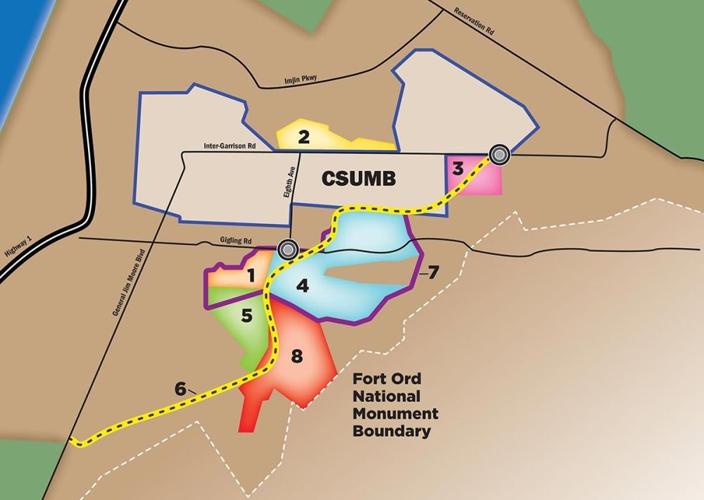
[1] SEASIDE COMMUNITY PARK
These 50 acres, south of Gigling Road at 7th Avenue in Seaside, were slated in the Base Reuse Plan for a community park. The 2004 city General Plan rezoned it as high-density residential.
Measure M would revert this parcel to its original use as a community park.
Measure K would designate it as mixed use, including “equestrian-oriented event centers, entertainment, hotels, office and cultural uses and neighborhood shopping opportunities.”
[2] WHISPERING OAKS
This former landfill site, north of Inter-Garrison Road bordering Marina, gained a high profile when activists successfully blocked plans to turn the wooded 50 acres into a business park and bus yard. The county supervisors lifted the parcel’s heavy commercial zoning. But the county now considers it an asset of the redevelopment successor agency, and it could still be put out to bid for development. It’s currently designated as county office and research space.
Both measures M and K would preserve the parcel for recreation and open space.
[3] MARINA COMMUNITY PARK
The unincorporated 70-acre parcel south of Inter-Garrison Road, at a Fort Ord National Monument access point, was historically zoned for a Marina park.
But about 10 years ago the city traded the parcel to the county, which had initially considered it for a potential school site. County staff later added the word “business” in front of “park,” potentially opening the parcel to heavier uses.
Measure M would preserve it for recreational use.
Measure K would also preserve it for recreation, while expressly permitting the realignment of the future Eastside Parkway through it.
[4] EUCALYPTUS ROAD PLANNING AREA
This is the big one. These former Army training grounds, also known as Parker Flats, include unincorporated land off the Gigling Road and 8th Avenue trailheads on the west side of Fort Ord, near the Seaside/Marina border. It’s a popular recreational area for hikers, bikers and equestrians, and also part of the proposed Monterey Downs development.
Measure M would preserve 373 acres of this area as open space and recreation, including access to the Fort Ord National Monument, centralized equestrian facilities and up to 3 acres for parking. About 84 acres would be reserved for a Monterey-Salinas Transit Center and various U.S. Army uses. One acre would support retail-serving outdoor recreation.
Measure M would also delete designations for a residential district and a light-industrial business park called a “university corporate center.” It would expressly prohibit golf, horse racing and fee-for-entry spectator arenas.
The scope of those changes is unclear. Measure M leaders say they would only affect the 373 acres in their map. But FORA planner Garcia says the initiative is written in such a way that it could delete 520 acres of residential, 209 acres of light-industrial, and other land uses totaling 1,300 acres.
One parcel Measure M does not mention is the Monterey Horse Park, a 110-acre piece of Parker Flats where equestrian enthusiasts hope to build horse training and competition facilities. A nonprofit has advocated for that vision since 2001, when the horse park was part of the failed 2012 San Francisco Olympics bid. Monterey Downs (see below) is currently acting as the Monterey Horse Park developer.
Measure K, like Measure M, would delete the light-industrial and residential districts from Parker Flats. But unlike M, it would replace those designations with a mixed-use village district including event centers, housing, parks, hotels, offices and retail.
The Promise initiative would also set aside land for wildlife habitat and direct the county to work with the Monterey Horse Park developers – that’s Monterey Downs – to build a cross-country course.
[5] VETERANS CEMETERY
This is another fat, hairy, complicated element of the M-vs.-K dukeout.
The 178-acre parcel straddles the city of Seaside and the county. Eighty-four of those acres are being transferred to the state of California for a future veterans cemetery. A 48-acre southern portion is designated for development and habitat, and a 31-acre northern portion is an endowment parcel Seaside can sell for development, with the proceeds earmarked for the cemetery.
Measure M would not alter the land uses of any of these parcels. Initiative coauthor Jason Campbell says he and the Access Alliance absolutely support the cemetery – though fellow Measure M coauthor Michael Salerno is spokesman of a separate group, Keep Fort Ord Wild, that has publicly questioned the cemetery’s location as environmentally unsuitable.
Promise supporters, however, argue that if Measure M prevents development to the cemetery’s north and northeast, there will be no developer fees to pay for improvements to a quarter-mile of road needed under the federal Americans with Disabilities Act.
Measure K would establish a Veterans Cemetery District straddling Seaside and the county, including an endowment parcel with residential units. It would also indirectly support Monterey Downs’ plan to buy the endowment parcel from the city of Seaside for about $1.5 million and build housing on it.
Promise supporters worry future cemetery buildout will stall if the Access initiative scares off Monterey Downs or another developer from buying the endowment parcel. Access supporter Gordon Smith’s offer to raise money for the parcel was rejected by Seaside and FORA officials. But State Sen. Bill Monning, D-Carmel, effectively de-linked the cemetery’s fate from the Downs endowment deal by securing $1.5 million from the state instead.
However, the sale of the endowment parcel – to Monterey Downs or anyone else – was never on track to happen in time for this year’s application for federal cemetery funding. In other words, the cemetery (which has been scaled back to a 10-acre columbarium, or a building for interment of cremated remains, in the first phase) can move forward with or without the Downs deal and regardless of the fates of Measures M and K.
The most pressing hurdle cemetery proponents face is a $2.6 million funding gap they’ll have to close fast. A blue-ribbon panel led by Carmel Mayor Jason Burnett and Monterey County Assistant District Attorney Jimmy Panetta is scrambling to convince donors to write large checks to help. Monning, meanwhile, has introduced state legislation seeking another $1 million for cemetery funding.
[6] EASTSIDE PARKWAY
This is a proposed road running east-west through the northern third of Fort Ord, from Parker Flats to East Garrison, to support anticipated population growth and development.
Measure M doesn’t address it. But Secure the Promise supporter Leffel says the initiative would cut the parkway in three places, creating traffic-mitigation hurdles that could block proposed developments all around north Fort Ord.
“Absolutely everything will be able to be stopped if you cannot mitigate the traffic,” she says. “It’s very clever.”
Access leader Campbell counters that the initiative’s open-space designations don’t block road improvements or new roads, including Eastside Parkway. FORA hasn’t even confirmed the road’s alignment yet.
Measure K would strengthen language in the Base Reuse Plan to encourage the Eastside Parkway.
[7] MONTEREY DOWNS
The highly controversial, 550-acre, $750-million proposal is, in a sense, at the core of this ballot battle, though it never appears in either initiative by name.
The proposal includes a 1-mile racetrack with a 1,500-seat grandstand, a 5,000-seat sports arena, a 115-acre horse park, trails and open space, two hotels, an office complex, a tennis and swim center, a veterinarian clinic, a pedestrian commercial center and 1,528 homes.
Measure M would most likely kill Downs by designating much of its proposed site as open space and recreation.
Measure K would not approve or fast-track the Downs proposal, but it would allow it to keep moving through the regulatory process. The initiative states that among the projected recreational land uses in 250 acres of the Parker Flats mixed-village district are “trails and staging areas, equestrian centers, a thoroughbred racing facility, a sports arena and affordable workforce lodging units” – language Access supporters read as explicitly pro-Downs.
But Promise supporter Sid Williams stresses Measure K is not about supporting Downs per se: “[It’s] about preserving the opportunity to develop there.”
The Promise team’s claim of independence from Monterey Downs is compromised by some sticky associations. One, the developers have funded 90 percent of the Measure K campaign so far, according to campaign finance reports. Two, company attorney James Sutton represented Promise leader James Bogan in his legal challenge to the Access initiative, and Monterey Downs Managing Partner Brian Boudreau appeared at the court hearing.
Promise supporters note Monterey Downs could very well die in the permitting and approval process – or due to a lack of available water credits from the city of Seaside. All water for future Fort Ord buildout is serviced by Marina Coast Water District, which last week requested 2,400 acre-feet of Salinas River surface water from the county.
With Marina Coast’s desalination ambitions stalled, however, the latest calculations show there just isn’t enough water for Monterey Downs – or any other Parker Flats development of its scale.
Leffel, however, isn’t worried about that. She says it will take more than 40 years for Fort Ord to realize its full buildout. New water sources are sure to come online over that time, she says: “If you can have water in Abu Dhabi, there is definitely a way to provide enough water for what this community wants to do.”
[8] EMERGENCY VEHICLES OPERATIONS COURSE (EVOC)
This parcel will be owned by Monterey Peninsula College (MPC), which plans to build a high-speed vehicle training facility for police and fire operations.
Measure M doesn’t touch the EVOC, instead focusing on two unaffiliated parcels to the north. But some Promise leaders, like Leffel, say the Access measure’s open-space restrictions could be interpreted to include the EVOC (see description of Eucalyptus Road Planning Area, p. 20). Others, like Sid Williams of the Veterans Council, say Measure M indirectly quashes the EVOC by cutting off road access to it – an interpretation Access leaders vehemently dispute.
Measure K includes the EVOC in its “habitat management and education district” within the Eucalyptus Road Planning Area. Promise mailers say Measure K would allow the EVOC to be built, while Measure M would stop it.
MPC President Walt Tribley isn’t sure who’s right. “The actual impact on the college’s plans to develop public safety training facilities in Parker Flats,” he writes in a statement, “is uncertain and may ultimately require interpretation by a court.”
~ ~ ~
Among the most compelling arguments for Measure M: That it would preserve some of Fort Ord’s rarest habitat. It’s where countless numbers of hikers, bikers and horseback riders enjoy Fort Ord’s “Happy Trails,” a long-standing network of paths connecting the beach to the Fort Ord National Monument.
Access folks say Seaside has the fewest open-space acres per capita in the region. Fort Ord’s northwest corner offers, in the Facebooked words of Access coauthor Luana Conley, “an easily accessible wildland experience in the heart of Monterey Bay that is poised to become a valuable enhancement to our hospitality sector.”
Measure M would essentially block not just Monterey Downs, but any heavy development on the four parcels in the initiative. Access leaders say that’s a good thing for the community: “Recreation drives economy,” Campbell says.
They argue developers should build on Marina’s stagnant paved acres, the legacy of Fort Ord’s closure almost 20 years ago, before bulldozing oak woodlands. “It’s up to the public to push development into blighted areas and preserve our dwindling open space,” Conley writes.
That’s the primary concern of LandWatch Monterey County, which has endorsed Measure M. LandWatch Executive Director Amy White notes the thousands of approved but unconstructed residential and commercial units on Fort Ord. “Those projects should move forward first,” she says.
She says it’s especially unfair for the county to pursue heavy housing on Parker Flats in light of a 2005 deal to lay off. The land-swap agreement eliminates residential development on the 1,200 acres for Parker Flats, where Monterey Downs is proposed, in order to go heavy on the East Garrison housing project to the east.
Attorney Mark Wolfe, however, suggests the agreement – which hasn’t been incorporated into the Base Reuse Plan – would be hard to enforce in court.
Gordon Smith says elected officials have no intimacy with the land under debate, not in the way Fort Ord hikers, bikers and equestrians do. “We have spoken up, and we’ve fallen on deaf ears with these agencies,” he says. “They may as well be planning developments on Mars.”
Particularly enraging to him is the prominence of veterans on the K side of this battle. Smith – former Air Force mission controller, past commander of VFW 5888, cofounder of Veterans for Peace and founder of Veterans Wild Fort Ord – says the developers and politicians behind Monterey Downs are exploiting some local veterans who desperately want the widely supported, long-awaited but cash-strapped cemetery to be built.
The cemetery has already been scaled back, at least for the near future, from Arlington-style burials to the columbarium on one-eighth the acreage. Smith says its fate, despite Promise claims to the contrary, has absolutely nothing to do with Measure M.
~ ~ ~
On the other hand:
When the feds closed the Fort Ord Army base in the mid-1990s, local jurisdictions were promised the land would be used toward three principles: environment, education and economy. More than 20,000 of the base’s 28,000 acres are already dedicated to open space – even if the public can only access a fraction of them due to the continued cleanup of unexploded ordnance. It’s Fort Ord development fees, $0.25 of every $1, that pay to maintain that open space.
Only 2,100 acres, by Leffel’s calculation, are actually dedicated to development. Measure M takes more than a quarter of that strategic land off the table.
It’s that threat, Promise leaders argue, that prompted them to launch Measure K in the first place. “There wouldn’t be a second petition if the first didn’t go in,” says Monterey Peninsula Chamber of Commerce President Jody Hansen. (The chamber endorses K.)
To Carlos Ramos, who’s affiliated with a number of Measure K endorsers but says he’s speaking for the Coalition for Jobs, Opportunity and Business in Seaside, the Access initiative amounts to a second closure of Fort Ord. “I support anything that’s going to create jobs and revenue for the city of Seaside,” he says.
The Base Reuse Plan was created through a long-term community collaboration attempting to balance the three E’s. Promise supporters argue that process, and the ability of FORA and elected officials to amend the Base Reuse Plan, should be honored.
It’s a point made clear by Seaside’s lawsuit (see sidebar, p. 22) which, though unsuccessful, underscores a social-justice angle. Seaside has more developable land on Fort Ord than any other city. Measure M would take away much of Seaside residents’ power to influence that land use, while allowing people in more affluent parts of the county to weigh in.
“We should never be doing land use by ballot measure,” Hanson says. “[Access supporters] have an agenda: to close off access to development and dictate land use to Seaside.”
Even if preservation would generate some additional ecotourism and academic jobs, it’s hard to argue they would outnumber the jobs created by large-scale development. That point is made clear by the jobs analysis, commissioned by the city of Seaside, showing M slashing more than four-fifths of the potential job creation in Fort Ord development.
Mary Ann Leffel, for her part, feels betrayed by the Access initiative. She says she rallied to conservationists’ side when they called her: Just last year she traveled to Washington, D.C., to help lobby for the Fort Ord National Monument designation. The enviros needed a credible business representative to vouch for the economic benefit of that open space, she says, or President Barack Obama might have balked.
“It’s irritating to me that we come back a year later and 20,000 [open-space] acres isn’t enough; we need 540 more,” she says. “The development community will look at this as a place where you drop your money into a black hole.”
She says she’s had enough of the drama. Coming up on her 68th birthday after almost two decades volunteering for the business council, Leffel swears this is her last round in a ballot fight. She jokes that she should be at home doing needlepoint with her feet up – if only she didn’t care so much about providing jobs for local youth with college degrees.
“I’m getting too old for this shit,” she says. But the mirth in her eyes suggests she doesn’t mean it. If the lawyers are right, and M-vs.-K is headed inevitably to court (again), Leffel should probably leave her stitchery supplies in the closet – and her blinds drawn.
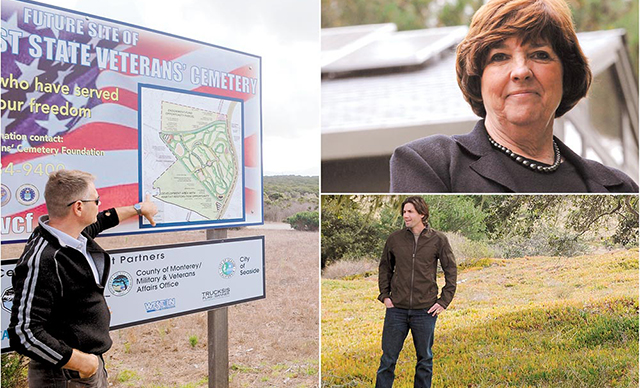
(left) FORA Program Manager Stan Cook stands at the entrance to the planned Central Coast Veterans Cemetery, which now faces an emergency funding shortage. (top) Monterey County Business Council President Mary Ann Leffel envisions a mix of residential and commercial uses, recreation, Olympic-sized pools and baseball fields on the former Fort Ord. (below) Fort Ord Access Alliance organizer Michael Salerno admires one of the coast live oak trees that make northwest Fort Ord a rare and prized habitat in conservationists’ eyes.
• The M-vs.-K initiative battle has been nasty from the beginning. A quick recap:
• Last March, the Fort Ord Access Alliance went public with its campaign to protect 540 Fort Ord acres for open space and recreation through a countywide ballot initiative. The group started collecting signatures in April.
• By early May, the United Veterans Council of Monterey County and the Monterey County Business Council had teamed up to launch a counter-petition, this one for an initiative allowing development on most of the same Fort Ord acres. Secure the Promise, as the team is called, also aimed to bolster plans for the Central Coast Veterans Cemetery and pave the way for the controversial Eastside Parkway, which would cut west-east across northern Fort Ord.
• During the petition-circulating phase that followed, the Elections Department fielded complaints that signature-gatherers on both sides were being aggressive and dishonest with potential voters.
• Secure the Promise organizer James Bogan started the first court fight, alleging the Access petition failed to provide signatories with enough information. But in June Superior Court Judge Kay Kingsley swatted the suit down, saying it was, in fact, the 119-page Measure K petition that was hard to decipher.
• In August, with both initiatives certified, the Seaside City Council decided to spend $50,000 on a “public education” campaign on Measures M and K. State law doesn’t allow jurisdictions to use public money for political advocacy, but city leaders assured critics they wouldn’t take sides. One consultant later returned with a report finding Measure M would result in an 82-percent potential job loss on Fort Ord, while Measure K would lose 17 percent of the 25,525 jobs expected from the full realization of the existing Fort Ord Base Reuse Plan.
• Just a few weeks later, the city issued a legal challenge to get both initiatives thrown off the ballot, arguing Seaside elected officials – not countywide voters – should make the city’s land-use decisions. Judge Kingsley tossed that challenge too, ruling the public should make the call.
• The sources of money for the two campaigns are also markedly different. The first wave of campaign-disclosure statements, filed in August, show the Access campaign collected about $69,000 in the first half of the year, almost all of it from individuals. The biggest donation was $20,000 from retiree Henry Wheeler.
• The Promise campaign, by contrast, was funded almost entirely by one source: Monterey Downs LLC, which funneled about $82,000 toward signature-gathering and petition printing and gave another $4,400 to the Veterans Council. Those disclosures were not made on a Form 460, the typical way of filing campaign finance statements, but rather through the company’s own Form 461, a major-donor statement. The Veterans Council filed a separate Form 460 showing $10,620 in additional donations to the campaign, $10,000 of that from the council itself.



(2) comments
The Weekly’s analysis of Measures K and M (“Measure by Measure,” 10.03.13) pointed out that “one parcel Measure M does not mention is the Monterey Horse Park, a 110-acre piece of Parker Flats where equestrian enthusiasts hope to build horse training and competition facilities.” Indeed the public discourse on Measures K and M rarely mention the Monterey Horse Park (MHP).
I have been a Director of MHP since its incorporation in 2001 as a nonprofit, public benefit corporation (www.montereyhorsepark.org). It was formed to bring to fruition the dream of local equestrians to build a horse park at the former Fort Ord and to provide the “high-quality equestrian center” designated by the 1997 Base Reuse Plan as one of its desired public recreation facilities. It is not a racetrack, not merely a boarding stable, not simply a competition venue. It will be a center for all recreational and competitive equestrians, a venue for equine assisted therapy for veterans, children and adults and equine related training and education. Kids will be able to learn how to ride and then compete up to the highest levels, in all Western and English disciplines. It will provide trailhead facilities, including rest rooms and horse camps, for easy access to the Fort Ord National Monument and the Habitat Recreation Area. According to the study prepared for the County in 2005 by Economic & Planning Systems, Inc., its visitors and competitors will generate positive economic impact for the County of $65 Million, each year. It is difficult to see how the parking provided by Measure M for equestrian trailers, limited to 3 acres, will be paid for let alone generate $65 Million for the County every year.
There has never been any public outcry of opposition to MHP. However, adoption of Measure M would eliminate our project entirely. But this is solely because Measure M targets Monterey Downs. While the 110 acres of Parker Flats planned for MHP is part of the land being developed by Monterey Downs, MHP is separate from, not part of, Monterey Downs. When it became clear that MHP would not be able to meet the financial and other requirements of its 2005 Negotiating Agreement with the County, it welcomed the financial assistance and development expertise offered by Monterey Downs, especially because its manager is an equestrian who has been recognized for his design of environmentally sensitive equestrian facilities. But MHP will remain independently managed and operated and will continue as a nonprofit for the public benefit.
As reported by the Weekly’s article, an argument lodged in favor of Measure M by LandWatch is that since housing planned for Parker Flats had been shifted to East Garrison by a land-swap, it would be unfair now to allow Monterey Downs to build housing on Parker Flats. This contention, though, ignores the fact that that land-swap also shifted the Monterey Horse Park site from East Garrison to Parker Flats. More than unfair, using Measure M to now kill the Horse Park would be an unwarranted double-cross, to the great detriment of all equestrians, young and old, and to the populace of Monterey County.
While not directly approving MHP, Measure K keeps land available for our project as the Base Reuse Plan’s “high-quality equestrian center.” I join the Weekly's recommendation to vote No on M in order to save Monterey Horse Park. Thank you.
Thanks for this analysis of M vs. K.
During two recent debates, the race track proponents said that Measure M's open space will create huge traffic problems. The racetrack is estimated to generate over 7000 traffic trips per day while there is no state funding allocated for Highway 1 or 156 for decades. A freeway through Fort Ord habitat won't fix a horse racetrack's burden on our infrastructure.
And, if state law doesn’t allow jurisdictions to use public money for political advocacy, how come Seaside bestowed $50,000 to a campaign consultant, whose web pages promise political victory? Economists cannot predict the economic future, so that entire report is nothing but taxpayer funded speculation and spin.
It is also appalling that ballot initiative proponents have to enforce the law against non factual ballot arguments by chasing down the authors on their own. One would like to think our system of laws would protect voters from reading campaign baloney on the ballot itself. Oh well. Another expectation dashed.
Welcome to the discussion.
Log In
Keep it Clean. Please avoid obscene, vulgar, lewd, racist or sexually-oriented language.
PLEASE TURN OFF YOUR CAPS LOCK.
Don't Threaten. Threats of harming another person will not be tolerated.
Be Truthful. Don't knowingly lie about anyone or anything.
Be Nice. No racism, sexism or any sort of -ism that is degrading to another person.
Be Proactive. Use the 'Report' link on each comment to let us know of abusive posts.
Share with Us. We'd love to hear eyewitness accounts, the history behind an article.