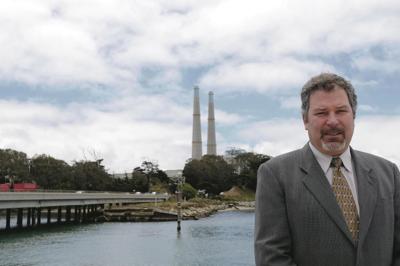
One might generate a decent amount of heat from burning the thousands of pages of documents Dynegy has accumulated in recent months concerning air pollution fees.
But however much those stacks of paper would burn, they’ve got nothing on Dynegy’s Moss Landing power plant, the largest-capacity power generator in California.
When Pete Ziegler took over as managing director of the Moss Landing plant last year, he started poring over operating costs – hence the giant stack of paper, obtained through a series of California Public Records Act requests (by Houston-based Dynegy and the Weekly), from the Monterey Bay Unified Air Pollution Control District.
His number crunching showed Dynegy’s fees (about $1.1 million last year) amount to about 45 percent of what the district collects from polluters.
“This inequity is untenable and cannot continue,” Dynegy Vice President Martin Daley wrote in a May 8 letter to the air district board.
Ziegler points to eco-friendly improvements Dynegy has installed in the past 12 years – a catalytic reduction device that cut nitrogen oxide emissions (responsible for acid rain) by 90 percent, and two modern, more efficient units that went online in 2002, reducing the run times for the two 1960s units.
The fees are based on a four-year average of particulates, carbon monoxide, nitrogen oxide and other pollutants, emitted from 1998 to 2001.
The plant emitted 588 tons of pollutants last year, down from an average of 7,580 tons per year from 1998-2001. Considering those figures, Dynegy claims it’s overpaid $9.5 million.
“The rule is outdated,” Ziegler says. “It seems unfair to assess a time period in which we didn’t have the best available technology.”
The air district, which has an annual operating budget of $6.8 million, relies on nearly $2.8 million in fees from polluters. The old Cemex plant in Davenport closed in 2010, cutting off a regular $1 million revenue stream.
Air Pollution Control Officer Richard Stedman acknowledges Dynegy’s emissions are down, but says the district’s cost of monitoring the plant’s emissions doesn’t change.
“To be honest, it’s not $1 million worth,” Stedman adds, “but they’re paying for the privilege to pollute.”
Ziegler thinks Dynegy should get an incentive to reduce its emissions in the form of lower fees.
In Stedman’s view, there’s room to negotiate if Dynegy agrees to cap its emissions. “We’re going to see if we can live with lower fees, but we want to get something in return,” he says.
Ziegler, however, wants the option to run the plant at full capacity when there’s demand for it. “I’m not going to agree to a ceiling on our emissions,” he says. “We want to be able to answer the call of the marketplace.”
Ziegler would not disclose operating cost information or how much Dynegy has invested in eco-friendly upgrades.
Unlike a retail utility like Pacific Gas & Electric, which can transfer increased costs directly to ratepayers through public proceedings overseen by the California Public Utilities Commission, Dynegy is a wholesaler. (PG&E is a major customer, buying power on a contract that expires at the end of 2013.)
Most of Dynegy’s natural gas-burned power goes to the California Independent System Operator Corp., which procures 57,000 megawatts from 1,400 plants that feed into the grid.
The air district levies no fees on greenhouse gases, which Stedman says could change in the future. “The best way right now to reduce CO2 is to limit the hours of operation,” he says.





(2) comments
If it's "not $1 million", what is it? Isn't that Stedman's job to determine? Why doesn't he know how much it should be? Does he shoot into dark closets? And figure that's good enough?
"Paying for the privilege to pollute"? What about the wineries, coffee roasters and gas stations?
Is this guy a public official or some sort of autocrat?
Looks like this guy wants to give favored businesses a free ride at the expense of the power plant. Sounds like the Good Ole Boys are taking care of their friends. Or flunked fourth grade math.
Is Stedman starting his own Cap and Trade program? Better tell CalAm that its desal plant will have to run on solar or wind, not juice from a power plant.
Welcome to the discussion.
Log In
Keep it Clean. Please avoid obscene, vulgar, lewd, racist or sexually-oriented language.
PLEASE TURN OFF YOUR CAPS LOCK.
Don't Threaten. Threats of harming another person will not be tolerated.
Be Truthful. Don't knowingly lie about anyone or anything.
Be Nice. No racism, sexism or any sort of -ism that is degrading to another person.
Be Proactive. Use the 'Report' link on each comment to let us know of abusive posts.
Share with Us. We'd love to hear eyewitness accounts, the history behind an article.