
The floodwaters in Pajaro have long since receded, and state and federal officials gathered in Watsonville on Nov. 21 to announce progress on infrastructure improvements to the Pajaro River levee to prevent future flooding. But the impacts are still being felt by some residents.
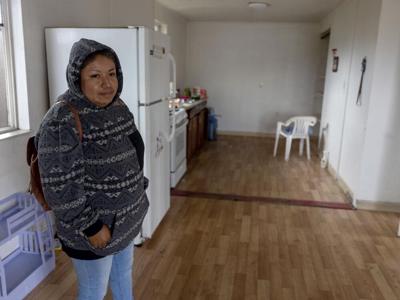
Farmworkers found their income diminished due to flooded fields. “The season was really bad – the biggest check was $600,” Fabiana, a Pajaro resident and farmworker who declined to give her last name, says in Spanish, noting many workdays were under eight hours.
She is part of a close-knit community of about 80 people, many of them multigenerational families, living in apartments at 29 San Juan Road, who received tenancy termination notices on Oct. 20 from landlord Rose Rental LLC, giving them 60 days to vacate.
On Sept. 28, the property owners (Joseph, Maria de Luz and Edward J. Nunez) received an administrative citation from the Monterey County Department of Housing and Community Development for violations in all 15 units, including lack of heating, non-operational windows, missing smoke and carbon monoxide alarms, and a roach infestation. They red-tagged one unit, Apartment P.
Most of the units are office spaces converted into housing units without permits, county officials say. The landlords have options to either bring the units up to code or demolish them. If the Nunezes don’t fix the violations by Dec. 7, fines will pile up starting with $100 the first day, $500 the second, and $1,000 on each additional day.
“We don’t have much control over the tenant-landlord relationships. We’re just out there making sure that housing is safe to live in,” says Craig Spencer, interim director of HCD.
The situation leaves tenants in a bind. The notices indicate the last day to vacate is Dec. 20, but if they leave by Nov. 20, they will receive two months’ rent. Still, residents say finding a place to live is challenging and prices for available units are at least $1,000 more than what they currently pay. “I was cleaning my car to sleep there,” says Rocio Morando, a mother of three.
Estela García lives in a two-bedroom apartment with her dad, her brother and his family (five total), and her son. They pay $2,350 per month and have lived there for a decade. “We don’t have resources to pay a deposit and pay rent,” she says, noting they’ve found homes for $3,500/month, but don’t have the $7,000 needed for first month’s rent and a deposit. García says with strawberry season over, only her brother is working part-time.
A coalition of nonprofits has stepped in to assist, including Community Bridges, Raíces y Cariño, Legal Services for Seniors and more. “[The Nunezes] have knowingly been renting uninhabitable units to low-income farmworkers and have been exploiting the realities of how hard it is to find affordable housing in our community,” says Raymon Cancino, CEO of Community Bridges.
In a statement, the Nunezes said: “Rose Rentals and the Nunez Family are committed to helping the families at 29 San Juan Road transition.”
Community Bridges has raised $63,000 to help the tenants with rent, deposits or hotels. That includes a $50,000 grant from the Community Foundation for Monterey County, and $13,000 from over 100 donors via a GoFundMe campaign.


(0) comments
Welcome to the discussion.
Log In
Keep it Clean. Please avoid obscene, vulgar, lewd, racist or sexually-oriented language.
PLEASE TURN OFF YOUR CAPS LOCK.
Don't Threaten. Threats of harming another person will not be tolerated.
Be Truthful. Don't knowingly lie about anyone or anything.
Be Nice. No racism, sexism or any sort of -ism that is degrading to another person.
Be Proactive. Use the 'Report' link on each comment to let us know of abusive posts.
Share with Us. We'd love to hear eyewitness accounts, the history behind an article.