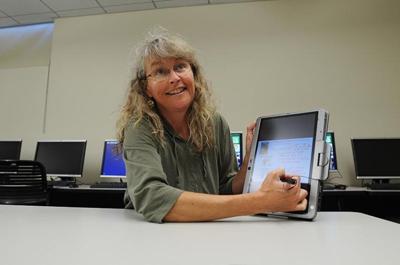
Class work is done in class, homework is done at home. That’s the way it’s always been. But imagine that model flipped: the traditional classroom experience – like sitting through a lecture – happens at home, while homework is done in class.
It’s called the “inverted classroom,” and it’s a strategy more schools and colleges, including CSU Monterey Bay, are using nationwide.
“Lecturing is a basic cognitive skill for a student. All they’re doing is taking in information, writing notes and maybe asking questions,” says Rachel Esselstein, a CSUMB math professor who introduced the new model to the university in 2010. “We send them home to do homework because we’re asking them to apply the knowledge. This is the time that they need the support [of a teacher].”
This summer CSUMB Professor Suzanne Worchester is working on “flipping” her Introduction to Biology class. In previous years, Worchester would lecture for an hour and a half straight, interspersing the talks with stories and audience participation from her 100-plus students. With inversion, students will watch videos before class so class time can be spent working in groups and solving problems. The videos will be short – three to 10 minutes. Students will watch about four a week, then take an online quiz.
During class time, students will jump straight into doing “homework,” or problem solving, with lecture interspersed. “Getting students engaged in learning is what it’s all about,” she says.
The inversion experiment is part of CSUMB’s mission to amplify education with technology. Last semester, the university launched a $100,000 grant program for professors who had ideas for innovative teaching. Of 22 grants given, about half went to professors like Worchester who were interested in flipping their classrooms, Esselstein says.
The idea took root three years ago, when Esselstein inverted an upper-level math class after being inspired by Khan Academy, an educational nonprofit that produces video lectures. About 20 professors joined her to further explore using similar technology in their teaching.
“That’s been sort of a grassroots effort,” says CSUMB President Eduardo Ochoa. “What’s new is that this is also a priority for me, and we’re going to be really supporting it and highlighting it.” Ochoa’s interest in new education can be seen in his President’s Speaker Series, which brought in innovators like Sebastian Thrun, who co-founded Udacity, a website offering “massive open online courses,” or MOOCs.
For students, though, having to watch videos in addition to reading and going to class can feel like more work.
“I try to convince them it’s even better than class, because they can pause it, they can rewatch it as many times as they want,” Esselstein says. “And then in class they have the help they need when they’re solving the problem sets.” The difference between this model and a straight video course is that teacher-student engagement in the classroom is still key.
One surprise: The new model seems to have an impact on female Hispanic students. Esselstein says she’s noticed more Latinas participating in the flipped classroom. Traditionally those students are less likely to speak during a lecture, perhaps because of cultural upbringing to “not rock the boat.”
“We need to take full advantage of science, technology and computer power to re-engineer the learning experiences students go through to be more effective and efficient,” Ochoa says.



(1) comment
Doing homework in class after school hours is a good idea to help students understand their tasks and increase their school performance. Children who follow the bilingual program at http://www.bambooshootseducation.com and have plenty homework to do after school and at home are smarter that an average student. This means that students who study harder are smarter.
Welcome to the discussion.
Log In
Keep it Clean. Please avoid obscene, vulgar, lewd, racist or sexually-oriented language.
PLEASE TURN OFF YOUR CAPS LOCK.
Don't Threaten. Threats of harming another person will not be tolerated.
Be Truthful. Don't knowingly lie about anyone or anything.
Be Nice. No racism, sexism or any sort of -ism that is degrading to another person.
Be Proactive. Use the 'Report' link on each comment to let us know of abusive posts.
Share with Us. We'd love to hear eyewitness accounts, the history behind an article.