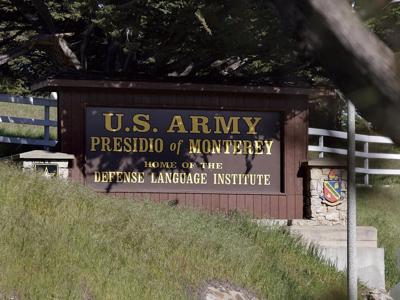

That the United States military has its sights clearly fixed on China as a threat was no more evident than in the recent shooting down of a Chinese balloon that the U.S. calls a spying tool and Chinese officials played off as a weather balloon. Along with Russia’s war against Ukraine and the U.S. withdrawal from Afghanistan in 2021, American military forces are shifting away from training soldiers in the Afghan language of Pashto and instead increasing focus on Mandarin and Russian. That means the Defense Language Institute’s Pashto program with 37-39 instructors is coming to an end this year.
“It’s always a shifting requirement here based on the needs of the Department of Defense,” says DLI Chief of Staff Steven Collins. Most of the instructors originally from Afghanistan are on a fixed term of employment, with terms ending at staggered times. A few have permanent positions at DLI.
When the announcement was made to staff last year, the president of the American Federation of Government Employees Local 1263, Dennis Hickman, began lobbying administrators to give employees whose terms were ending in the fall and winter as much time as possible to transition into other jobs. Some instructors worked as translators for U.S. military forces during the war in Afghanistan, meaning it’s too dangerous for them to return there, Hickman says. Instructors’ options for jobs in this country are limited.
After getting no response from administrators, Hickman filed a grievance on Jan. 13. The union is asking that employees whose terms end prior to June 24, 2023 be allowed to remain through that date. The union’s rationale includes giving instructors more time to find employment, some within DLI, as well as allowing their children to be able to finish out the school year.
“I feel bad for them. They should be given a safety net when they leave,” Hickman says. One instructor who spoke to the Weekly on the condition of anonymity out of fear of being fired before his term ends, said he regrets having come to the U.S. to teach at DLI. “Because they are treating us in a way that they use us and are throwing us away,” he says. He adds that he was denied a job in another language he is qualified to teach and has no current job prospects elsewhere.
Collins says the institute has no choice but to end the Pashto program because the need is now over. “We’re doing the best we can under the circumstances,” he says.


(0) comments
Welcome to the discussion.
Log In
Keep it Clean. Please avoid obscene, vulgar, lewd, racist or sexually-oriented language.
PLEASE TURN OFF YOUR CAPS LOCK.
Don't Threaten. Threats of harming another person will not be tolerated.
Be Truthful. Don't knowingly lie about anyone or anything.
Be Nice. No racism, sexism or any sort of -ism that is degrading to another person.
Be Proactive. Use the 'Report' link on each comment to let us know of abusive posts.
Share with Us. We'd love to hear eyewitness accounts, the history behind an article.