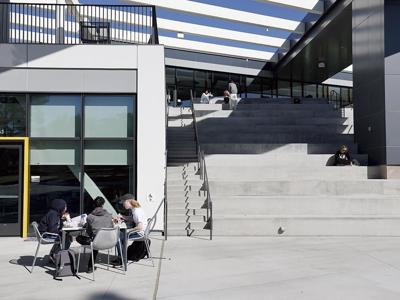

The CSU Monterey Bay community has been working on two documents that will chart the university’s path into the future – one regulatory, the other aspirational. The regulatory document is a proposed master plan for increasing CSUMB’s size and campus population (6,000 more students and 750 more faculty are predicted) through 2035. The aspirational one is its Inclusive Sustainability Plan, which seeks to shrink the university’s carbon footprint to nearly zero by 2030.
Those two things – growth and sustainability – are contradictory, and in fact there were contradictions between the two documents. The sustainability plan, which is not binding, calls for carbon neutrality by 2030; the master plan, which is binding, would increase greenhouse gas emissions.
Two things happened in March that have now brought the two documents into closer alignment. The draft environmental impact report for the master plan went out for public comment, and comments included a detailed critique by environmental group Landwatch. Then on March 23, the California State University Board of Trustees adopted revisions to its sustainability policy that required carbon neutrality across the entire campus system by 2045.
Anya Spear, CSUMB’s director of strategic initiatives, revised the master plan accordingly. It is headed to the CSU Board of Trustees on May 25 for consideration and potential adoption.
Drawing from a Landwatch data analysis completed by the company EcoDataLab and their own calculations, CSUMB staff incorporated changes into the plan that resulted in fewer greenhouse gas emissions. Ben Gould, president and co-founder of EcoDataLab, estimates emissions savings went from 47 percent to 56 percent.
Other changes to the master plan include more specifics on how the university plans to meet its goals of reducing emissions as well as reducing waste to net zero by 2030, another goal laid out in the CSUMB sustainability plan. For example, the master plan includes a commitment to hiring a zero waste point person, something that was delayed while student interns tackled the issue over the years.
Landwatch Executive Director Michael DeLapa was pleasantly surprised by CSUMB officials. “They not only listened to us, they addressed all of our concerns,” DeLapa says. “We were really grateful that they took the time and energy to look at it.”
Gould points out that even with the data changes, CSUMB probably won’t meet its 2030 goal of carbon neutrality and is only bound by the CSU policy of meeting the goal by 2045. “We’re still a little disappointed, but we recognize it’s a very ambitious target,” Gould says. The target is ambitious, Spear says, but the campus community is “really committed to getting to carbon neutrality as soon as possible, regardless of what the CSU policy says.”
The CSU trustees are scheduled to consider the master plan EIR after 11am on Wednesday, May 25, at the Office of the Chancellor in Long Beach. The meeting will be livestreamed at bit.ly/CSUBOT.


(0) comments
Welcome to the discussion.
Log In
Keep it Clean. Please avoid obscene, vulgar, lewd, racist or sexually-oriented language.
PLEASE TURN OFF YOUR CAPS LOCK.
Don't Threaten. Threats of harming another person will not be tolerated.
Be Truthful. Don't knowingly lie about anyone or anything.
Be Nice. No racism, sexism or any sort of -ism that is degrading to another person.
Be Proactive. Use the 'Report' link on each comment to let us know of abusive posts.
Share with Us. We'd love to hear eyewitness accounts, the history behind an article.