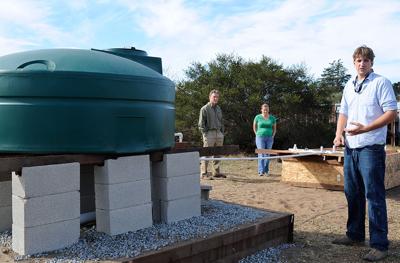

Flowers and oceanscapes cover the exterior of Building 42, the humble headquarters of CSU Monterey Bay’s Watershed Institute. In the lot behind it, a geometric contraption has taken shape beside the greenhouses. A round plastic water tank balances on stilts, another tank is sunk into the ground, and a grid of PVC pipes runs through a compartmentalized box between them.
This is the field laboratory of CSUMB environmental science lecturers John Skardon and John Silveus and their six students. They’re trying to find better ways to filter the pollutants out of agricultural runoff.
When farmers apply fertilizer to their crops, excess nitrates can flow into the watershed, contaminating groundwater and polluting aquatic habitats – contributing to hazards like “blue-baby syndrome” in humans and dead zones in oceans.
“Once it gets out of the fields, it becomes a real booger,” Skardon says.
The low-tech treatment: wood-chip bioreactors. They’re basically just mulch-filled trenches in the ground. Farmers pipe their runoff through them, and bacteria colonizing the wood chips consume some of the nitrate. But the systems often don’t improve water quality enough to comply with regulations, Skardon says. More sophisticated systems are often too expensive to use on a large scale.
“I am really concerned we have to solve this problem in order to keep the ag industry here in California,” he says. “With the lower level of rainfall, we’re going to have to up our game a little bit.”
The problem with today’s bioreactors, Skardon says, is that wood chips don’t provide enough carbon to feed the bacteria that break down nitrates. By adding more carbon to the system, his lab is cultivating the kind of low-oxygen bacteria that are really hungry for nitrates. (You may recognize these sorts of microbes as the snotty stuff plumbers clear out of kitchen drains.)
Hunter Burnham, a marine science undergrad, is researching alternatives – like ceramic pumice stones and grooved “bio-balls” – with more surface area than wood chips for bacteria to grow on.
Molecular biology student Alexandra Walling is studying how bacteria react to different carbon sources, an effort to nail the perfect nitrate-removing recipe.
Skardon wants to set up his lab’s bioreactor in Tembladero Slough, one of the state’s most polluted waterways, which runs from north Salinas to Moss Landing. The CSUMB team is already running the slough’s runoff through another model bioreactor in the Molera Road Treatment Wetland, a 3.5-acre experimental plot near Castroville. But they can’t control the amount of nitrate going into that system, and that’s where the on-campus bioreactor comes in.
Skardon’s students feed the water tank on stilts with fixed nitrate levels, run that water through the four-part box (which they call a “multi-channel reactor”), test the water that comes out and repeat. Their Holy Grail: resulting nitrate levels of less than 10 parts per million.
Partial funding comes from CSUMB’s Undergraduate Research Opportunities Center and the U.S. Department of Agriculture. Skardon hopes it will lead to a patent – and an affordable ag runoff solution.



(1) comment
The bioreactor working group at CSUMB also includes Dr. Arlene Haffa.
Welcome to the discussion.
Log In
Keep it Clean. Please avoid obscene, vulgar, lewd, racist or sexually-oriented language.
PLEASE TURN OFF YOUR CAPS LOCK.
Don't Threaten. Threats of harming another person will not be tolerated.
Be Truthful. Don't knowingly lie about anyone or anything.
Be Nice. No racism, sexism or any sort of -ism that is degrading to another person.
Be Proactive. Use the 'Report' link on each comment to let us know of abusive posts.
Share with Us. We'd love to hear eyewitness accounts, the history behind an article.