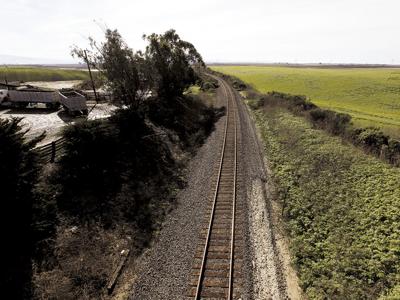

Imagine an 80-car rail train filled with 53,532 barrels of crude oil entering Monterey County from the north.
After passing by Watsonville, it crosses over the Elkhorn Slough – a federally protected estuary home to sea otters, seals and hundreds of species of birds, fish and invertebrates – just a few feet from the water.
Or imagine that same train as it passes through Salinas where – in the event of a rail accident – the heart of the city sits in the potential impact zone.
Those scenarios become possible with a proposed project coming before the San Luis Obispo County Planning Commission Feb. 4, one that would add a series of rail spurs to connect parts of the Santa Maria Refinery – an oil refinery in Nipomo owned by Phillips 66 – to the main rail line.
The project, which has received a groundswell of opposition throughout the state, would allow the delivery of crude oil by rail; the refinery currently receives crude via pipeline and trucks.
“If you’re not working in the extraction industry, people are almost 100-percent against it,” says Laurance Shinderman, a spokesman for Mesa Refinery Watch, a Nipomo-area citizens group that formed in opposition to the project. “The more you peel back the onion, the more you see the impacts.”
The project’s final environmental impact report was released in December. Among the potential impacts in Monterey County, 10 are listed as significant and unavoidable.
Some are easy enough to imagine: A derailed train in the Salinas Valley spills oil on the surrounding agricultural area and seeps into its groundwater resources. An accident in Salinas results in the evacuation of entire neighborhoods, or a catastrophic explosion. In the Elkhorn Slough, a derailment devastates one of the most biologically important ecosystems in the state.
Shinderman has studied maps of the entire railway and where the oil would travel through, and says the Elkhorn Slough in particular jumped out at him.
“When I saw the tracks running on the water,” Shinderman says, “it’s insane, there’s no other way to say it.”
Thousands of letters from across the state have been sent to San Luis Obispo County opposing the project, including letters from the Monterey County Board of Supervisors, the Association of Monterey Bay Area Governments and State Sen. Bill Monning, D-Carmel.
“The benefits of extending the Phillips 66 rail spur to allow for increased crude oil shipments by train,” Monning writes, “simply do not outweigh the potentially significant cost to the public’s safety and environment.”
Dennis Nuss, a spokesman for Phillips 66, declined to answer specific questions about the project.
“We understand there are concerns about the project,” he writes by email. “We look forward to addressing questions raised in the final EIR during next week’s planning commission hearing.”
To that end, Nuss may be facing an uphill battle: In a Jan. 25 report, the San Luis Obispo County Planning Department recommends denying the project, citing its many unavoidable impacts both in and out of the county.
Nonetheless, Shinderman doesn’t think denial’s a slam dunk. “[Phillips has] friends up there on the [planning] commission,” he says. “They spread the money around [the community], they pay a lot of taxes and they provide a lot of jobs.”


(1) comment
Missing from this discussion is the impact on potential passenger services on the rail route. With long stretches of single track, the line will come closer to maximum capacity with additional trains (presumably about one per day in both directions). This will leave less room for planned passenger services from Salinas north, and still less for any expansion south of Salinas. Without a massive investment in rail infrastructure, this proposal is going to shut Monterey County out of much needed future transportation capacity. If the oil company is intent on pursuing this plan, they should at least be held to paying for upgrading and increasing the capacity of the rail line.
--Brian Ashurst
Welcome to the discussion.
Log In
Keep it Clean. Please avoid obscene, vulgar, lewd, racist or sexually-oriented language.
PLEASE TURN OFF YOUR CAPS LOCK.
Don't Threaten. Threats of harming another person will not be tolerated.
Be Truthful. Don't knowingly lie about anyone or anything.
Be Nice. No racism, sexism or any sort of -ism that is degrading to another person.
Be Proactive. Use the 'Report' link on each comment to let us know of abusive posts.
Share with Us. We'd love to hear eyewitness accounts, the history behind an article.