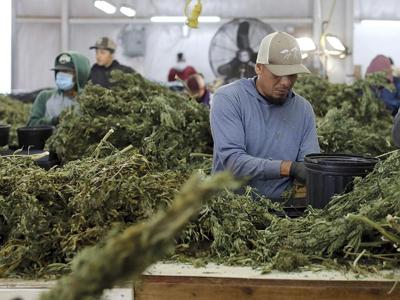

More than 60 percent of cannabis cultivators in Monterey County owe unpaid taxes to the county, a reflection of a once-booming local industry facing oversupply and variable market conditions. Responding to the industry’s cries for aid, county officials are preparing a tax structure overhaul they hope will offer temporary respite.
The Board of Supervisors unanimously voted on July 26 to retroactively slash its per-square-foot tax rate on cannabis cultivators dating back to the second quarter of fiscal year 2021-22. The plan, which supervisors are expected to codify on Aug. 23, would refund $384,000 in collected tax revenue back to cultivators who already paid their taxes under the old rates, and require those late on their taxes to pay in full by Jan. 31, 2023.
Under this new structure, the county would take an $8.6 million hit against the $19 million it projected to earn through cannabis tax revenue in fiscal year 2021-22. Prior to her vote, Supervisor Mary Adams said she hoped the plan would provide relief, but said she was worried cultivators would be back in the same position in a few months. “I don’t know what’s going to happen to change things, I really don’t,” Adams said.
The board’s action is short of what local industry leaders pleaded for: completely wipe out the tax debt and retroactively reduce the fiscal year 2021-22 tax rate to $0, allowing cultivators a clean slate as they head into the new fiscal year. The proposal was also backed by the county’s elected treasurer and tax collector, Mary Zeeb.
Although the supervisors showed little appetite for debt forgiveness – citing, in part, concerns over violating Measure Y, the voter-approved referendum that brought cannabis cultivation to Monterey County with tax revenue to fund county services – supervisors acknowledged the tightrope walk ahead between keeping the industry’s long-term prospects afloat while making sure the government is continuing to receive cannabis tax revenue.
Attorney Aaron Johnson, who specializes in cannabis, says if they’re going to maximize revenue, the county needs to find the still-elusive sweet spot between allowable square footage and tax rate. However, Johnson says the county also needs to review how much it relies on cannabis tax dollars.
“We told them at the start to treat cannabis tax revenue as one-time dollars, because it wasn’t always going to be there,” Johnson says. “And it sure as hell isn’t.”


(3) comments
On August 23 the Board of Supervisors declined to address the local tax rate that is unsupportable in the current market where prices are near or below the cost of production. They kicked the can down the road again with vague statements about continuing to work on a solution. They have a regulatory program that costs over $6,000,000 and seem unwilling address the costs, as a business would to. The tax revenue will not be $19,000,000 as forecast long ago or even the $10,500,000 that has been reduced to. The result will be the collapse of many businesses and loss of jobs for hundreds of cannabis workers.
When cars replaced the horse and wagon, many buggy whip companies went out of business. Are you saying buggy whip workers should have somehow been kept at their jobs? - When your "solution" involves supporting a failed or outdated business model, you just set yourself up for more failure. Professional growers have admitted it costs about six dollars an ounce to produce sun-grown marijuana. There is something radically wrong about the spread from six dollars to three hundred dollar retail prices. - Again, it's just a plant. The price should float a little above that of fine tobacco, as I described below. If this is not adjusted to reality, at some point, someone's going to make a business helping people grow their own and then the price will be forced down to reality anyway.
There is some justification for the extra taxes on alcohol and tobacco. Because of the massive harms they cause to health, they create huge social costs. The extra taxes, at least partially, compensate for those costs.
Science and widespread experience have shown marijuana has no significant harms. Hence, there is no real justification for extra taxes.
Part of the problem, though, is the current business model. Marijuana is just a near harmless plant. It doesn't need special stores with all that dedicated overhead.
After the fraudulently enacted federal prohibition finally collapses, national and world markets will quickly develop. Marijuana will be grown in the most favorable climates and shipped everywhere else. It will be sold wherever more harmful beer and wine are available, and it will cost between $25 and $50 an ounce. - It's just a plant.
Welcome to the discussion.
Log In
Keep it Clean. Please avoid obscene, vulgar, lewd, racist or sexually-oriented language.
PLEASE TURN OFF YOUR CAPS LOCK.
Don't Threaten. Threats of harming another person will not be tolerated.
Be Truthful. Don't knowingly lie about anyone or anything.
Be Nice. No racism, sexism or any sort of -ism that is degrading to another person.
Be Proactive. Use the 'Report' link on each comment to let us know of abusive posts.
Share with Us. We'd love to hear eyewitness accounts, the history behind an article.