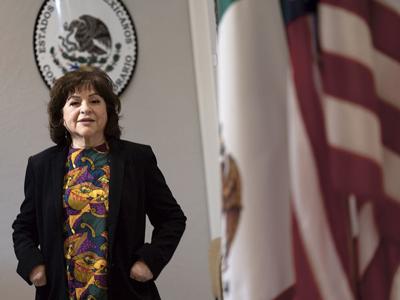

As Inauguration Day approaches and Donald Trump, a president-elect who focused his campaign in part on mass deportations and border security, will take the oath of office, local government – in partnership with the Mexican consulate, business leaders and nonprofit organizations – is getting to work. Convening through a newly formed ad hoc committee on immigrant rights, the group is mobilizing to provide information and resources to the undocumented community in Monterey County.
“When this issue is talked about on the national scale, they’re talked about as if these are just people somewhere else. But when local residents start seeing this could be our neighbors, our coworkers, friends or your family members, the perception from the public on this issue will change dramatically,” says County Supervisor Luis Alejo, who serves on the committee.
The committee was approved in December and has so far met twice, with about 60 people in attendance. The County has assembled a website (comry.us/knowyourights) with resources and information about constitutional and immigration rights in multiple languages including English, Spanish, Mixteco and Triqui (both Mexican Indigenous languages). It also has a downloadable and printable “red card,” a short Spanish/English guide that people can hand to an immigration agent, and guidance about asserting Fourth Amendment rights (to review a warrant) and Fifth Amendment rights (to due process and to decline to answer questions). The county so far spent $1,500 to print 20,000 red cards.
Anayeli Rodriguez is a leader with nonprofit COPA (Communities Organized for Relational Power in Action) and Lideres Campesinas. She says it’s great the county has disseminated information in multiple languages, but the Mixteco speaker highlights more needs to be done to help the Indigenous community: “I know a lot of them don’t know how to read. Many don’t speak either English or Spanish [so] it’s more difficult to access information,” she says.
Rodriguez says residents are afraid agents with U.S. Immigration and Customs Enforcement (ICE) could conduct raids near schools or workplaces, or government offices where families of mixed immigration status may enroll in programs like Medi-Cal or CalFresh; registrants may worry that becoming a so-called “public charge” could later impact their ability to obtain legal status.
“We know that any effort targeting undocumented immigrants is going to have a chilling effect across our county, and could be detrimental in many different ways,” Alejo says.
About 11 million immigrants from the over 60 million foreign-born population in the country lack legal status, representing 23 percent of the immigrant population. Monterey County has the highest proportion of immigrants of any county in the state, with nearly 22 percent, according to an ad hoc committee report. As of 2013, the most recent date when such estimates were released, 62,000 immigrants in Monterey and San Benito counties were believed to be undocumented. Monterey County’s two largest industries, agriculture and hospitality, depend on immigrant labor.
On Tuesday, Jan. 14, the County Board of Supervisors will consider approving a welcoming resolution to reflect its support for a large immigrant community.
California has been a sanctuary state since 2018, meaning local law enforcement can’t inquire about people’s immigration status nor hold undocumented immigrants on the basis of their immigration status.
“When it comes to immigration, it’s a touchy subject, depending on how you look at the issue,” Sheriff Tina Nieto says. “But here at the Sheriff’s Office, we want our community to feel safe. We want anybody that’s part of our community, no matter what their status is, to be able to call us.”
Nieto notes her office follows the Truth Act, under which local law enforcement agencies do share information with ICE about people convicted for serious crimes such as homicide, rape, or sales and transportation of drugs. “[If] you’re in our jail for that conviction, you’re not safe to our community,” Nieto says.
At the state and international levels, government agencies are also gearing up for a crackdown. California Attorney General Rob Bonta released guidelines for public institutions to protect immigrants’ rights including courts, shelters and schools.
“My office will continue to use the full force of the law and every tool at our disposal to protect the rights of California’s immigrants. We cannot let the Trump deportation machine create a culture of fear and mistrust that prevents immigrants from accessing vital public services,” Bonta said in a statement.
This month, the Mexican government will launch an app, “Botón de Alerta,” where Mexican immigrants can receive aid 24/7 and inform the nearest consulate and relatives if they are detained by ICE.
Alejo says future board actions could include requesting funding for an ad campaign on radio, TV and social media.
“Our focus should be on reassuring our immigrants that our county is welcoming to them, that we’re going to do everything possible to deploy resources to enhance their lives,” Alejo says.


(1) comment
"Monterey County’s two largest industries, agriculture and hospitality, depend on immigrant labor." Clearly an asinine sentiment with little understanding of history at all. Further, and unfortunately for you, deportations is a bipartisan issue. Tom Homan : D
Welcome to the discussion.
Log In
Keep it Clean. Please avoid obscene, vulgar, lewd, racist or sexually-oriented language.
PLEASE TURN OFF YOUR CAPS LOCK.
Don't Threaten. Threats of harming another person will not be tolerated.
Be Truthful. Don't knowingly lie about anyone or anything.
Be Nice. No racism, sexism or any sort of -ism that is degrading to another person.
Be Proactive. Use the 'Report' link on each comment to let us know of abusive posts.
Share with Us. We'd love to hear eyewitness accounts, the history behind an article.