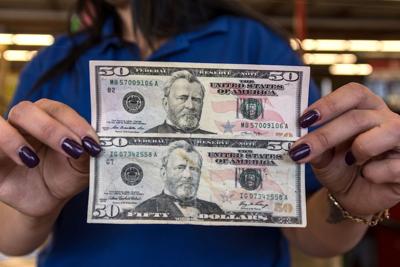

In a crowded bar with multiple patrons vying for the sole bartender’s attention, someone slips a counterfeit $20 bill among a few other legit greenbacks. The money is hastily counted and change is given as the barkeep tries to catch up with the backlog of drink orders.
This situation struck Alfredo’s Cantina in Monterey in late July, and fake twenties also landed in Grocery Outlet in Seaside earlier this month. Twenty dollars won’t break the bank at these businesses, but it is a nuisance, and hard to spot: Bartenders and servers have grown accustomed to only suspecting higher-denomination bills like fifties and hundreds.
“There were a bunch going around town then. My bank told me they received six or seven in a week,” says Doug Garnero, who owns Alfredo’s.
In the close-knit world of the Monterey Peninsula’s service industry, news of forgeries spreads fast.
“When I heard about it, I got paranoid,” says Penelope Pfefferkuch, a bartender at the Crown and Anchor in Monterey. “I immediately went to my drawer and made sure I hadn’t got taken, too.”
In terms of money scams, counterfeiting is one of the least costly to U.S. businesses and consumers. The high estimate of forged U.S. currency in circulation is $200 million, while counterfeit merchandise costs about $460 billion, according to the U.S. Chamber of Commerce. Identity theft, credit fraud and fake checks all cost billions.
Even with credit and debit cards already the norm, and app-based payments taking off in popularity – and with them, a host of new security threats – cash still causes problems.
“We see our fair share of counterfeit bills come through,” says Lee Ann Cimino, chief administrative officer at Salinas-based Pacific Valley Bank. “Normally we see two to three fake bills a week, typically hundreds.”
When banks receive counterfeit currency, they send the bills along with a report to the U.S. Treasury. Unlike credit card fraud, in which a bank refunds money to the victim, the cost of accepting a fake bill falls on the consumer or business owner, Cimino adds.
“From my experience, it comes in waves. Someone comes to town with a lot a counterfeit bills, spends it quickly and then moves on to the next place,” Cimino says.
When there is a spike in fake currency, banks post pictures and descriptions of the bills in question at branches and on social media pages, she says, so the community will know how to spot a bad bill.
Technological changes are leading to more advanced and secure features on currency, including color-shifting ink, microprinting and 3-D imaging. But with those developments come improved design software and printing.
“In the last seven or eight years, the ability to make pretty good-looking bills has gotten better,” says Mary Ann Leffel, president of the Monterey County Business Council. “At the same time, the government keeps changing bills which can make it difficult for people to spot what’s real and what’s not.”
With Car Week in full swing, local businesses will likely see an influx is fake bills, Leffel says.
“When we have big events, we always see an increase in all kinds of fraud,” she says. “It’s always worth taking a second look at the cash you’re handling.”




(0) comments
Welcome to the discussion.
Log In
Keep it Clean. Please avoid obscene, vulgar, lewd, racist or sexually-oriented language.
PLEASE TURN OFF YOUR CAPS LOCK.
Don't Threaten. Threats of harming another person will not be tolerated.
Be Truthful. Don't knowingly lie about anyone or anything.
Be Nice. No racism, sexism or any sort of -ism that is degrading to another person.
Be Proactive. Use the 'Report' link on each comment to let us know of abusive posts.
Share with Us. We'd love to hear eyewitness accounts, the history behind an article.