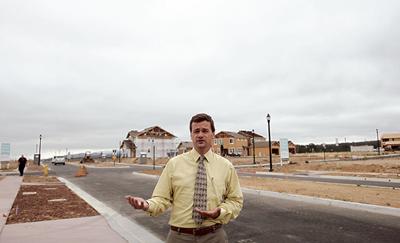
The city of Seaside’s thirst for development might be bigger than its water bank.
Seaside has some of the grandest building ambitions on the water-limited Monterey Peninsula, thanks to its hefty chunk of Fort Ord: 4,000 acres – 1,658 of them developable, according to the Fort Ord Reuse Authority – plus 563 more with the planned annexation of the proposed Monterey Downs project.
But those would-be developments need more water than the city has. Marina Coast Water District, which supplies water to the former Army base, has allocated 1,012 acre-feet from the Salinas Valley Groundwater Basin to Seaside, according to a revised table in the water-supply assessment for Monterey Downs. But the city’s 11 existing sub-allocations, including 430 acre-feet for temporary golf-course use, add up to 1,217 acre-feet.
That’s not including several additional Fort Ord proposals in Seaside’s scope: Fifty acres south of Gigling Road, now under negotiation for residential development, and 26 commercial acres south of Lightfighter Drive (neither of which has estimated water needs yet). Plus the big one, Monterey Downs, with its suggested water need of 853 acre-feet.
Taken together, the projects could put Seaside at more than double its current allocation. The discrepancy’s caught the attention of activist group Keep Fort Ord Wild, which is critical of several proposed projects on Fort Ord open space.
“They’re in a real water bind, but they’re not really admitting it,” group spokesman Michael Salerno says.
Brian Lee, Marina Coast’s interim general manager, says district officials are starting a conversation with all the land-use jurisdictions that have stakes in Fort Ord. The district has split a total of about 6,600 acre-feet of water among them.
“Everybody has a number, but they don’t necessarily agree,” Lee says. “Clear as mud, unfortunately, but we are working toward a solution.”
Diana Ingersoll, Seaside’s deputy city manager, responds by email that the Downs water assessment was done by Marina Coast without the city’s input. But she notes the city can’t approve projects without available water credits.
Marina Coast isn’t likely to produce new water anytime soon. The November 2012 Monterey Downs Water Supply Assessment states that the district is pursuing recycled-water and desalination projects that could produce 2,400 acre-feet per year of water for new Fort Ord developments, but the desal component has since been shelved.
[The last paragraph of this article was corrected Sept. 16, 2013. An earlier version incorrectly states that California American Water's groundwater recharge and regional desalination projects would produce 2,400 acre-feet for Fort Ord development. In fact, no Cal Am water will be used for the area, which is served exclusively by Marina Coast Water District.]



(1) comment
The question underneath all this, really, is how much more massive developments can the Peninsula stand and still be a livable area? It is already impossible to get from point A to point B any time of day with all the boosters creating one massive event after the other.
How much more development and hotels and retail and housing sprawl can we take before visitors stop coming, or talk about us behind our back for allowing the ruination of a once spectacular coastline?
So we get a giant desal plant followed by more freeways? And more housing and more fast food drive throughs and more freeways and more business parks and shopping centers and less and less and less quality of life.
I wish all the people who promote this vision would move to L.A. already and leave the rest of us in peace.
Welcome to the discussion.
Log In
Keep it Clean. Please avoid obscene, vulgar, lewd, racist or sexually-oriented language.
PLEASE TURN OFF YOUR CAPS LOCK.
Don't Threaten. Threats of harming another person will not be tolerated.
Be Truthful. Don't knowingly lie about anyone or anything.
Be Nice. No racism, sexism or any sort of -ism that is degrading to another person.
Be Proactive. Use the 'Report' link on each comment to let us know of abusive posts.
Share with Us. We'd love to hear eyewitness accounts, the history behind an article.