It’s not uncommon to hear about a 2-year-old who can use an iPad before a toilet. But when she steps into a classroom, her precocious web proficiency might be suppressed in favor of textbooks and pencils.
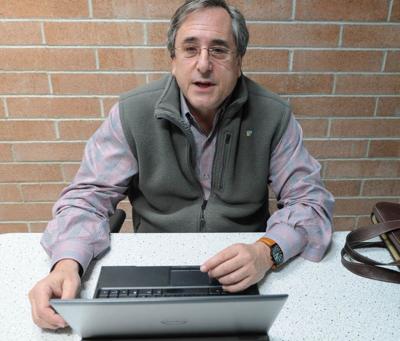
Information technology is more central to our everyday lives than it is to our school system, according to Gordon Freedman, a Carmel Valley resident who’s built a career in technology education with companies such as Blackboard, Inc. Now, he’s on a mission to bring public education into the IT age by integrating tech like social media, and breaking down the walls between human and computer languages.
“Schooling is the prevailing method of education, but it is failing us horribly in every major urban area in the country,” he says.
In his view, education should be customized so students can work at their own paces, with individualized curricula.
“[Kids] are using different parts of their brains, and they are moving at different rates,” he says.
Last year, Freedman founded the National Laboratory for Education Transformation, a nonprofit made up of professors, researchers and corporate executives. Freedman has his sights on Silicon Valley, but for now, NLET is based in Monterey County.
All work done for NLET has been volunteer, with help from some research grants. The nonprofit has recently hit up deep-pocketed companies such as Google to propose partnerships and ask for contributions of funds, software and volunteer time, Freedman says, but nothing has been formalized.
NLET’s vision: Public schools could utilize a database to track student progress and use that information to supplement classroom learning with resources like tutoring and competitions. The network would be customized, similar to how Amazon.com makes product recommendations for each customer.
“Every student in the country could have a secure [online] education account that would allow them to manage – with their parents and their teachers – their education and experiences,” Freedman says. “If you had those [academic] resources served to you in the way you do in your consumer life, that would be a tremendous strive forward.”
Rodney Ogawa, a UC Santa Cruz education professor who’s helping NLET pursue a Silicon Valley project, says public education should adopt the flexibility of private industry. “Industry can take a general idea from science, capitalize on it and quickly spin off innovations,” he says.
Freedman hopes to rope the IT, financial, military and security sectors into public education reform.
“I want to get them involved because they are the stakeholders,” he says. “If kids aren’t smart enough to get jobs to be able to invest in products and services and in the stock market, those companies aren’t going to do well in the future.”
NLET is partnering with the University of Texas, Austin; UC Santa Cruz; and Los Alamos National Laboratory to analyze 14 years of data on 30,000 students generated by the San Jose Unified School District.
This project represents a sliver of what NLET hopes to accomplish, Freedman says. His goal is to conduct a study of education on a national scale.



(0) comments
Welcome to the discussion.
Log In
Keep it Clean. Please avoid obscene, vulgar, lewd, racist or sexually-oriented language.
PLEASE TURN OFF YOUR CAPS LOCK.
Don't Threaten. Threats of harming another person will not be tolerated.
Be Truthful. Don't knowingly lie about anyone or anything.
Be Nice. No racism, sexism or any sort of -ism that is degrading to another person.
Be Proactive. Use the 'Report' link on each comment to let us know of abusive posts.
Share with Us. We'd love to hear eyewitness accounts, the history behind an article.