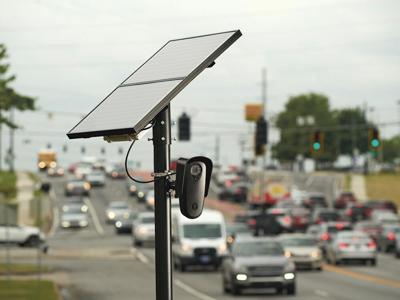

The past month has seen local cities double down on automated police surveillance equipment that promises to reduce crime and assist short-staffed forces – but which has also raised privacy concerns among citizens and civil liberties advocates.
On March 1, Pacific Grove became the latest local city to approve the use of automated license plate reader (ALPR) technology, after its city council voted unanimously in favor of entering a two-year agreement with vendor Flock Safety to install 12 of its cameras in strategic locations around P.G.
That vote came just a couple weeks after Seaside City Council voted in favor of its own deal with Flock, which will see Seaside police deploy 25 ALPR cameras around the city, as well as the company’s Raven gunshot detection technology in an unspecified, one-square-mile area.
Salinas, meanwhile, has used Flock’s ALPR cameras since late 2021 and a similar gunfire detection system by ShotSpotter since 2016. The Salinas Police Department is now using nearly $1.17 million in recently awarded federal funding to double its number of Flock ALPR cameras, to 40, and adopt other technologies meant to aid a significantly shorthanded police force.
Flock’s ALPR cameras automatically detect and scan every vehicle they come across, instantly alerting authorities to any vehicles associated with a reported crime and also providing them with a database of vehicles searchable by make, model, color, license plate and other details.
Flock has looked to assuage privacy concerns. The company says it does not use facial recognition or capture personally identifiable data about vehicle occupants, and insists all of the data stored by its cameras is deleted after 30 days, with the exception of footage flagged as evidence. That data is also “fully encrypted” and stored on a secure cloud database, according to a Flock spokesperson, who adds that the company doesn’t own or access data captured on behalf of its customers.
But those safeguards haven’t spared Flock from scrutiny by civil liberties advocates as well as local residents. A March 2022 report by the ACLU describes Flock as “building a form of mass surveillance unlike any seen before in American life.” At the Pacific Grove City Council meeting, computer scientist and P.G. resident Joshua Kroll criticized the city’s use of “dragnet surveillance” and voiced his belief that “the government should not be tracking us unless it has individualized suspicion that we’re engaged in wrongdoing.”
But those concerns aren’t stopping other local agencies from taking a look at adopting such technology, with Monterey and Carmel among the police departments currently considering ALPR cameras. Monterey Chief Dave Hober cites the appeal of being “connected with other regional [law enforcement] partners on the Peninsula” via the same system. Carmel Sgt. Michael Bruno notes that Flock “appears to be more technologically advanced” than Carmel’s existing six-camera surveillance system, provided by Morgan Hill-based company SurveillanceGrid since 2017.


(0) comments
Welcome to the discussion.
Log In
Keep it Clean. Please avoid obscene, vulgar, lewd, racist or sexually-oriented language.
PLEASE TURN OFF YOUR CAPS LOCK.
Don't Threaten. Threats of harming another person will not be tolerated.
Be Truthful. Don't knowingly lie about anyone or anything.
Be Nice. No racism, sexism or any sort of -ism that is degrading to another person.
Be Proactive. Use the 'Report' link on each comment to let us know of abusive posts.
Share with Us. We'd love to hear eyewitness accounts, the history behind an article.