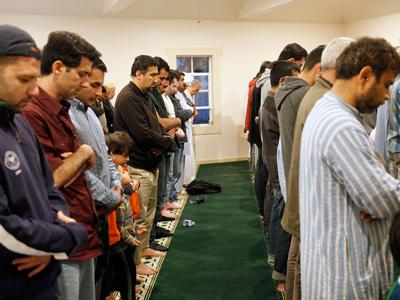

On Friday afternoons, dozens of local Muslims gather at the Islamic Society of Monterey County in Seaside to pray. On Nov. 18, they kept their religious schedule, unwavering in the midst of the national political transition.
As 40 men entered the building, they took off their shoes and knelt on the carpeted floor to listen to the imam lead them in prayer. About 30 women gathered in a separate room and listened to the same teachings via a television screen.
On this day, the imam’s lesson is about the meaning of being a good lifelong Muslim, something the imam says is measured by improving one’s actions as one ages. After prayer, the mood is peaceful, and one by one the dozens of worshippers walk out and back into a country where the anti-Muslim rhetoric has intensified in the months leading up to the Nov. 8 presidential election.
“I’ve been told I look like an alien before,” Dina Sadduk of Marina says. “Now, those insults are more pronounced because they think they now have the right to discriminate because Trump won.”
Two days before, Kansas Secretary of State Kris Kobach, a member of Trump’s transition team, who is providing guidance on immigration policy, said the Trump Administration was already mulling over a plan to launch a registry for immigrants and visitors of Muslim countries. During his campaign, Trump said a database to register Muslims would “absolutely” be implemented.
While it is difficult to pinpoint the exact size of the Muslim population in Monterey County, it was estimated by the U.S. Religious Census in 2010 that there were 2,518 people identifying as Muslim, or 6 percent of the population. With institutions like the Defense Language Institute, where thousands of students and professors come from 19 different countries and various religious backgrounds, a Muslim registry could potentially impact enrollment.
Rabbi Bruce Greenbaum of the Congregation Beth Israel in Carmel says there is “extreme concern” in the local Jewish community arising from the registry proposal.
“When you start registering any community based on religious identity, it does not take long to say, ‘Hey, let’s start now by registering the Jews,’” Greenbaum says. “In Germany they said, ‘Let’s mark them with the yellow star.’ Registry is just the first step in the process. The rest is history.”
In response to Trump’s comments, Greenbaum says the Abrahamic Alliance International, an organization with a mission to unite Christians, Jews and Muslims for poverty relief efforts, will plan an informal social event in March to fortify relationships between people of different faiths.
Nashwan Hamza of Monterey is also putting in time to protect religious rights locally and is working on creating a local hotline to track the number of hate crimes against Muslims, as well as offer help to those who are victimized.
“This is nothing new for us,” Hamza says. “As Muslims, we have heard many insults and experienced this before, but it is much more alarming at this point and I fear hate crimes will increase.”
On Nov. 18, Hamza spoke to CSU Monterey Bay professors to help them identify Islamophobia on campus and in the classroom, and what to do in response when it occurs.
“There’s always been cases of discrimination, but probably the biggest concern now is our children being bullied,” Hamza says.



(0) comments
Welcome to the discussion.
Log In
Keep it Clean. Please avoid obscene, vulgar, lewd, racist or sexually-oriented language.
PLEASE TURN OFF YOUR CAPS LOCK.
Don't Threaten. Threats of harming another person will not be tolerated.
Be Truthful. Don't knowingly lie about anyone or anything.
Be Nice. No racism, sexism or any sort of -ism that is degrading to another person.
Be Proactive. Use the 'Report' link on each comment to let us know of abusive posts.
Share with Us. We'd love to hear eyewitness accounts, the history behind an article.