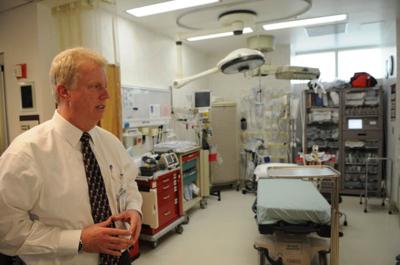
It takes an expert presentation to moisten eyeballs during three hours of PowerPoints on proposed hospital mergers and acquisitions.
But Bryan Rogers, president of the Hospital Corporation of America’s west division, left a few people sniffling during a March 29 presentation to the Salinas Valley Memorial Healthcare System board. He played a neatly edited video of HCA helicopters airlifting patients and doctors from a flooded hospital in post-Hurricane Katrina New Orleans, in what the company says is the nation’s largest corporate rescue in U.S. history.
With 163 hospitals in 20 states and $30 billion in annual revenue, Nashville-based HCA is the nation’s largest private healthcare provider, and it’s looking to add SVMH to its roster.
So is Nashville-based Vanguard Health Systems, a $6.5 billion private healthcare company with 28 hospitals in five states that’s looking to branch out to the California market. Vanguard Senior Vice President Trip Pilgrim assured the board that corporate would be just a clearinghouse. “Healthcare is a local business,” he said, “and we want to leverage the legacy and history of local institutions.”
Then there’s the public safety net county hospital, Natividad Medical Center, valued at $242 million and competing with national healthcare behemoths for the SVMH board’s approval.
Natividad CEO Harry Weis’ presentation might not have been as glitzy as that of the nation’s largest hospital company, but he speaks about a merger as if it’s inevitable. He suggests the public hospital can rescue SVMH.
“There will be significant lost dollars, in the tens of millions, that will never be recoverable if the merger does not happen on time,” he says. “Hindsight tells us we’re several years late already.”
Indeed, the insurance reimbursement bubble Monterey County healthcare has long enjoyed is deflating rapidly. “The whole healthcare landscape really started to change in 2008 once the recession hit,” says SVMH spokeswoman Adrienne Laurent.
So SVMH hired consultant McKinsey & Co. at a cost of $950,000 to look at how to make operations leaner. Some of McKinsey’s June 2011 recommendations have already been implemented: the decision to pursue an upgrade in trauma-center designation, certification as a stroke center from the nonprofit Joint Commission, and staff cuts. (SVMH has eliminated 415 positions in the past two years, but is now starting to hire back.)
McKinsey also recommended SVMH find a partner, which led to the current contract with San Francisco-based consultant Cain Brothers – tagline “investment bankers to the healthcare industry” – to solicit potential mates.
Jim Moloney, managing director at Cain Brothers, says that’s a national trend. “It’s already a difficult environment to operate in, but I think the pressure will become more significant,” he says. “The number of stand-alone hospitals in this country is going to be significantly lower in five years than it is today.”
He expects SVMH’s already-waning era of high insurance reimbursement rates to plummet. Monterey County healthcare providers used to receive insurance reimbursements above 400 percent of Medicare rates – “a jaw-dropping amount,” Moloney says – until the recession struck. Those rates were still about four times higher last year, according to the California Office of Statewide Health Planning and Development, because of lack of competition.
Reimbursement rates north of 150 percent are still worth uncorking Champagne for, in Moloney’s estimation, but they aren’t likely to last.
If President Barack Obama’s Patient Protection and Affordable Care Act survives the U.S. Supreme Court test, there are more challenges in store. There’s the fundamental shift in how hospitals get paid, and the notion that bundled payments – a lump sum for a patient’s care – as opposed to fee-for-service will mean fewer unnecessary tests and procedures.
That’s partly how Natividad gets paid, and it’s an incentive to free up beds and keep patients more independent.
“A properly configured safety-net facility will become the most highly desired partner for any hospital to affiliate with,” Weis says. It will also be well positioned to continue serving the uninsured and underinsured.
Moloney’s also got a charitable side, and it almost makes him sound like an occupier. “What’s our biggest problem today? In my view, it’s income disparity,” he says. He suggests selling the hospital to a for-profit buyer could free up cash for the needy.
Weis isn’t buying it. “That’s like thinking our future’s a 100-yard dash instead of a marathon,” he says. “It would be very short sighted.”
The SVMH board continued affiliation talks April 4. Check www.mcweekly.com/svmh for an update.


(0) comments
Welcome to the discussion.
Log In
Keep it Clean. Please avoid obscene, vulgar, lewd, racist or sexually-oriented language.
PLEASE TURN OFF YOUR CAPS LOCK.
Don't Threaten. Threats of harming another person will not be tolerated.
Be Truthful. Don't knowingly lie about anyone or anything.
Be Nice. No racism, sexism or any sort of -ism that is degrading to another person.
Be Proactive. Use the 'Report' link on each comment to let us know of abusive posts.
Share with Us. We'd love to hear eyewitness accounts, the history behind an article.