City leaders across California were shell-shocked when the California Supreme Court eliminated local redevelopment agencies last December. Now they’re mapping out what’s next, which is mostly a whole lot of debt.
Sand City, population 350, owes nearly $29 million to banks, developers and the city’s general fund.
“It is painful,” City Manager Steve Matarazzo says. “The whole city was a redevelopment project area.”
Matarazzo’s now dismantling the redevelopment agency under the watchful eye of an oversight committee, established by Assembly Bill X1 26 to give third-party supervision to the repayment of some $30 billion statewide.
Sand City is facing questions from the oversight committee and the state over $12.9 million of its redevelopment debt. Matarazzo says $4 million of that covered staff time, and about $8 million was a cash advance the city fronted the redevelopment agency to make payments to Seaside. The neighbors have a sales-tax-sharing agreement that allowed Sand City to build its economic engine, the Sand Dollar and Edgewater big-box shopping centers.
Sand City’s single largest revenue stream is its sales tax, at about $1.8 million annually. About $400,000 a year goes to Seaside.
Matarazzo says when redevelopment agencies dissolved, that agreement became void. Sand City stopped making the payments in January, and Seaside is threatening legal action.
“We believe the sharing arrangement should continue,” Seaside Interim City Manager John Dunn says. “The agreement was made in good faith.”
Seaside already took a $1.5 million hit from redevelopment, and Dunn says a $400,000 loss – about 2 percent of the general fund – only worsens the pain.
Sand City oversight committee chair Stephen Ma wants a closer look at the 1989 tax-sharing agreement, which was forged with the redevelopment agency that no longer exists. “Was it something that was more flexible versus being very black-and-white?” Ma asks.
The oversight committee will consider hiring an attorney at its July 2 meeting.
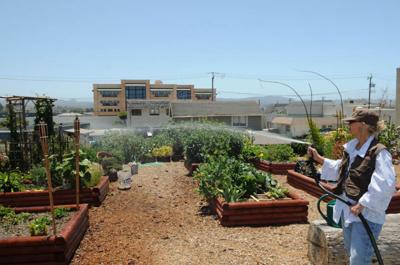
Ma also wants legal advice on Mata-razzo’s request to transfer a community garden, created last year, from the redevelopment agency to the city for free. Under AB X1 26, they may be forced to sell it.
“We’d like it to be in the city’s hands,” garden organizer Suzka Collins says.
The redevelopment agency bought the one-tenth-acre site for $75,000. At worst, Matarazzo says, the city could buy back the garden from itself.



(0) comments
Welcome to the discussion.
Log In
Keep it Clean. Please avoid obscene, vulgar, lewd, racist or sexually-oriented language.
PLEASE TURN OFF YOUR CAPS LOCK.
Don't Threaten. Threats of harming another person will not be tolerated.
Be Truthful. Don't knowingly lie about anyone or anything.
Be Nice. No racism, sexism or any sort of -ism that is degrading to another person.
Be Proactive. Use the 'Report' link on each comment to let us know of abusive posts.
Share with Us. We'd love to hear eyewitness accounts, the history behind an article.