
A curious thing happened in Salinas amid the pandemic, when many Americans began working remotely and offices emptied out: The vacancy rate for office space decreased, bucking the national trend.
Greg Findley, who’s been a commercial real estate broker in Salinas for about 30 years, says that in the first quarter of 2020, when the Covid-19 pandemic began, commercial office space vacancies in the city were 2.8 percent. In the first quarter of 2022, that number was just 2.1 percent, according to quarterly reports published by real estate firm Cushman & Wakefield, Findley’s employer.
Findley attributes that to agriculture being deemed an essential industry, and that many other businesses in Salinas – accountants, law offices – help keep the industry running.
“Ag permeates our entire business community,” he says, adding that the local commercial real estate market proved “Covid-resistant.”
Concurrent with this resilience has been a burgeoning revitalization of downtown Salinas: The Rabobank building at 301 Main St. is being converted into a mixed-use building with 49 studio apartments, while the ground floor and basement will become the next outpost for Alvarado Street Brewery. At 300 Main St., the long-vacant Bruhn building is undergoing a transformation into 19 apartments, with some commercial space.
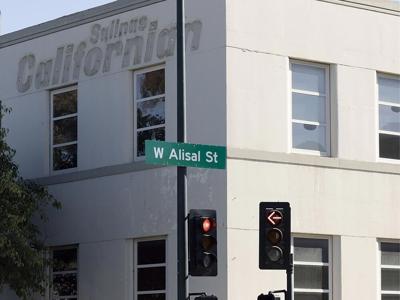
But one major piece of vacant commercial real estate in downtown is still on the market, waiting to be transformed: the old Salinas Californian building at 123 W. Alisal St., which developer Tony Flores bought in 2016 for $1.5 million. Flores owns around 20 properties in Monterey County, according to the county Assessor’s Office.
The building has sat vacant since 2017, but has long been a core presence in downtown since it was built in 1949.
Currently, Flores, who declined to comment for this story, has the property listed for sale at $2.499 million. There are site plans to convert it into 40 apartments and some commercial space on the ground floor.
Those plans, approved by the city in 2019, have since expired. But getting them reapproved would be an easy lift. That’s because in 2018, the City Council approved an adaptive reuse ordinance that streamlines approval to convert non-residential buildings in downtown, built at least 50 years prior to the application – or a historic building outside of downtown – to residential properties. Under the ordinance, applications don’t have to go to any boards for approval – it’s ministerial, and handled by city staff.
“It’s a great ordinance,” says Salinas Planning Director Megan Hunter. “As far as I know, we’re the only ones in Monterey County that have [it].”
Findley, who brokered the Bruhn building sale and Alvarado Street deal at the Rabobank building, is also working on selling the Californian building.
“It’s an exciting time to be part of the downtown,” he says, adding that the Californian building is “the largest redevelopment opportunity remaining” in the area.


(1) comment
Good opportunity to add needed housing units. The demise of print opens new opportunities.
Welcome to the discussion.
Log In
Keep it Clean. Please avoid obscene, vulgar, lewd, racist or sexually-oriented language.
PLEASE TURN OFF YOUR CAPS LOCK.
Don't Threaten. Threats of harming another person will not be tolerated.
Be Truthful. Don't knowingly lie about anyone or anything.
Be Nice. No racism, sexism or any sort of -ism that is degrading to another person.
Be Proactive. Use the 'Report' link on each comment to let us know of abusive posts.
Share with Us. We'd love to hear eyewitness accounts, the history behind an article.