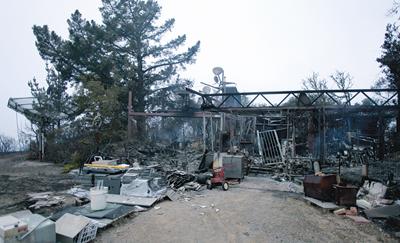
As Monterey County officials were roaming the ashy remains of Pfeiffer Ridge, Big Sur community members gathered for a daily 4pm briefing outside the Big Sur Ranger Station. There were mostly familiar faces, but a few people stood out: Mark Trueblood, an investigator with the District Attorney’s insurance fraud unit, and two women from the Morgan Hill office of the California Department of Insurance, who wore dark windbreakers with bright yellow letters on the back: “Investigator.”
“We make ourselves known so people coming into the community to prey on homeowners know we’re already there,” Insurance Department spokeswoman Nancy Kincaid says.
So far, investigators have been distributing booklets titled “Don’t Get Burned” to homeowners and businesses.
“The most common fraud that occurs in the aftermath of a disaster generally involves price gouging, offers of debris removal and fraudulent charitable solicitations,” the guide states.
The department’s guidance is, essentially: If it seems too good to be true, it probably is. “These people need help and they need it quickly,” Trueblood says. “We just don’t want people taking advantage of these homeowners in their vulnerable moment.”
And insurance companies were among the first on the scene. AIG, for example, had a branded truck from its Wildfire Protection Unit in Big Sur on Monday.
Meanwhile, the county’s damage assessment teams, made up of environmental health and building officials, are checking the burn area to see whether homes are safely habitable. Depending on structural integrity, water and septic systems, they may allow people full residential access, no access or limited access to retrieve personal belongings.
Butch Kronlund, president of the Coast Property Owners Association, is creating a spreadsheet listing all the losses, and is an advocate in the rebuild.
The latest tally, at press time, was 22 structures destroyed, compared to 26 in the 2008 fire. And like that year’s Basin Complex Fire, it’s likely some of the out-of-the-way properties weren’t to code.
“There is an unspoken agreement that they’re not looking for illegal structures,” Kronlund says. “No one was red-tagged in the last fire. If it burned down, it was considered to be valid.”
CPOA’s priority right now is fundraising. As of Dec. 19, the group had distributed 30 checks for $500 to adults who had lost their homes, thanks to leftover fire relief funds from 2008. “That’s just a drop in the bucket for what’s ahead,” Kronlund says.



(0) comments
Welcome to the discussion.
Log In
Keep it Clean. Please avoid obscene, vulgar, lewd, racist or sexually-oriented language.
PLEASE TURN OFF YOUR CAPS LOCK.
Don't Threaten. Threats of harming another person will not be tolerated.
Be Truthful. Don't knowingly lie about anyone or anything.
Be Nice. No racism, sexism or any sort of -ism that is degrading to another person.
Be Proactive. Use the 'Report' link on each comment to let us know of abusive posts.
Share with Us. We'd love to hear eyewitness accounts, the history behind an article.