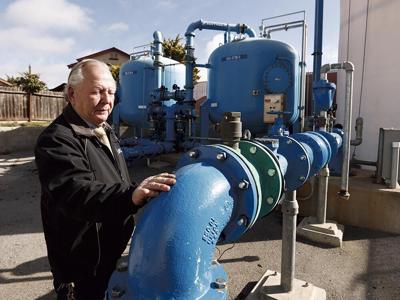

Eric Tynan, general manager of Castroville Community Services District, often calls Castroville’s water supply challenges “the canary in the coal mine” for the northern Salinas Valley.
Castroville CSD has three wells in the 400-foot aquifer. One had to be shut down in March 2021 because it became too salty, and the other two remain in constant danger of the same fate due to ever-increasing seawater intrusion in the aquifer.
The district’s other well is in the deep aquifer, which is around 900 feet deep and contains water believed to be several thousand years old – a water supply that is not replenishing. Add to that problem, Tynan says, its water comes out hot (99 degrees). To deliver it to customers, it has to be blended with water from the two shallower wells.
That puts Castroville in a bind: Tynan says there’s been a recent uptick in the salinity of the 400-foot wells, and estimates they could be forced out of commission in three to five years – which means the district would be unable to deliver water to over 1,600 residences in its service area, as well as local businesses.
Cal Am’s planned desalination project in Marina – if it’s ever fully permitted and built – proposes to send water to Castroville to give it a sustainable water supply, but it would be sourced from brackish groundwater under the beach in Marina, a process Marina Coast Water District believes could harm its own water supply.
So earlier this year, Rem Scherzinger, general manager of Marina Coast, came up with a potential solution. His idea is to build an intertie – a pipeline, essentially – to connect to Castroville’s system that would allow MCWD to pump water from its own 400-foot wells and ship it north to Castroville, at cost, to blend with the deep-well water.
Marina Coast’s board approved $50,000 for an initial design for the intertie, which includes determining the ideal route.
Scherzinger says the project is “extraordinarily simple” as engineering goes – the toughest part is hanging a pipe over a bridge. MCWD is laying the groundwork to find funding for the project – Scherzinger ballparks the construction cost between $5 million-$7 million – and says the district is undertaking the effort altruistically, in an effort to help out a regional partner in crisis.
Tynan says he would be thankful for the help, but also worries that MCWD’s water supply is much like Castroville’s. “I hope it’s not a red herring,” Tynan says.



(1) comment
Sounds like Castroville has a great tourist business opportunity - 99' water is perfect for a Hot Springs Resort, something we're lacking in this area!
About 1910, a forward-looking developer made a similar proposal for a spa resort in booming Seaside, using a hot water seep in the area where the auto mall and Tesco now stand. Sadly it went nowhere.
But nowadays, hot springs across the West have changed from hidden hippy hideaways to luxury resorts.
Welcome to the discussion.
Log In
Keep it Clean. Please avoid obscene, vulgar, lewd, racist or sexually-oriented language.
PLEASE TURN OFF YOUR CAPS LOCK.
Don't Threaten. Threats of harming another person will not be tolerated.
Be Truthful. Don't knowingly lie about anyone or anything.
Be Nice. No racism, sexism or any sort of -ism that is degrading to another person.
Be Proactive. Use the 'Report' link on each comment to let us know of abusive posts.
Share with Us. We'd love to hear eyewitness accounts, the history behind an article.