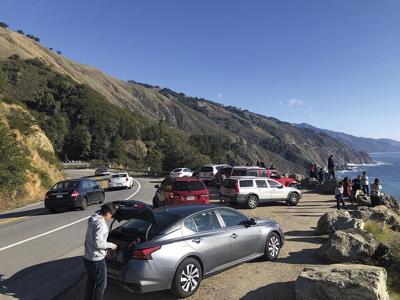

In rising numbers, roadtrippers, backpackers, hikers and campers from across the globe have steadily saturated Big Sur’s roads, trails, parks and campgrounds in recent years. As the region’s popularity has grown, so too have concerns from residents and agencies over the sustainability of its natural resources and how lack of education around the rules and conditions could lead to substantial damage, such as wildfires.
The beloved 75-mile stretch of coastline is governed under a quilt of county, state and federal jurisdictions, which has complicated attempts to regulate use. However, the U.S. Forest Service is working to adapt to the region’s ballooning popularity and protect and manage the federal government’s slice of the Big Sur pie.
John “Fin” Eifert, a resource manager with the Los Padres National Forest Monterey Ranger District, says the federal agency is collecting community input and working with stakeholders such as the Community Association of Big Sur and the Ventana Wilderness Alliance to determine how best to mitigate the impact of visitors on areas such as the Ventana Wilderness, Pfeiffer and Sand Dollar beaches and dispersed camping areas along the south coast near Plaskett Ridge and Nacimiento-Fergusson Road.
Eifert says this planning effort is the first attempt by the federal government to substantially manage use of its Big Sur land in response to tourism trends.
In recent months, CABS and the VWA have been conducting their own surveys in collaboration with the USFS to gain insight into local concerns and enhanced wildfire risk.
“There’s been utter disregard for fire restrictions to the point where local citizens are patrolling the roads and camp areas on their own,” says Rich Popchak, VWA’s development director.
Although they hesitate to commit to any potential outcome from the planning effort, Eifert and Popchak say possibilities include a permitting requirement for overnight camping along popular federal trails such as the Pine Ridge Trail, as well as some dispersed camping on the south coast. The VWA initiated a voluntary registration for the Pine Ridge Trail upon its reopening last spring, an initial step toward permit requirements.
“We’re looking to have overnight permit requirements for all trailheads along the Big Sur coast,” Popchak says. “To require permits for only one would only push traffic to other trails.”
The USFS is seeking comments from locals on their priority issues within the region, which can be submitted through the Coastal Zone Visitor Use Management website at bit.ly/BigSurVUM. Representatives from CABS and the VWA say stakeholders have had issues navigating the USFS website to leave comments. Eifert says the comment portal is unlikely to change, but residents can also send comments directly through email to sm.fs.bigsurvisuse@usda.gov. Although July 8 is listed as the deadline for comments, Eifert says the USFS will continue taking comments after July 8 as well.


(0) comments
Welcome to the discussion.
Log In
Keep it Clean. Please avoid obscene, vulgar, lewd, racist or sexually-oriented language.
PLEASE TURN OFF YOUR CAPS LOCK.
Don't Threaten. Threats of harming another person will not be tolerated.
Be Truthful. Don't knowingly lie about anyone or anything.
Be Nice. No racism, sexism or any sort of -ism that is degrading to another person.
Be Proactive. Use the 'Report' link on each comment to let us know of abusive posts.
Share with Us. We'd love to hear eyewitness accounts, the history behind an article.