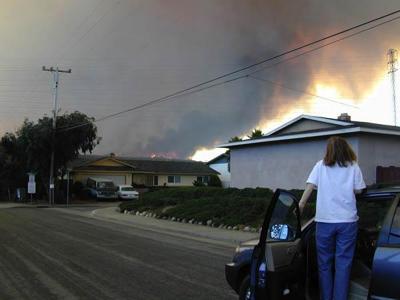
The Army is hoping to nix an environmental rule that requires it to temporarily relocate families when it burns contaminated lands on the former Fort Ord. That proposal is being met with heated opposition from nearby residents, largely because the last two times the Army attempted to perform “controlled” burns on military lands, fires quickly spread out of control.
The Army sets fire to lands as a means of clearing them of brush, so that teams can go in later and pick out munitions debris.
The most recent Army-planned burn happened in October of 2003, when workers intended to scorch 500 acres of land littered with more than half-a-century’s worth of unexploded munitions. Once the fire was lit, however, winds shifted unexpectedly and the flames ran roughshod over more than 1,500 acres of land over several days. The fire came within a few hundred feet of Gen. Jim Moore Boulevard and the ensuing black smoke engulfed much of Monterey County, literally blotting out the sun.
“The smoke from these fires is no different from any other smoke.”
In an earlier burn, in 1997, a similar thing happened. The wildfire was blamed on a “flaming rabbit” (others say a deer) that ran out of burning brush and past the fire boundary.
The Army is planning to set a new fire sometime this summer or early fall. The burn will happen on a 60-acre swath of land about three miles east of Seaside called Munitions Response Site-16 (MRS-16). Like the lands burned in 2003, MRS-16 is saturated with munitions. It contains scores of 2.36-inch bazooka rockets, as well as grenades and other unexploded World War II-era rifle grenades above and below the surface.
Army spokespersons are working to reassure the public that the smoke from a fire on contaminated lands laced with TNT, white phosphorous and lead isn’t that dangerous. According to Gail Youngblood, the base environmental coordinator with the Army’s Base Realignment and Closure Commission, a study in 2003 concluded that “the smoke from these fires is no different from any other smoke,” she says. “Truly.”
Many don’t believe it. LeVonne Stone, executive director of the Fort Ord Environmental Justice Network, is one of them. “That’s simply not true,” Stone says. “Not only are they burning red oak, which is worse than poison oak, but they have munitions in the soil that have accumulated for years and years.”
Stone says that not only should the Army continue to relocate residents during the burns, but that they should complete a risk assessment report before any more burns are executed.
“Residents who are most at risk from the smoke, such as the sick or elderly, will have to relocate on their own or huddle in their homes,” says Stone, who is organizing a March 22 town hall meeting on the subject at the Oldemeyer Center in Seaside. “These residents are the very people who can least afford to stay in the smoke.”
Stone and other activists also complain that to date, the Army hasn’t tracked cases of people who fell ill during the 2003 burn.
Army officials insist that except for those people who are particularly sensitive to smoke, the burning of brush on former-munitions ranges doesn’t pose any long-term harm to the public. And besides, Youngblood argues, a wildfire like the one that broke out in 2003 is unlikely to happen again.
“The nature of this burn is so very different,” Youngblood says. “First, the prescribed burn is set for only 60 acres. And we’ve also tripled the size of the fuel breaks from [a width of] about 50 feet to 150 feet.”
Youngblood says Army officials will wait until the atmospheric conditions are just right before igniting the fire, in the summer or early fall. This means holding off from ignition until winds shift upwards and outwards, ready to pull the smoke out of the area.
But there is a downside to waiting for ideal conditions. Unlike years past, residents won’t know about the burn until after it has begun. That’s one of the main reasons the Army wants to eliminate the relocation program. “It’s going to be difficult, if not impossible, to give people timely notifications,” Youngblood says.
The Army is accepting public comment on the proposal until March 29. While officials have received a few letters that are in favor of letting the Army off the hook as far as paying for the temporary relocation of residents, Youngblood says that the reaction so far has been “what you might expect.”
In other words, most people are against the change. But it remains to be seen whether that’ll make a difference in the Army’s plans.
FOR INFORMATION about submitting a written public comment, call 393-1284. the Fort Ord Environmental Justice Network’s Town Hall Meeting will begin at 6pm, March 22 at the Oldemeyer Center, at 986 Hilby Ave., in Seaside.


(0) comments
Welcome to the discussion.
Log In
Keep it Clean. Please avoid obscene, vulgar, lewd, racist or sexually-oriented language.
PLEASE TURN OFF YOUR CAPS LOCK.
Don't Threaten. Threats of harming another person will not be tolerated.
Be Truthful. Don't knowingly lie about anyone or anything.
Be Nice. No racism, sexism or any sort of -ism that is degrading to another person.
Be Proactive. Use the 'Report' link on each comment to let us know of abusive posts.
Share with Us. We'd love to hear eyewitness accounts, the history behind an article.