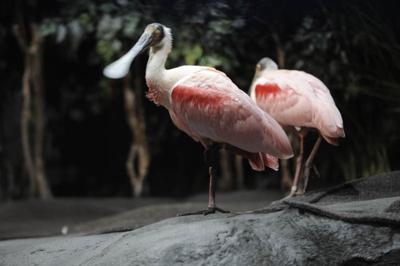
If the farting cow in a leather gas mask doesn’t do the trick, the flaming-orange roseate spoonbills might. Or perhaps a visitor will be inspired to do more biking after meeting the Magellanic penguins that haplessly rode an ocean current from Patagonia to Brazil.
Monterey Bay Aquarium’s newest exhibit, Hot Pink Flamingos: Stories of Hope in a Changing Sea, aims to get kids giggling, adults musing, and visitors of all ages thinking differently about climate change’s ocean impacts.
When the Weekly visits about a week before the unveiling, staffers are hard at work mounting interpretive panels, installing video monitors and testing media interactives. Two dozen volunteers catch up on the 7,000-square-foot exhibition while Aquarium spokeswoman Ali Barratt leads our tour.
The “Under Water” gallery of wading birds stars Chilean flamingos, scarlet and white ibises, roseate spoonbills, cattle egrets and American bitterns in mangrove habitat replica. As rising sea levels flood coastal wetlands, birds like these are forced inland – and in many coastal regions, like Florida, shoreline development leaves them with nowhere to go.
NEON-HUED DAMSELFISH, CONVICT TANGS AND SPINECHEEK ANEMONEFISH DART ABOUT.
In “Hope Electrified,” one of the exhibit’s most colorful assets comes into focus: Iconic posters, re-adapted to the climate change theme. A Shepard Fairey graphic is tweaked to read, “Respect Nature.” The cover of the 1950 British pulp novel Nebula X becomes Zap!, a science-nonfiction tale of alternative energy.
“Iceless Arctic” shifts the mood to swirling blue, evoking a feeling of immersion in polar waters. A tech worker adjusts the aurora borealis lights for a video about Shishmaref, Alaska, where residents voted to move inland in a rare human adaptation to climate change.
Katsushika Hokusai’s famous 1820s wood-block print, “Great Wave Off Kanagawa,” introduces the “Acid Ocean” gallery. A 10-foot tank displays the vibrant coral reef habitat threatened by the ocean’s changing chemistry, but one creature appears out of place. Neon-hued damselfish, convict tangs and spinecheek anemonefish dart about the neoprene legs of Senior Aquarist Wyatt Patry as he “plants” living corals – the final display will include about 60 species – in beds of PVC and expoxy.
“Simmering Seas” highlights spotted jellies living at the edge of their thermal tolerance, while a nearby tank features green turtles skewing girlish: Their sexes are determined by nest temperature. Here in Monterey Bay, warming seas may be responsible for porcelain crabs’ heart attacks, jellies flourishing in fishing grounds, and black cormorants going hungry.
“Vanishing Feast” showcases Magellanic penguins that scientists suspect have been chasing food further offshore. Three of the waddlers on display – Tango, Dolce and Giselda – were among several hundred caught up in a current that swept them 1,500 miles to Brazil. The three birds, deemed unreleasable, made it through customs into Monterey with the help of a Portuguese-speaking Aquarium staffer.
The topic of climate change can be a downer, but Flamingos is resolutely cheerful, focusing on stories of hope. The “Faith in Action” gallery celebrates climate-conscious actions by religious groups like San Francisco Zen Center, Bridgeview Islamic Center and Carmel Mission. “Hope Taking Root” offers 12 examples of green city policies, like S.F.’s fry-grease-fueled buses, Reykjavik’s geothermal power and San Jose, Costa Rica’s gas tax to fund carbon sequestration in forests.
“It’s a very sobering subject,” says Assistant Exhibit Developer Raul Nava, “but people around the world are taking actions and making a difference.”
The exhibit includes plenty of opportunities for visitors to make some changes of their own. An interactive kitchen demonstrates energy conservation at home, and a movie-screen-sized, 3-D video animates visitors who make climate-forward pledges like eating seasonally and re-using grocery bags. (Think Elf Yourself with an eco-conscious message, courtesy of software developers Spencer Lindsay and Willie Williams.)
Flamingos is just one piece of a sweeping Aquarium initiative to boost public awareness of climate change’s impacts on the sea. With funding from two federal grants totaling more than $1.4 million, new web features, policy initiatives and a theater skit are in the works, explains Vice President of Programs Cynthia Vernon. The Aquarium is also looking to shrink its own 6,732-metric-ton-per-year carbon footprint with more energy-efficient lighting and pump controls.
Meanwhile, the Aquarium’s newest birds are acclimating to Monterey. The captive-raised Chilean flamingos are still skittish and a bit clumsy around people, Associate Curator of Birds Aimee Greenebaum explains, but she expects them to settle into their new digs soon – and teach visitors a thing or two about adaptation.



(0) comments
Welcome to the discussion.
Log In
Keep it Clean. Please avoid obscene, vulgar, lewd, racist or sexually-oriented language.
PLEASE TURN OFF YOUR CAPS LOCK.
Don't Threaten. Threats of harming another person will not be tolerated.
Be Truthful. Don't knowingly lie about anyone or anything.
Be Nice. No racism, sexism or any sort of -ism that is degrading to another person.
Be Proactive. Use the 'Report' link on each comment to let us know of abusive posts.
Share with Us. We'd love to hear eyewitness accounts, the history behind an article.